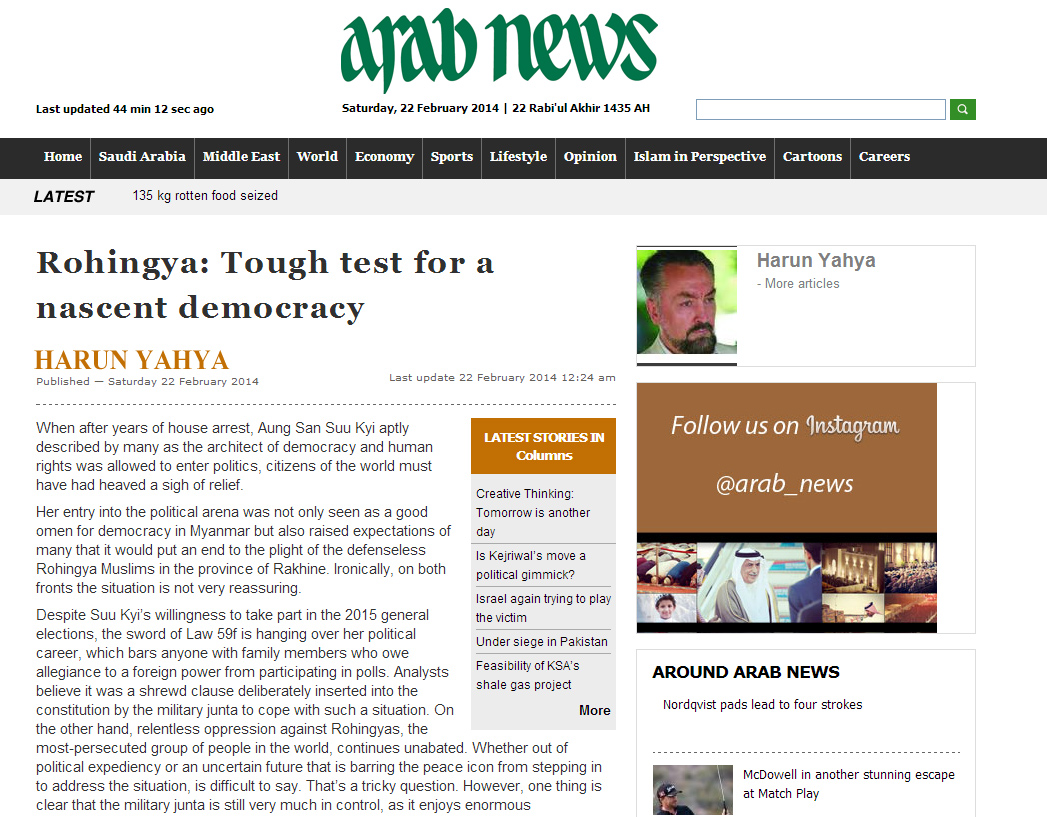
When after years of house arrest, Aung San Suu Kyi aptly described by many as the architect of democracy and human rights was allowed to enter politics, citizens of the world must have had heaved a sigh of relief.
Her entry into the political arena was not only seen as a good omen for democracy in Myanmar but also raised expectations of many that it would put an end to the plight of the defenseless Rohingya Muslims in the province of Rakhine. Ironically, on both fronts the situation is not very reassuring.
Despite Suu Kyi’s willingness to take part in the 2015 general elections, the sword of Law 59f is hanging over her political career, which bars anyone with family members who owe allegiance to a foreign power from participating in polls. Analysts believe it was a shrewd clause deliberately inserted into the constitution by the military junta to cope with such a situation. On the other hand, relentless oppression against Rohingyas, the most-persecuted group of people in the world, continues unabated. Whether out of political expediency or an uncertain future that is barring the peace icon from stepping in to address the situation, is difficult to say. That’s a tricky question. However, one thing is clear that the military junta is still very much in control, as it enjoys enormous constitutional powers. Without clipping the wings of the military and confining it to the barracks, achievement of a true democracy will remain a distant dream.
In all fairness to the Noble laureate, we cannot shift the entire responsibility on one person who is struggling to gain a foothold in a system that does not perhaps even recognize basic human rights. What is the rest of the world doing to resolve the issue? Why pin hopes only on Suu Kyi? Is it the same way the international community responded to the so-called Spring in the Arab World, when it turned bloody? Too many questions without appropriate answers! It is like talking to a wall. It is indeed a very depressing situation.
The poor Rohingyas are far from being political so any uprising on those lines is a far-fetched idea. This writer thinks many of the Rohingyas themselves must be wondering as to what they have done to deserve such a treatment. They are being butchered on a massive scale every now and then. Rights organizations are describing it as a slow-burning genocide.
The recent in the series of massacres took place in Du Chee Yar Tan village in the township of Maungdaw on the night between Jan. 13 and 14. According to credible media reports, a group called “969” attacks villages and unleashes a wave of terror on poor Rohingya Muslims reportedly with the connivance of local authorities.
The wave of slaughter that began in Du Chee Yar Tan has been described by Human Rights Watch (HRW) as “ethnic cleansing” and “crimes against humanity.” The United Nations, the United States and the United Kingdom issued official statements in the wake of the events. The Myanmar government was called upon to protect the Rohingyas by permitting humanitarian aid to reach them, improving humanitarian conditions in the camps and restoring their citizenship rights. UN High Commissioner for Human Rights Navi Pillay said they had documentation regarding the attacks and deaths and demanded that Myanmar officials open a swift and impartial investigation.
It is tragic that the so-called reform government in Myanmar has as of yet taken no steps to prevent these events and ensure the punishment of those responsible. It said that what has appeared in the world press was a smear campaign and that a national commission would investigate events if necessary. In order to hoodwink the world, the Myanmar government set up a national commission to investigate the events in Du Chee Yar Tan village. A representative of the Rohingya people was added to the 27 members of this commission, which had also investigated the events in 2012 in order to give the impression the rights of the Rohingyas were being protected. However, villagers stated that this person, identified as Mawji Hullah, was a government supporter who acted against the interests of the Rohingyas, and that this measure was purely eyewash. The Rohingyas stated that the commission’s 2012 report did not reflect the truth and that events had been misrepresented to the global media. They are, therefore, calling for all countries, the UN and human rights organizations to impose economic and political sanctions on the Myanmar government until they agree to the establishment of an independent investigative commission.
While the world’s attention is focused on the Middle East, the Rohingya people have for years been exposed to the most ruthless oppression; various extreme nationalist terrorist groups are on the prowl literally hunting down Rohingyas. The reform government that recently came to power in Myanmar had emerged as a ray of hope for the Rohingyas but to no avail. This turmoil in the country represents a grave threat to Myanmar’s political, social and economic development.
This is a source of great concern. The future of democracy in Myanmar depends on how the current government, which is moving away from the shadows of decades of military rule, handles the Rohingya issue. This is a make or break situation for the government. This is the time when the government representing a budding democracy takes effective measures to address the issue and lays the foundations of an all-inclusive democracy.
Myanmar is coming out of its decades-long isolation. It is a golden opportunity for democratic forces, particularly Suu Kyi, to act in support of the Rohingyas. This will, on one hand, put an end to the bloodshed in Rakhine and on the other hand boost the stature of democratic forces of Myanmar in the world. However, if the government fails in protecting the minorities, strict economic and military sanctions should be imposed to ensure an end to this bloodshed.
Adnan Oktar's article on Arab News: