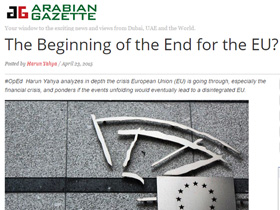
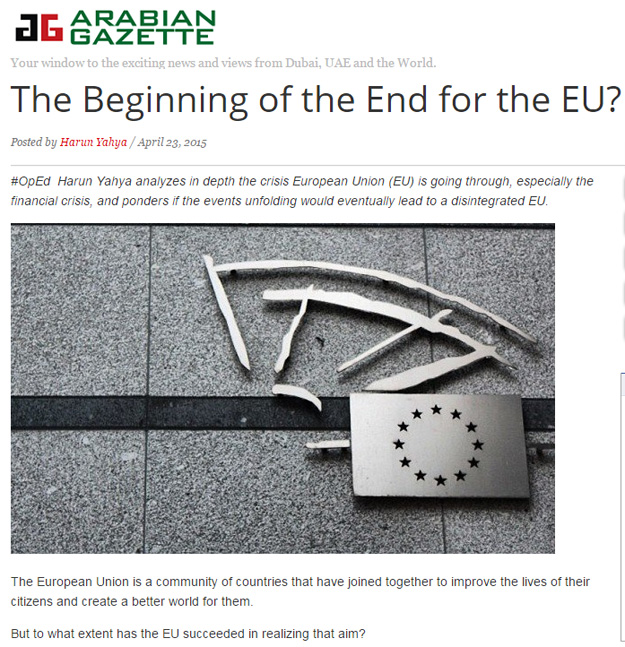
The European Union is a community of countries that have joined together to improve the lives of their citizens and create a better world for them.
But to what extent has the EU succeeded in realizing that aim?
Given the news reports in recent days along the lines of ‘Cracks in the EU,’ ‘Alarm Bells in the EU’ and ‘Bad News for the EU’, it is not going to be easy to respond to that question positively.
Indeed, we can even say that the existing picture is worse than it was before the EU.
Dissolution Beginning with Sinking Countries
The countries of the EU came under a severe threat when the economic crisis that began in the U.S. in 2008 spread to Europe. The Eurozone contracted by 4.1% in 2009, the worst in its history. Many EU countries that had to divert a significant part of their revenues to debt repayments quickly came to the brink of bankruptcy.
Five EU countries were particularly hard hit by the financial crisis: Ireland, Greece, Portugal, Spain and Italy. Unemployment in the Eurozone hit record levels according to data for March 2013.
Greece was the country worst affected by the crisis. The country was the poorest to be admitted to membership in the Eurozone. While it recorded temporary growth in the first years of membership, that was short-lived. Per capita income in Greece may have risen to $32,100 with Eurozone membership, but the citizenry also assumed a burden of $27,300 in foreign debt.
Greece found itself unable to repay its foreign debts, and the banks and government came to the brink of bankruptcy. Numerous businesses went bust. The money in people’s pockets melted away, and that meant there was no way for the state to collect taxes, which was difficult enough even during boom times. The Eurozone process gave Greece a huge debt and a budget deficit equal to 127% of the country’s GDP.
People took to the streets as a result of the inability to make ends meet and unemployment caused by the crisis. Tensions at meetings and marches rose by the day. Four people died during acts of violence that spread across the country, 311 were injured and dozens were arrested.
Powerful Economies Also at Risk
The European countries listed above whose economies hit rock bottom also placed financially stronger countries such as Germany and France at risk and under burden. Powerful economies unable to receive debt repayments from struggling countries and investing billions of dollars in rescue and credit packages as required by their EU membership began heading for the same abyss.
Germany stands in 24th place on the list of indebted countries, with a debt-to-GDP ratio of 188%. Germany, with the greatest responsibility for EU lending, shoulders 27% of the burden of the EU budget. In addition to the troubles in the European economy, sanctions against Russia are also placing a strain on the German economy.
In the event that Germany, Europe’s strongest economy, fails to emerge from the crisis unscathed, then there are concerns that this will have an earthquake effect, not just on the EU, but also on the global economy.
With its $2.8 trillion debt burden, France, Europe’s second largest economy, is also one of the Eurozone economies over which the greatest concerns are being raised. In recent weeks the European Commission wanted France to reduce its structural budget deficit by at least 5% in 2015 and to make savings of at least four billion euros within a specific period this year.
This being the state of affairs in even the strongest countries in the EU, the specter of deflation is hovering over the Eurozone. Never mind meeting growth targets, the EU’s priority for 2015 is now avoiding its third recession in seven years.
Great Britain Heads the List of Those Questioning the EU
The grim picture summarized here has led to an increase in skepticism over the union itself. It even led to numerous circles questioning the union. It is an inescapable fact that, not only for economic reasons, Great Britain, France and Germany, which have been in competition throughout the course of European history, and often at war instead of peace, will eventually want to head in their own directions rather than coming together on a common position.
The most concrete initiative concerning departure from the EU has come from Great Britain: Prime Minister David Cameron has announced that if his party wins the elections, a referendum will be held on whether to remain part of the EU or leave. If the ruling Conservative Party remains in power after the May elections, the referendum will be held sometime between 2015-2018.
In his statement, Cameron said that until the referendum takes place, he wishes to renegotiate the UK’s relations with the EU. He also said that he does not wish the EU to fall apart, but that there is a danger of that happening under the prevailing conditions.
The disaster scenarios being discussed in terms of the EU inevitably raises some concerns – and thus some questions – of whether these developments will lead to the end of the EU.
Meanwhile another aspect of the issue deserves mention here. We no longer live in the polarized world of the Cold War era. In the highly interwoven relations of countries of our globalized times, any vicissitude plaguing one part of the world inevitably affects the others. This holds true for countries as well as unions like the EU. The EU tries to stand on its feet by means of economically-based politics. However, unions can only remain strong as long as they base their existence on more reliable relations based on goodwill and benevolence; furthermore this holds true not only for its relations with member countries but also for non-member countries. No union can survive by excluding other entities, treating itself like a lone island in an ocean. Thus the EU must before long recognize the flaw in its policy towards Russia and adopt a similar embracing policy towards it. A world based on goodwill rather than hostilities would make our world a better place to live.
Adnan Oktar's piece on Arabian Gazette: