When one’s health fails, the proper way to regain former health and strength is to find the source of the problem. If the disease is misdiagnosed there will be no improvement even if the most effective treatment is applied; furthermore, the disease may even get worse. First of all, therefore, the reason for the disease needs to be properly identified, and then the right treatment should be taken in the right dose. Of course this can be done by seeing an experienced doctor.
Today, many Arab countries, Yemen leading the list, are severely ill, both politically and socially. International organizations such as the UN and NATO, countries such as the USA, Iran and Saudi Arabia have taken on various tasks claiming to end this problem. These tasks are generally based on the idea of stopping the opponent by armed force.
However, no institution or country can produce a cure for the current problems. Each armed intervention in the region spreads the disease and makes it worse. This resembles a doctor with an itching palm who desires to make more money by operating on a patient, whereas a pill could easily heal that patient.
If you ask any citizen in the street in Yemen why the country has come to the state its in, he will surely have a lot to say. He will attribute the current situation to Shia-Sunni tension, foreign countries’ interventions, political leaders’ greed, corruption and bribery, the spread of weapons, poverty, disputes between tribes, ignorance or some other reasons.
It’s true that all these reasons play a role in the current situation. But it’s possible to collect them all under two main titles: First, a lack of unity between Muslims, and second, a mistaken practice within Islam by identifying it with values that actually have no place in the Qur’an. Let us now deal with the first one.
Materialist and imperialist movements have long prevented the world from being a safe place. World Wars I and II are the most concrete examples of this fact. Even though this state of affairs has not turned into a world war thus far, there is currently a struggle waged secretly throughout the world to carve it up.
Many countries feel unsafe due to this struggle. They join forces in the international arena both because of this worry for their safety and in order to produce more effective policies. Those counties that do not lean towards cooperation are either isolated or subjected to domestic disturbance or external attacks.
That’s why international organizations such as the European Union, the Organization of Islamic Cooperation, the Arab League, the Shanghai Cooperation Organization and NATO have been set up with the participation of numerous countries.
However, these organizations – which hoped to bring security and prosperity to their member countries – have failed to prevent evil in the world. This state of affairs reveals the importance of Islamic countries once again.
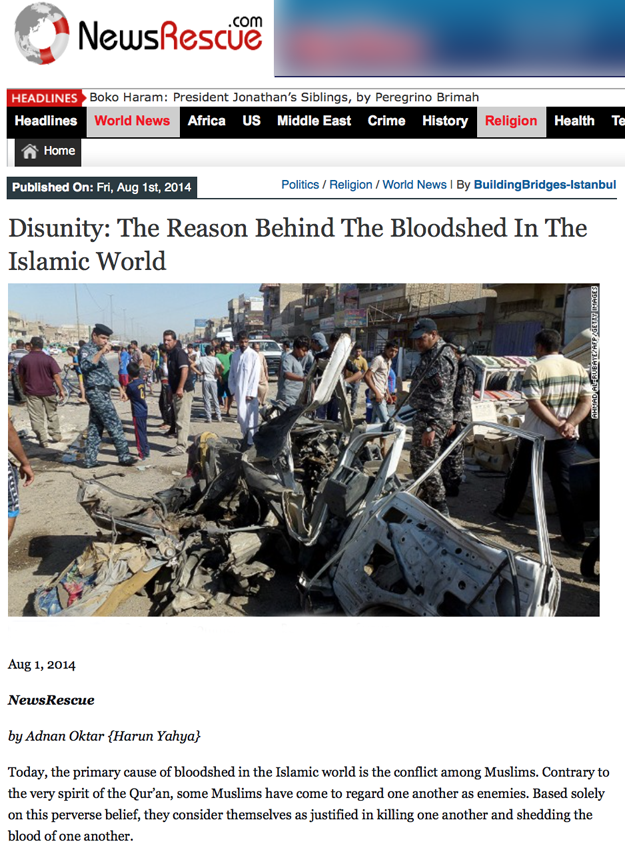
If Islamic countries wish to be strong, stable and prosperous civilizations and to lead the world in all fields, then they need to act in unison. Because of the lack of such unity, the Islamic world is now badly divided and dispersed. Muslim countries have invariably failed to reach settlements even on the most basic of issues and they simply cannot produce effective solutions. This leaves many innocent Muslims unprotected and vulnerable; from Libya to Yemen to Afghanistan, innocent women, children and elderly are in need and waiting to be freed from oppression.
No matter which side they represent, which sect or religious community they belong to, all Muslims must remember that unity is a command of God. God reveals that Muslims should be united in a verse of the Qur’an as follows:
Those who are unbelievers are the friends and protectors of one another. If you do not act in this way [be friends and protectors of one another] there will be turmoil in the land and great corruption. (Qur’an, 8:73)
Let us suppose that Muslims felt the need for becoming united and embarked on a quest to this end; what should that desired Islamic Union be? What should that union’s political, economic or military dimensions be?
I say again that it’s high time that all Muslims, and those in Yemen as well, must fervently desire to be united. I will deal with the details as to a model of the Islamic Union in next week’s article.
Adnan Oktar's piece on National Yemen: