Days pass. Fridays chase Mondays. People wake up, get on trains, go to work, then go back home and sleep. The same thing happens every day. Only when a slight disturbance to their daily habits takes place are they are stirred out of their comfortable routine.
But as many around the world continue with their lives, only hearing in passing about far-flung tragedies, there are millions of people who have been violently shaken out of their comfortable routines by the most unthinkable of situations.
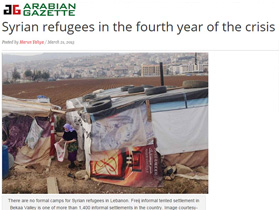
Most Syrians who are now refugees face immense difficulties in every waking minute of their lives. In the best-case scenario they have to rely upon the goodwill and considerate actions of their host nations to lead a normal, dignified, humane life. However, most of the time, refugee camps lack the necessary conditions to maintain a civilised life, or there is simply not enough space or resources, and people have to attempt to survive in an alien and foreign country with no citizenship, shelter, or income.
An estimated nine million Syrians have fled their homes since the outbreak of the civil war in March 2011, most taking refuge in neighbouring countries or within Syria itself. According to the United Nations High Commissioner for Refugees (UNHCR), over three million have fled to Syria's immediate neighbours: Turkey, Lebanon, Jordan and Iraq; while some six and a half million are internally displaced within Syria.
Turkey is home to highest number of refugees, with 1.6 million Syrians seeking a new home within its borders. It is praised by international agencies for the efficiency and high quality of its refugee camps. However, the camps are grossly under-resourced and can only accommodate a maximum of 220,000 people. The rest have either been forced to make their way to Istanbul or to other big cities in order to find shelter. Naturally, they face a difficult life of poverty and constant struggle.
As for the 10.8 million people who chose to stay in Syria, there is an urgent need of humanitarian assistance. The limited humanitarian response from the international community has entirely failed this beautiful nation, and as a result scores of people, most of them children, have perished of hunger and cold in Syria. This could have been easily prevented if international efforts had been better orchestrated to offer basic help in Syria's hour of need.
In order to stir the conscience of the masses and open their eyes to the continuing disaster of humanity, let us try to imagine the ordeal the Syrians have to face on a daily basis. Those left in Syria have to deal with a constant threat of being hunted down, killed, tortured, bombed, or losing their loved ones. If they somehow escape such scenarios unscathed, they are forced to witness their cities and houses being burned to the ground and have to learn to live without proper shelter, food, or medical care. Assad's regime has essentially razed the entire nation to ground, not leaving behind even a semblance of a habitable country. Hundreds of thousands were killed, tens of thousands were tortured, millions were forced to leave their homes, families were torn apart and children, women and the elderly died en masse.
Four neighbouring countries – Turkey, Lebanon, Jordan and Egypt – bore the brunt of the war and welcomed millions as refugees. Turkey is the country that hosts the highest numbers, closely followed by Jordan and Lebanon. These countries provide admirable support for these people in need of help, despite their limited economic resources. For example, the president of the Turkish Disaster and Emergency Management (AFAD) has said that the institution has spent five billion dollars providing services to Syrian refugees in Turkey. However, such a tremendous influx of people is more than any country can bear single-handedly. The result is that many Syrians in these countries now have to live in less than desirable conditions. For instance, just last week three Syrian refugees, two of them children, died of hypothermia in Lebanon.
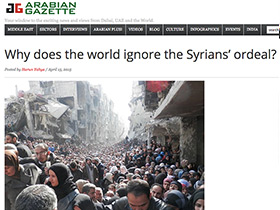
How is it possible that the world remains silent as such tragedy unfolds so openly? Although the media have covered the ordeal of Syrians, broadcasting he unforgettable images of 20,000 Syrians that were tortured to death, the children that were targeted by snipers, the chemical attack that killed thousands in Homs, or the children that died of hunger and cold in Yarmouk, the expected – and urgently needed – help from the international community never came.
Obviously, there are richer countries than Turkey and its neighbours that are much better positioned to help Syrians. The Gulf countries have yet to offer any real aid to Syrians; while the European Union has failed miserably to offer any tangible help. As a result, the enduring ordeal of Syrian refugees continues every day.
The people of the world and their governments should remember that for every passing day they focus on less important matters, more innocent people, children, women, and the elderly are killed; they starve to death, or die of cold.
So what can we do to help? Almost everyone has access to the Internet. Even a thousand people can make a huge difference with a Twitter campaign. Humanitarian campaigns, online petitions, and protests are not that difficult to do; once a person makes a decision to do everything in his power to help.
Everyone lives and dies; it is how you live your life that makes a difference. You can choose to do everything in your power to help people in need, or you can simply continue with your daily routine. Either way you will live, but your actions will ultimately decide who you are, and your worth as a human being.
Adnan Oktar's piece on Middle East Monitor: