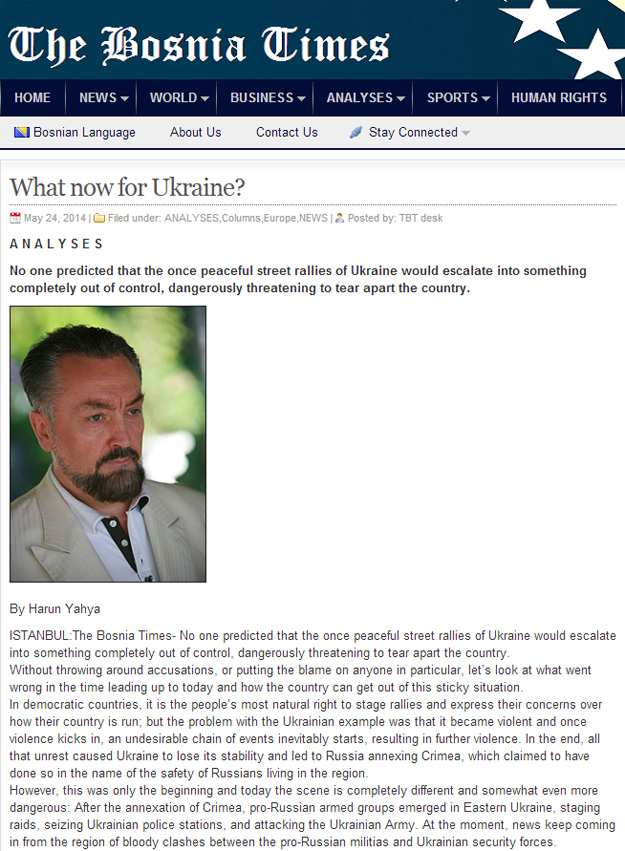
No one predicted that the once peaceful street rallies of Ukraine would escalate into something completely out of control, dangerously threatening to tear apart the country.
Without throwing around accusations, or putting the blame on anyone in particular, let’s look at what went wrong in the time leading up to today and how the country can get out of this sticky situation.
In democratic countries, it is the people’s most natural right to stage rallies and express their concerns over how their country is run; but the problem with the Ukrainian example was that it became violent and once violence kicks in, an undesirable chain of events inevitably starts, resulting in further violence. In the end, all that unrest caused Ukraine to lose its stability and led to Russia annexing Crimea, which claimed to have done so in the name of the safety of Russians living in the region.
However, this was only the beginning and today the scene is completely different and somewhat even more dangerous: After the annexation of Crimea, pro-Russian armed groups emerged in Eastern Ukraine, staging raids, seizing Ukrainian police stations, and attacking the Ukrainian Army. At the moment, news keep coming in from the region of bloody clashes between the pro-Russian militias and Ukrainian security forces.
Ukraine is descending into a sort of madness from which it can be saved only through reason and common sense.
Surely, in times of conflict where emotions run high, people with common sense and reason are needed more than ever. These leaders should be able to empathize with both sides, negotiating a compromise to prevent further damage.
The pro-Russians have made it abundantly clear that they want to hold a referendum for independence of the Eastern Region. Many believe that this could further splinter the country and give Russia a reason to outright annex Eastern Ukraine. However, the recent polls showed that only 15 to 20% of the population in the Eastern Ukraine is in favor of independence and Russia hasn't declared any desire to annex this part of the country.
In any case, Russia knows better than to go forward with annexing territory from other countries, or stirring up unrest, as it would lead to nothing but a greater burden to its own economy, instability in the region, and would ultimately pose a significant threat to its national security. Most likely, Russia could easily rein in the pro-Russian groups causing unrest in Ukraine; however, the current sentiment in the Russian administration seems to be one of resentment over an obvious policy of isolation by the West towards Russia. Not only is this Western policy uncalled for, and discourteous, anyone can easily see that these policies of isolation and the imposition of economic sanctions against Russia accomplish little else other than causing more unwanted reaction from the country. If the cooperation of Russia is desired - which is only natural as the country is in the best position to help calm down the situation in Ukraine - then Russia's fears of isolation should be addressed.
However the world seems the be doing the exact opposite at the moment, driving Russia further into isolation. As a response, Russia, trying to hold on to its former alliances, seems to be working to build a buffer zone for itself with these extreme measures: This in turn, alienates West more, creating a vicious cycle.
There is no need for any of this, as the Russians are a great people with a great culture, history and legacy. Once they are approached with a friendly manner, and with the intention of making them a part of the Western world, they could play a great role in the stabilization of the region and make immense contributions to the safety and welfare of the world.
It is high time for the Western powers to approach Russia in a friendly manner, ease its concerns, and engage it in its circle of cooperation and warm relations.
Once this is done, the current turmoil in Ukraine could easily be ended with the help of Russia.
It is never too late to repair the damage done and prevent this from escalating any further.
Adnan Oktar's piece on The Bosnia Times: