One of the main elements for growth and stability in Yemen are the women who live there. Despite representing half the population of Yemen, women do not enjoy the same opportunities as the male half, however. This is immediately clear from statistics published by various international bodies:
According to the World Economic Forum, Yemen is the region with the worst sexual discrimination.
The great majority of women are illiterate. More than half of women marry before the age of 18.
While 73% of boys in rural parts of Yemen attend primary school, only 30% of girls do. Although discrimination based on gender was banned under a law passed in 1995, discrimination against women is still widespread, particularly in workplaces.
Only 35% of women are literate in Yemen. There is also a deep economic gulf between men and women, with a female to male income ratio of 30:100. Yemen comes in at 134th in a list of 136 countries on education attainment for women. Women’s education, marital, health care and human rights are all at very low levels in Yemen; divorce, custody and inheritance rights are also at very low levels. Women can only travel and hold passports with their father’s or husband’s permission. Female share in the Yemeni Assembly of Representatives is at the lowest level in the world, less than 1%. In an investigation into women’s rights by the World Economic Forum in 2013, Yemen came last on a list of 136 countries.
Why are women in Yemen in this position? In fact, women in a wide range of countries throughout the Islamic world, from Morocco to Afghanistan, live under similar conditions to those in Yemen. This causes some people to blame Islam for these difficult conditions faced by women. This is clearly a blatant error, however. The ignorance of our faith among many people emerges on the subjects of women’s rights and the importance of women in the Qur’an, as it does in so many other areas. The false idea that women should be treated as second-class people in Islam is based, not on the Qur’an, but on various forms of regional traditions, ignorance, or belief in outright nonsense.
In the verses of the Qur’an, God constantly calls for women to be watched over and protected, and imposes on men various responsibilities regarding the protection of women: However, to interpret this as meaning that men have power over women either indicates a lack of knowledge or else a deliberate distortion. According to the Holy Qur’an, men only watch over women, but do not govern them;
Men are the protectors and maintainers of women, because God has given the one more (strength) than the other, and because they support them from their means ... (Surat an-Nisa’, 34)
As God reveals, men are charged with protecting and watching over women. Indeed, the Arabic word “qawwam” in the verse means “protector” or “guardian.”
God has supported women with various material and other rights lest they be mistreated, praises them and always gives them legal priority. According to verses, women’s financial positions are guaranteed after divorce; for example, assets bestowed on women cannot be taken back after divorce. Women’s accommodation is also guaranteed. The Qur’an also prohibits men from inheriting women by force, and Muslims are also commanded to show their mothers special respect.
In addition, God reveals in verses of the Qur'an that men and women occupy an equal place in society. Our infinitely merciful Lord eliminated all distinctions that had been made between men and women during the Time of Ignorance through His verses and commanded that women be valued as they deserve. Man or woman, a person achieves superiority through the strength of their faith in God, their moral values, character and the responsibilities they assume.
In another verse, God reveals that “Anyone who acts rightly, male or female, being a believer, We will give them a good life and We will recompense them according to the best of what they did” (Surat an-Nahl, 97), showing that everyone, man or woman, will be exactly recompensed in this world and the hereafter, with no injustice being suffered by anyone. This is all evidence of God’s mercy on His believing servants.
Structurally, Yemen is preparing for great changes. That can be utilized as a major opportunity for women to assume a respected and more influential place in society. The constitution currently being prepared might be amended to address the subject of women enjoying the same rights as they do in modern Western societies. Legal changes about the strengthening of women’s rights and the protection of women can be reinforced by amendments to both criminal and civil law, and not just restricted to the constitution.
The elimination of discrimination against women in Yemen, preventing violence against women and most important of all, recognizing women’s educational rights, are all important steps that can – and should – be taken toward the development of the country. These things must not remain limited as initiatives of a single party; greater rights for women must be made a national policy supported by all parties. Increasing women’s right to representation in the Assembly of Representatives would be a good place to start.
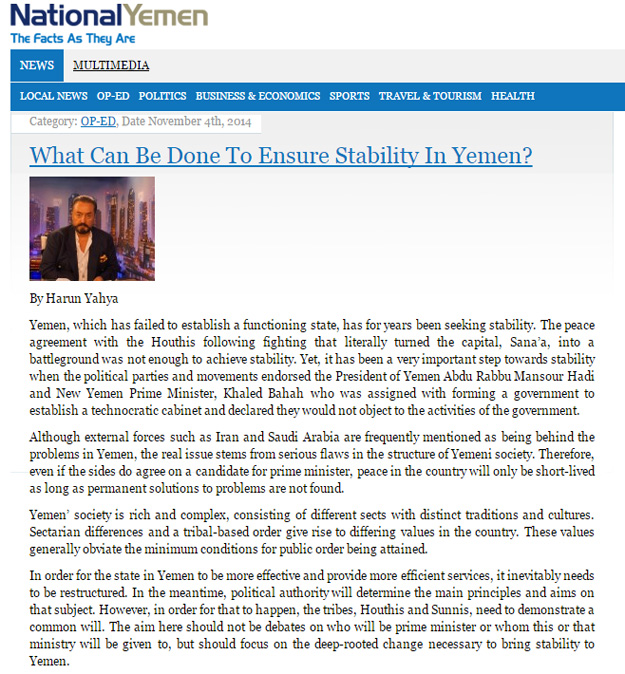
Adnan Oktar's piece on National Yemen: