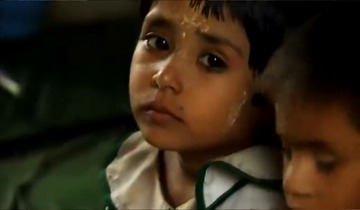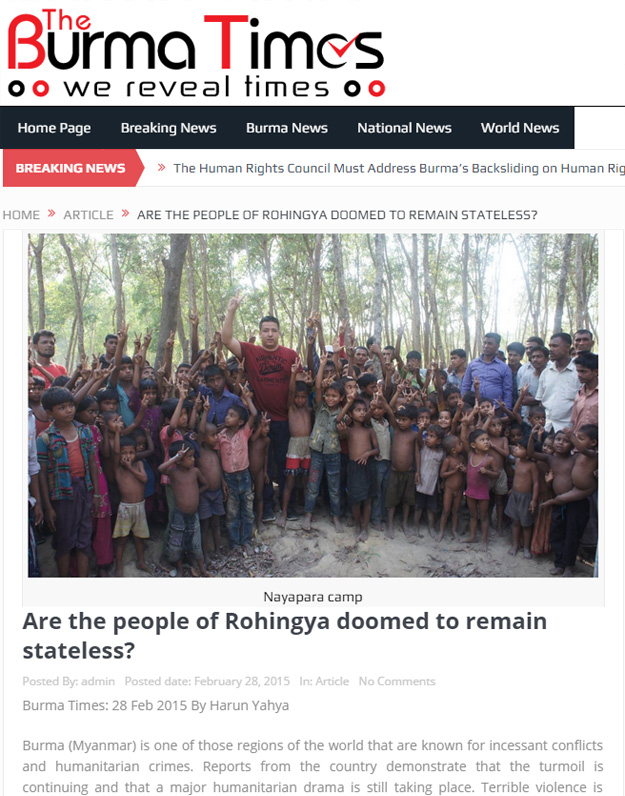
Burma (Myanmar) is one of those regions of the world that are known for incessant conflicts and humanitarian crimes. Reports from the country demonstrate that the turmoil is continuing and that a major humanitarian drama is still taking place. Terrible violence is being inflicted on the Muslim Rakhine or Rohingya people, one of the ethnic groups in the country. The main source of this violence is ethnic and religious discrimination. The Muslim Rohingya people, described by the U.N. as ‘an oppressed religious minority,’ constitute 4% of the Burmese population of nearly 56 million. These people, who live in ramshackle camps in Rakhine state in the west of the country, are now the subject of a fresh debate. A government decision to allow the Rohingya people to vote in a constitutional referendum has sparked protest demonstrations by Myanmar’s Buddhist majority. The Rohingya are not recognized as Burmese citizens and are forced to live in camps because they are refugees in their own country; that is why the Buddhist citizens of the country do not want them to vote.
The Muslim Rohingya lost all their citizenship rights in a single day under a law passed in 1982. These people are regarded as ‘illegal immigrants’ from neighboring Bangladesh. There are about a million of them in Myanmar, but they cannot prove their identity as ‘Burmese citizens’: They exist, but not officially. On the other hand, however, Rohingyas living along the coastal strip on the border are not allowed into Bangladesh by the Bangladesh government because they are not citizens of that country. Rejected by both countries, the Rohingya are struggling to survive as ‘people of no land.’ Since both countries reject them, the Rohingya have no official identity documents, and thus no citizenship rights; they are, quite simply, stateless.
Myanmar moved to democracy from a military regime four years ago. The civilian government led by head of state Tein Sein, which has been in power since February 2011, has taken a number of steps toward democratization. Although a large number of political prisoners have been freed, ceasefire agreements have been signed with various ethnic groups, freedom of the press has been broadened and repressive laws have been lightened, Myanmar still draws the attention of the world with the systematic violations of the human rights of the Rohingya and discrimination carried out against religious minorities.
The coming to power of a civilian government changed nothing in the lives of the Rohingya. It has failed to prevent the loss of Muslim lives in religious clashes, hundreds of homes and workplaces being put to the torch and some 250,000 having had to abandon their homes because of the conflict. Moreover, it did not grant the Rohingya the right to citizenship, one of the most basic human rights. Burmese Muslims, suffering the pain of having no homeland or protection, are today living a life of imprisonment in isolated camps in Rakhine province rather than in their own homes. They have no social rights and have no access to public services such as education and health. They get sick, but they are not admitted to hospital. They find themselves unemployed, but they cannot work in official institutions. Since they have no access to education, illiteracy levels stand at 80%. They cannot even obtain birth certificates for their children. They do not have permission to marry. They cannot own land or property. They are not allowed to build concrete homes, and can only live in homes built of bamboo or wood, buildings which can be easily destroyed during attacks. Many of the rights of citizenship, blessings we never even think of, are just a dream for the Rohingya. The aim here is, quite bluntly, ethnic cleansing. One of the latest features of this ethnic cleansing campaign is forcing Muslims of Rakhine to identify themselves as Bengali in order to become citizens. The Rakhine Muslim identity is thus eradicated. Rakhine Muslims who reject that identity are punished by being sent to isolation camps.
The government has now granted temporary citizenship rights to the 1.5 million Rakhine Muslims previously regarded as refugees and allowed them to vote in the upcoming referendum. However, this is also a very cunning stratagem intended as a part of this ethnic cleansing; they are not recognized as citizens, but are only allowed to vote with the white cards given to people regarded as immigrants. In this way, while Rakhine Muslims are pushed to accept being regarded as immigrants, they are trying to give the impression that the country is a democratic one.
Even this temporary right was enough to instigate discriminatory behavior against the Muslim population in the country. Burmese Buddhists have protested against Rakhine Muslims being given the right to vote, albeit on a temporary basis, and have started public demonstrations. Rakhine Muslims are thus subjected both to acts of violence and also to legal, economic and social discrimination.
The Burmese administration is adopting a wrong-headed policy by oppressing its people and the Muslims citizens. Different races and nations coming together is a source of cultural wealth, not war and conflict. That diversity is a beauty in God’s creation. Islam is a religion of peace and love. Our Burmese brothers’ religious faith, devotion to the Qur’an and their loyalty to the Sunnah of our Prophet (saas) are therefore also a blessing and a beauty for Myanmar. Being a Muslim brings about altruism, devotion, moderation, balance, industriousness and love for country and one’s fellow citizens. These brothers of ours would therefore never harm the Burmese state. On the contrary, they would support Myanmar with their obedient and respectful behavior. Consequently, there is no need for the Burmese administration to be uneasy about Muslims. If Myanmar wishes to take its place among the modern and democratic countries of the world, instead of persecuting innocent Muslims who do no harm to anyone, they should recognize them as their free and fellow citizens and allow them to live their lives and their religion freely. If Myanmar wishes to take its place among modern, 21st Century nations of the worlds, it must adopt a system that bring human rights and democracy to the forefront instead of oppression and violence. This is the key to the peace and stability all the people of Myanmar long for.
Adnan Oktar's piece on Burma Times: