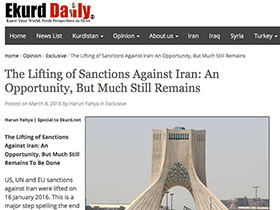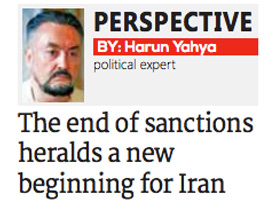

Iran, with a population of 80 million, has suffered under severe economic sanctions imposed by the U.S. and the EU since the 1979 Iranian Revolution. The détente with the U.S. administration started after President Obama changed his Middle East policy and decided to reach out to Iran following the global economic recession in 2008. It was an unexpected move from the U.S. given the policies of the previous U.S. administrations. The nuclear deal that was signed on July 17, 2015 was a milestone.
Turkey, who has been living in peace with Iran for nearly 400 years, was never on the side of sanctions and did not freeze its economic and cultural relations. Today with the lifting of sanctions, which will take effect in January, a new era awaits the Iranian people.
Yet it is not easy for Iran to recover the economy overnight. It has to go down a tough road to join a new arena with a lot of new players. Thanks to sanctions, the Iranian economy has been hurt with very high inflation and unemployment rates. Unemployment amongst the youth was at 25% and for women it was more than 40%. However, Iran is expected to overcome this unemployment easily as it has a large population, 64% which are under the age of 35 and the literacy rate is 87% and approximately 4.4 million students - of which 60% are female - registered in universities as of the 2012-2013 school term.
The Iranians are hopeful of optimistic economic developments as the banking and financial organizations coalesce with the global system, and above all, oil and natural gas production will increase, as the locked doors to export will open. The energy sector is extremely important as Iran has the world’s fourth largest oil and second largest natural gas reserves and that makes economists consider that energy as the sole economic potential. However, that is not the case for Iran. It has a diverse economy in terms of resources including services, industry and agriculture and it was the world’s 13th largest automotive manufacturer in 2011 before the sanctions. Turkey, as a crucial trade partner, plays an important role in Iran’s energy sector by purchasing most of the gas consumed in the country.
As a first step, Iran has to start by having better economic relations with neighboring countries like Turkey. In addition to many other advantages, the Turkish language spoken by 20% of the Iranian people plays a crucial role in facilitating trade relations. The geopolitical positions of both countries make them dependent on each other to reach other markets. For example, given the Syrian conflict, the Iranian border is the only path for Turkey to reach the Persian Gulf States and Iran will have the advantage of using the TANAP pipeline to transport its oil to Europe, which is seeking new oil sources as it is at odds with Russia due to the recent Ukrainian crisis. Despite all, the world powers will make every effort to get the biggest slice for their own companies in this new emerging market, just like they stymied the nuclear deal Turkey and Brazil had begun before the negotiations of the current deal took place.
What Iran has to do in this integration process is to attract foreign investment. Nevertheless, it is not an easy task for the Iranians, but not impossible, either. Iran will ultimately take back control of $150 billion of its frozen assets, yet this will not be sufficient for their recovery. This is where the need for foreign investment appears. Iran needs to create a more transparent and secure environment for foreign investors to be willing to partake in projects in Iran without hesitation.
Additionally, Iran has to undergo radical economic reforms to accelerate its economic system and reduce risks. Turkey can be a good example since it has undertaken long-term reforms and privatization processes, which began in the early 2000s. For example, Turkey gave complete functional independence to its central bank in 2001, enabling the Central Bank to achieve and maintain price stability, which provided the country to generate financial strength to attract foreign investors.
Another important step for Iran is to speed up its efforts to become a member of the World Trade Organization (WTO), it applied for membership in 1996 but was turned down owing to U.S. objections. Being a member would lower the customs duty on its goods, thereby easing exports, which will in time make it gain competitiveness in the global arena.
If Iran and Turkey endorse a common agenda to put their peoples’ prosperity first and do not let their political differences interfere in their economic and cultural relations, the outcome will be more efficient. Turkey will have better relations with Iran possessing a healthy thinking community not crippled by sanctions and bereft of fear and unease. Even though China and Germany are tough competitors within the same market, Turkey has superiority in logistics as a neighboring country, which will allow it to make faster exports at lower cost with the coming into force in January 2015 of the Preferential Trade Agreement.
Besides, the two Muslim countries with a common cultural background that have admiration for each other both have lessons to learn from each other to move forward. Additionally, it is important to show the world the power it will generate by forming a unity of two strong Muslim countries in the region and therefore generating a trustworthy environment that will attract foreign investors, who are invariably seeking a secure market. They complement each other in many ways and also in economic terms with Turkey supplying technology and transport opportunities to the rich Iranian oil and gas reserves. The aim of Turkey is to grow together with its neighbor as expected to be and not to rise alone in the region in competitiveness.
Adnan Oktar's piece on Tehran Times: