With the exception of Italy, European countries have ignored the fact that the Mediterranean has literally turned into a refugee graveyard. Nobody cared that thousands of people, including women and children, were dying as they tried to cross the Mediterranean.
The Germans thought about their public deficits. Spain wondered whether tourism revenues would rise this year, while the French debated their new intelligence law.
Yet when migrants began entering the Balkans via the Aegean, and from there into the European heartland, then their drama began finding a place on the European agenda. Yet its presence on that agenda did not, of course, mean that a humane solution was found. Indeed, rather than seek a solution, some European politicians began saying the most inhumane and disgraceful things, such as, “Let us send money and Turkey can keep them,” “We will become a minority if we admit migrants” and “We will admit Christian migrants, but not Muslims.” How quickly the Europeans seem to have forgotten that their prosperity was built on the resources obtained from the countries of refugees arriving from Africa and the Middle East.
Countries from Africa to the Far East, such as Libya, Egypt, Syria, Iraq and Chad had always been the colonies of various European countries. Europeans extracted their raw materials and processed them using the people of the regions as their workforce. Now today many people in these lands are abandoning those lands out of fear for their lives and are trying to reach Europe.
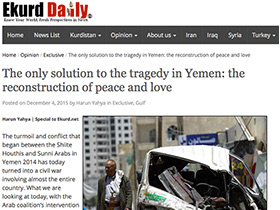
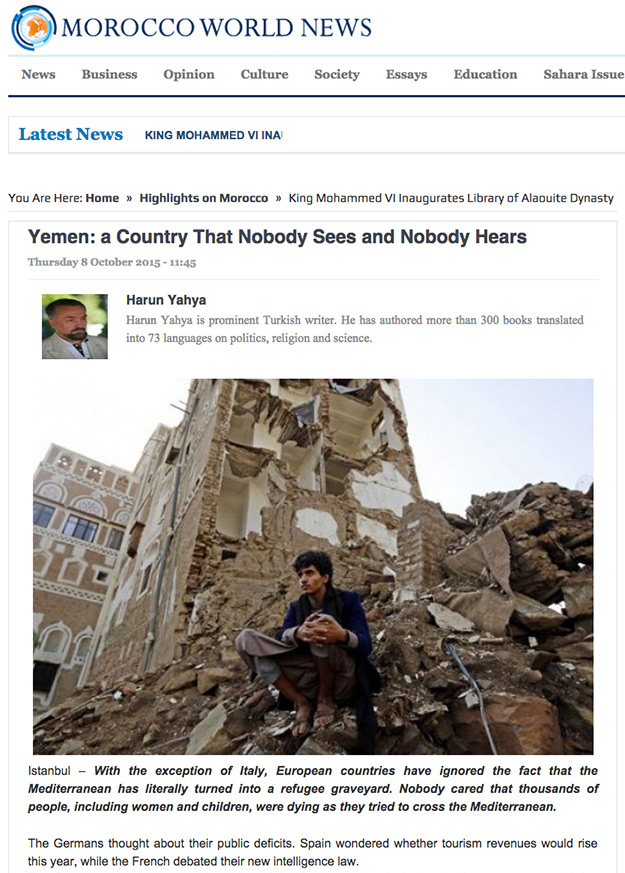
In addition to Libya, Syria, Afghanistan and Iraq, Yemen is also now staring disaster in the face. The Red Cross’s declaration that “Yemen after five months looks like Syria after five years” reveals the terrible nature of the situation.
Yet Yemen does not make the headlines as frequently as other countries in a similar predicament. It suffers greater devastation each and every day, and hunger and diseases are spreading fast. People sitting in their own homes are killed by bombs. The death toll is now regarded as mere statistical data, and does not even attract the interest of the press agencies.
In its latest report regarding Yemen, Amnesty International said that the Saudi-led bombing of Yemen had resulted in a “trail of civilian death and destruction” and that this was a “war crime.” The figures in the report reveal that 4,000 people have died to date in the operations, and that civilians constituted half of these.
The drama playing out in Yemen is not limited to murder and slaughter alone. The UN says that 80% of the 20 million civilians in Yemen stand in need of aid, and describes this as a “catastrophe.”
Ertharin Cousin, head of the UN’s World Food Programme, states that they are unable to get humanitarian aid through to the Yemeni people because of the ongoing violence. The head of the WFP paid a three-day visit to Yemen and called for all the groups fighting in the country to allow humanitarian aid to pass through. UN humanitarian chief Stephen O’Brien says that “the scale of human suffering is almost incomprehensible.” O’Brien also reports that humanitarian aid is failing to reach four people out of five, that almost 1.5 million people have had to abandon their homes, and that blood banks have closed.
Somali refugees who fled war and poverty in their own country and settled in Yemen are now trying to return home because of the worsening conditions. The fact that nearly 29,000 Somalis have returned home is an indication of how far things have worsened in Yemen.
It seems that the sides to the fighting in Yemen, and their sponsors, only care about their own side’s achieving dominance in the country.
In fact, all known means were employed to prevent the current situation in Yemen from arising. The UN stepped in, intermediaries became involved and bilateral talks were held with the opposing sides in the country. The U.S., Saudi Arabia and even Iran became involved. Aid organizations such as the Red Crescent and the Red Cross strove to get aid through to the country during ceasefire periods. None of these efforts has led to a solution and Yemen is now on the brink of the abyss.
Yet if the same sensitivity were shown to the needy people of Yemen that is shown to stranded whales or hunted seals, the situation would be very different. If Iran and Saudi Arabia could have sat down and worked together to unite Yemen, rather than bring their own supporters to power, none of these things would be happening. At the very least, the two countries can – and should – take steps now and strive to create places where Yemeni refugees can live under humane conditions and be housed in safety. Iran and Saudi Arabia both possess the financial resources with which to do this. This is a technical solution that may be applied to prevent the problem from growing even worse, yet there is a moral solution that can eliminate the problem once and for all.
The underlying reasons for the failure to find a definitive solution to the problem of Yemen are moral defects such as selfishness, self-interest, greed and apathy. The only way of eliminating these defects is by increasing people’s moral sensitivities. Someone who heeds the voice of his conscience, who has powerful feelings of love and affection and compassion, and who realizes the importance of sharing and mutual aid, can never be uncaring or insensitive in the face of such a tragedy. The real problem is therefore the moral weakness and the lack of love in the world. And it is the elimination of this moral weakness that will resolve the refugee problem, one of the main problems now facing the world.
Adnan Oktar's piece on Morocco World News: