Gender discrimination is still a major problem in developed countries as much as in developing ones. Worse is the way it is seen as normal.
Women are literally regarded as the shadows of men in many societies, and this outlandish notion has settled across the world, regardless of the levels of education.
As a result of gender discrimination, women are deprived of essential services in society, living under unequal conditions with men, suffering from violence or being underrepresented in politics and the workforce.
This also means that women are completely excluded from social life.
This inequality can only be redressed by allowing women to assume as much responsibility as men. Societies need to work together to eliminate this discrimination, and for that to happen, it is essential to increase educational opportunities across the world, abandon demagogic talk, and remind people of the importance of equality, love and being human.
In Islamic countries, explaining the importance of Koranic moral values could work towards eliminating discrimination.
God created human beings equal. Superiority, as revealed in verses and the sayings of the Prophet Mohammad, lies only in piety, meaning a good nature and good behaviour.
Yet, in the eyes of people with a fanatical mindset, a woman is supposedly deficient, with half a mind, or even a cursed entity that has to be kept under control.
Women are sometimes regarded by this mindset as dangerous; these people imagine that the best solution is to shut them up in their homes.
The great majority of people with such harsh attitude towards women draw it from sayings that were never spoken by the Prophet and fatwas by certain Islamic scholars that are incompatible with the Koran.
This has condemned half of the Islamic world to darkness for hundreds of years.
Yet, in the Prophet’s time, women and men appeared together in every area of social life. Female companions included traders, doctors and poets. Following the migration to Medina, in particular, female companions played a great role and made great sacrifices for the foundation of a new Islamic community.
The Prophet Mohammed emphasised equality between men and women, and even encouraged women to come to the forefront in many areas. He also attached great importance to women’s education. Women came to the mosque and listened to the Prophet’s conversations, and took part in the Eid prayers.
It is sad that the situation is the exact opposite in many Islamic countries today.
Women are entirely excluded from social life in many Islamic countries today. In Saudi Arabia, for example, women have no right to vote or stand for office, or even drive. They can only obtain a book from a library through a man. Many women do not even possess identity cards.
Under Yemeni tradition, if a woman is imprisoned for any reason, her family disowns her and all relations, material or emotional, are severed. Women are not allowed to vote or drive there, either. In much of Algeria, women have to cover their faces in such a way that only a single eye can be seen.
In the Khyber Pakhtunkhwa province of Pakistan, women are not allowed to go shopping without a man by their side. The reason is the fear that the mere appearance of an unescorted woman will somehow distract men.
In Afghanistan, schools are burned to the ground in order to prevent women from being educated, and female students are attacked by their teachers or killed. Threatening leaflets are handed out in the streets to prevent girls from going to school. As a result, some 90 per cent of Afghan women are illiterate. Women’s property and inheritance rights enjoy no constitutional protection.
Much progress has been made in regards to women’s rights in countries like Jordan and Tunisia. Gender discrimination is being studied through sociological, psychological and other methodologies around the world. Reports and statistics are produced and the dreadful situation is laid out for all to see, yet it is unfortunately clear that the outcome does not, and will not, change through this alone.
A massive educational campaign is needed to prevent treating women as if they were of lower status, especially in Islamic countries.
Educating both women and men, and living by the moral values of the Koran is the definitive solution.
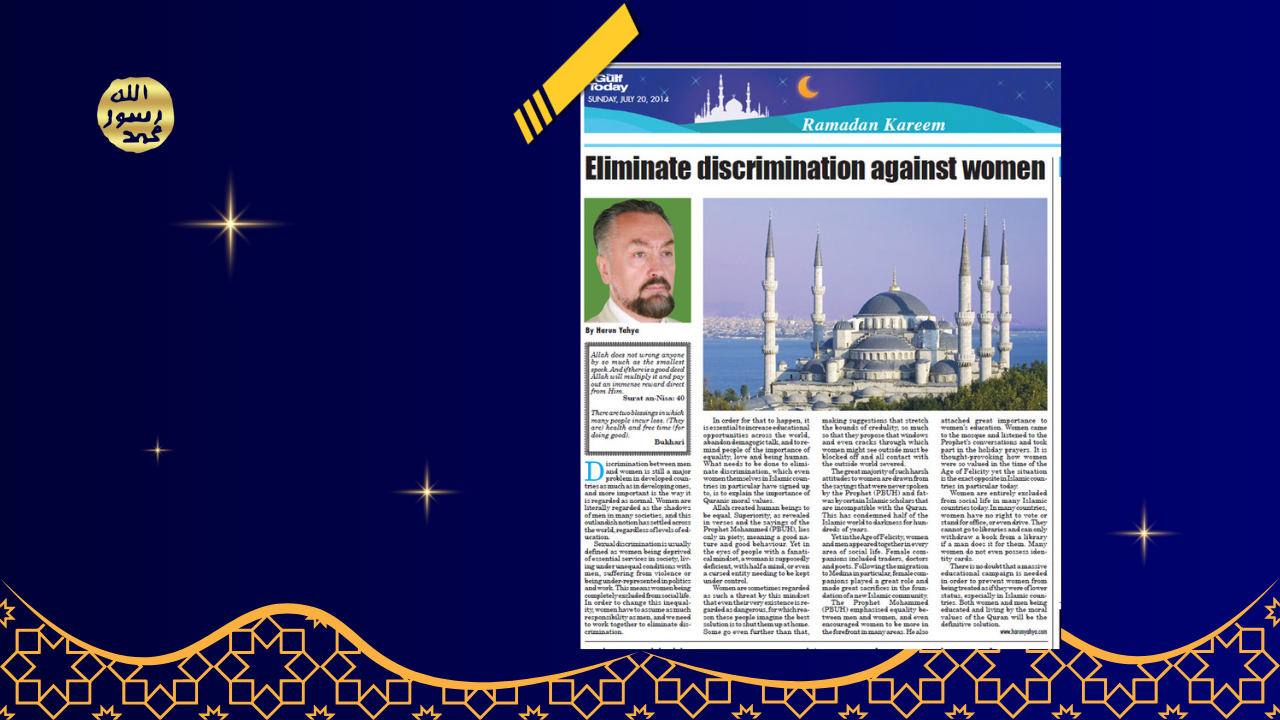
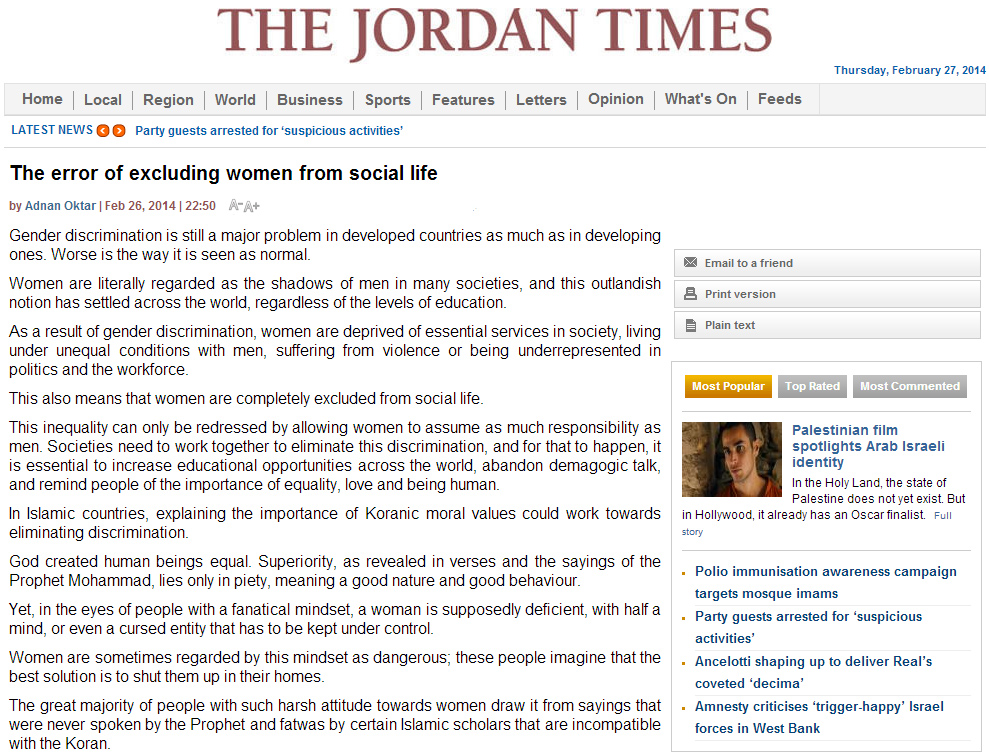
Adnan Oktar's article on Jordan Times: