Throughout history, justice has been one of the most fundamental values that all civilizations have aimed to attain. Regardless of what belief, culture, or society they belong to, people want to live in a world where justice prevails. However, adopting justice as a principle and being able to apply it under all circumstances are not the same thing. When personal interests, prejudices, anger, and self-interest come into play, justice is often undermined, and thus, in many societies, it cannot go beyond being a desired ideal.

For this reason, oppression, discrimination, and violations of rights have never been able to be completely eliminated in any society. This is because justice is not only a legal matter, but also a moral one. As long as a person places his own interests before what is right, even the most advanced legal systems will be insufficient to establish true justice.
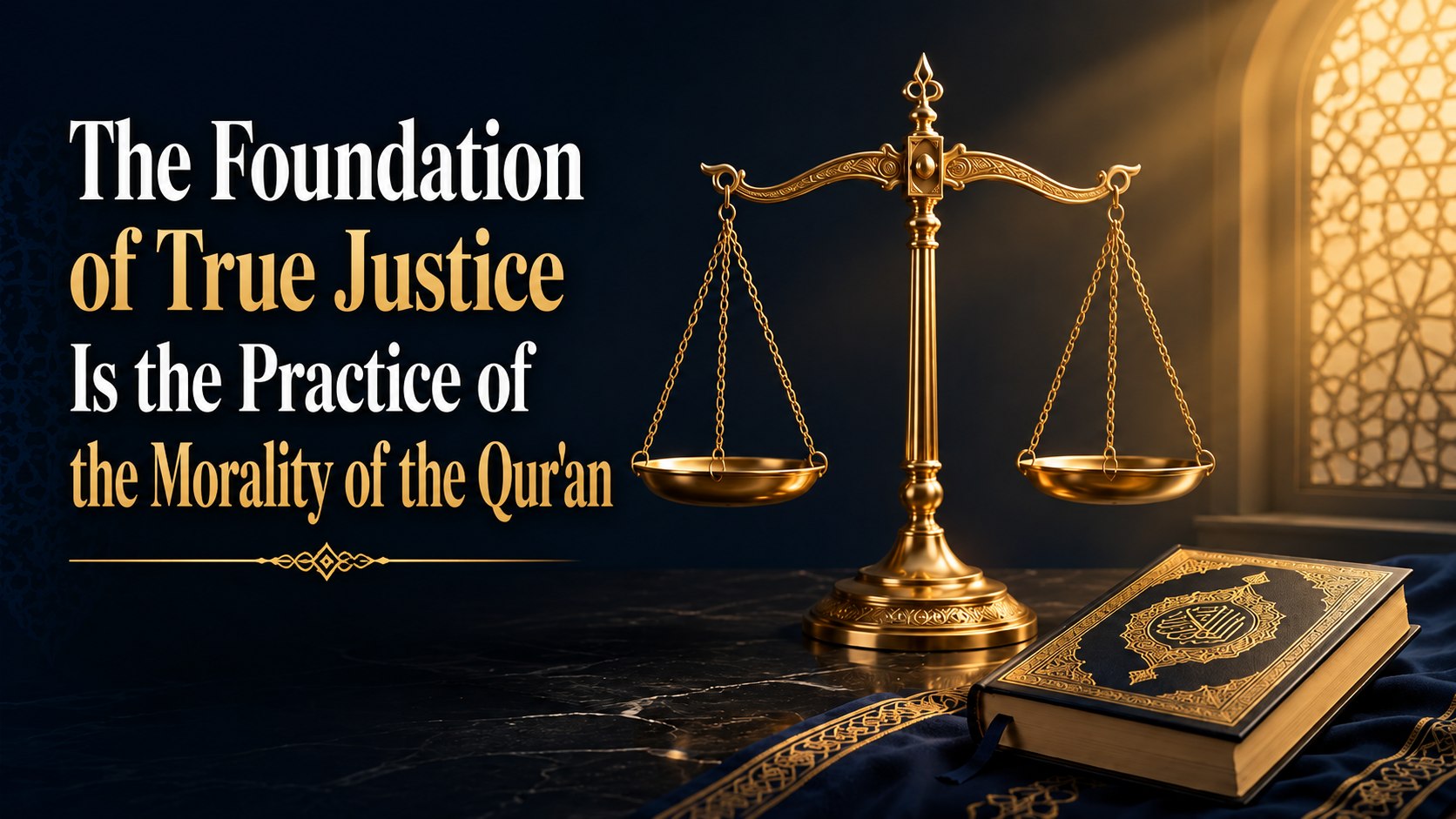
For true justice to be established, the existence of laws alone is not sufficient. The people who implement the laws and obey them must also possess strong morality. The soundest standard that can lead a person to give up his own self-interest and, when necessary, enable him to defend what is right even if it is against himself, is the good morality that God has revealed in the Qur'an.
The understanding of justice described in the Qur'an requires judging among people without making any distinction, protecting what is right with great care, never consenting to oppression under any circumstances, and standing alongside the oppressed. The Qur'an also advises making the provision of those in need, honesty, compassion, mercy, and fairness an inseparable part of life. Justice does not consist only of legal decisions; it is a moral understanding that encompasses all of a person's conduct in daily life.
In order to make a just decision, it is necessary to evaluate events from every aspect, to be free of prejudice, and not to be influenced by emotions. Anger, love, family ties, material interests, or social pressures can easily lead a person to an unjust judgment. However, a person who lives by the morality of the Qur'an sets aside his own feelings and thoughts and stands with whoever is in the right. When necessary, even if it is against himself, against his relatives, or contrary to his own interests, he does not compromise on justice. God commands the believers in the Qur'an as follows:
You who believe! Show integrity for the sake of God, bearing witness with justice. Do not let hatred for a people incite you into not being just. Be just. That is closer to heedfulness. Have fear of God. God is aware of what you do. (Surat al- Ma‘ida, 8)
This verse shows that justice is not an attitude that changes according to people's behavior, but is a command of God. A person cannot apply different standards according to whether he loves or dislikes someone. The standard of true justice, which is a principle that does not change even if circumstances change, is revealed in Surat an-Nisa as follows:
You who believe! Be upholders of justice, bearing witness for God alone, even against yourselves or your parents and relatives. Whether they are rich or poor, God is well able to look after them. Do not follow your own desires and deviate from the truth. If you twist or turn away, God is aware of what you do. (Surat an-Nisa', 135)
One of the greatest tests for a person is having to choose between his own self-interest and the truth. The Qur'an commands the believer, in such a situation, to consider only what is right. What is important in the Sight of God is whether or not a person stands with righteousness.

One of the greatest obstacles to justice is the distinctions made among people. Throughout history, standards such as race, color, lineage, position, wealth, or political power have, in many societies, taken precedence over justice. The strong have been protected, while the weak have often been left unable to seek their rights. However, in the Sight of God, people's superiority depends neither on their lineage nor on the opportunities they possess. God reveals this truth in Surat al-Hujurat as follows:
Mankind! We created you from a male and female, and made you into peoples and tribes so that you might come to know each other. The noblest among you in God's sight is the one with the most piety (who best performs his duty to God). God is All-Knowing, All-Aware. (Surat al-Hujurat, 13)
The existence of different nations, languages, and cultures is not a reason for superiority or discrimination, but a reflection of the richness that God has created. This diversity has been created so that people may come to know one another, understand one another, and live together in peace. For this reason, justice should be applied not according to skin color, nationality, ethnic origin, or social status, but only according to the standard of righteousness and fairness.
The Prophet Muhammad (peace and blessings be upon him) also practiced this principle throughout his life and did not make distinctions among people on the basis of lineage, tribe, or wealth. Our Prophet (saas) rejected the concept of racial superiority that remained from the Age of Ignorance and stated that people gain worth only through their piety. The statements made by our Prophet (saas) in the Farewell Sermon, that “an Arab has no superiority over a non-Arab, nor a non-Arab has any superiority over an Arab”; also demonstrate the universal understanding of justice in Islam in the clearest way.
Likewise, wealth or poverty cannot change the standard of justice. In many parts of the world, it is seen that those who possess material wealth gain an advantage in legal proceedings, while the poor have difficulty protecting their rights. However, according to the Qur'an, both wealth and poverty are temporary tests of the life of this world. Just as they do not give a person superiority, neither do they give him the right to violate the rights of others.
In a society where justice truly prevails, people are evaluated not according to their positions, wealth, identities, or the circles to which they belong, but according to whether they are righteous or not. In such a society, the sense of trust becomes stronger, people show greater respect for one another, and social peace becomes lasting.
What humanity needs most today is not to increase the number of laws, but to raise conscientious people who will apply those laws with justice. For where there is no conscience, laws also, in many cases, cannot achieve their purpose. The morality of the Qur'an reminds a person that God sees him at every moment and that he will be called to account in the Hereafter for everything he has done. It is this awareness that is the strongest assurance directing a person to act justly even where no one sees him.
True justice is possible only when a person places God’s pleasure above every kind of self-interest. In a society where such people become more numerous, trust, peace, and harmony will naturally become stronger, and justice will become a fundamental value that guides every area of life.