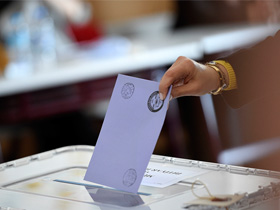

Keeping in view the political upheaval that began after last summer’s Gezi Park protests and the allegations against the government, the March 30 local election was said to be a litmus test for the ruling party. This election was perceived as a vote of confidence for the government in the wake of a number of controversies that marred the political climate. The overall situation made the local elections all the more important, as everybody wanted to find the answer to one question: Has the government lost its credibility and did the opposition get stronger?
Contrary to the expectations of many, the Justice and Development Party (AKP) maintained its position as the most popular party. The voter turnout remained quite high at around 89.1 percent, which was relatively high as compared with the local polls of 2009. The logical conclusion of the election result can be categorized as follows:
l Despite all corruption allegations, nationwide protests against the government, leaked audio recordings of government officials’ conversations and the intense tug-of-war between the government and the Gulen Movement, Turkey once again expressed confidence in the leadership of the AK Party.
However, things are not as simple as they might appear. The government must consider the fact that AK Party did not fare well in the coastal regions considered to be a bastion of the liberals. It is imperative to understand this group, which opposes the authorities on the issues of freedoms and democracy. In other words, 50 percent of Turkey not only opposed the AK Party but also is angry, frustrated and unhappy.
This calls for a review in AK Party’s policies to address the issues facing the liberals concentrated in the coastal regions. The party has to adopt an all-inclusive approach to accommodate all segments of Turkish society. Although AK Party has succeeded in making significant gains in two of the coastal cities, it must be seen that the source of unrest in Turkey is the fear of oppression and prohibitions felt by liberals. To allay their fears, the government must lift bans on YouTube and Twitter and allow freedom of information. Furthermore AK Party needs a radical change of mindset that yields a liberal, reforming, innovating and drastically more democratic Turkey for all. In his address from the balcony of his party headquarters in Ankara on the night of the election, Prime Minister Erdogan said: “We aim a democracy more advanced than Europe.” In order to achieve this goal, the lifestyles and requests of the liberals representing the coastal regions must be taken into account immediately and a policy change that will allow for a more liberal Turkey must be pursued.
l The defeat of the Republican People’s Party (CHP) — the main opposition force — in the local polls may have come as a surprise to many. Under the circumstances in which Turkey went to the polls, it should have made significant gains but that did not happen. The main reason behind CHP’s failure is the continuation of its policy of always siding against religious elements. The CHP and for that matter most of the left-wing parties have failed to understand that religious traditions are ingrained in the collective psyche of Turkish society.
In all fairness to the CHP, it tried to break away from its past but it was too little too late. In order for CHP to succeed, a radical persuasive change is needed. They need to embrace the religious conservative people in order to increase their outreach to the masses.
l It’s time to throw some light on the Kurdistan Workers’ Party (PKK). The 30-year-old turbulent past Turkey had with this Leninist terror organization had somewhat calmed down during the last year with the ongoing peace process. The PKK has understood that it cannot achieve its goals by using guerilla terror tactics. It has assumed a new public avatar by adopting a peaceful approach to attain its goals. The Peace and Democracy Party (BDP), which supports the PKK, made significant gains in many cities in Southeastern Anatolia. The PKK, which has been terrorizing the Southeastern people, openly forced them to go to polling station and vote for the BDP. Under these conditions the Southeastern people were desperate. Even the cities that had different preferences for years abruptly changed their voting behavior. The PKK is attempting to establish a region where it can have more dominance and carry out its propaganda comfortably.
The threat of Turkey’s disintegration has become much pronounced given the insidious methods that are being used now. The plan of establishing a communist state in the Southeastern Turkey by enslaving the Kurdish people is a great threat. Consequently the most important goal of the state should be foiling all plots against the integrity of Turkey and to eradicate terrorism in Southeastern Turkey. In addition to that, an inclusive education policy must be implemented. An anti-materialistic and scientific education is required to eliminate Leninist ideology so as to remove our Kurdish brothers from the ideological clutches of the PKK.
Simply put, with this election the Turkish people have sent a strong message to the world that Turkey undoubtedly can become the most democratic Islamic country of the world. It does not need any revolution — like the ones that are being experienced by many Muslim countries — but it has the capability to transform through liberties and rational scientific strategies.
Adnan Oktar's article on Arab News: