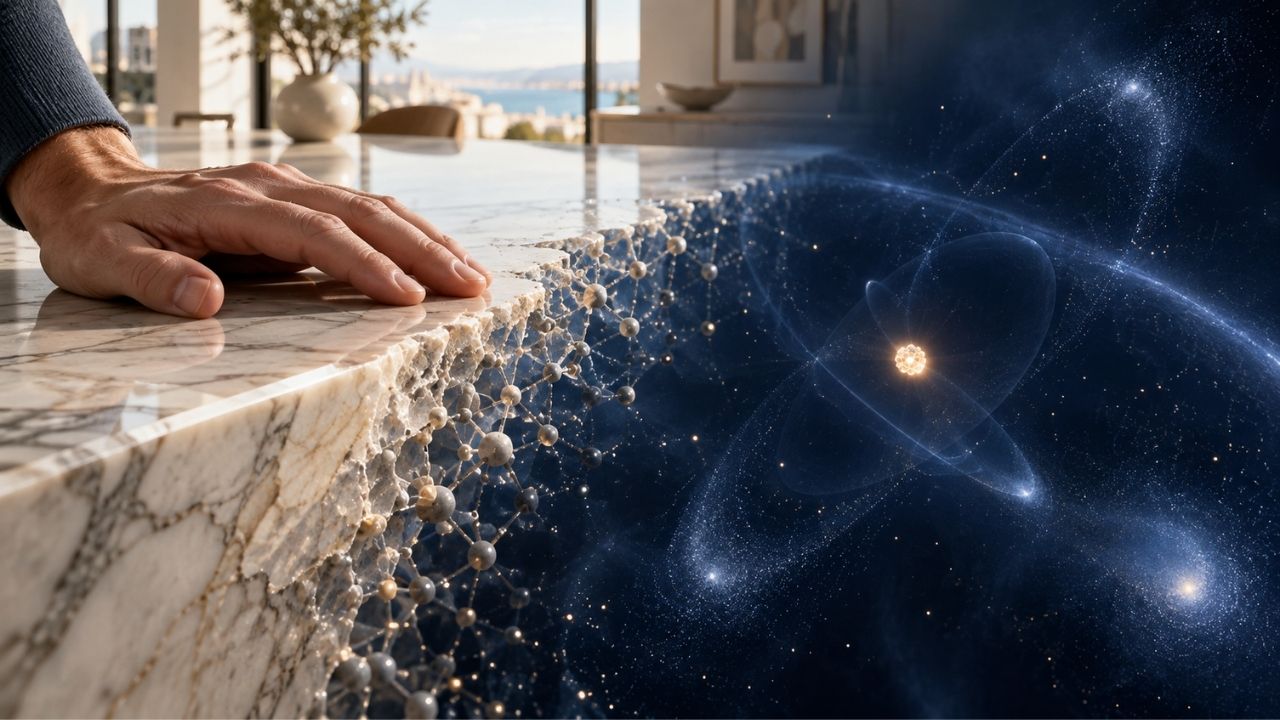
We think that the table on which we rest our elbow and the marble floor on which we step are “full” of matter from top to bottom. However, measurements made on the atom, the smallest building block of matter, have revealed that this fullness is merely an appearance and that matter is almost entirely empty space.
When we touch a stone wall with our hand and press our fingers against its surface, we feel resistance and say, “Here is hard and solid matter.” Yet if we could enter into the atoms that make up that stone wall, we would find not the fullness we expect, but an inconceivable emptiness!
.jpg)
An atom consists of a tiny nucleus at its center and extremely light electrons moving through a very large area around it. All the weight is concentrated in this minute nucleus at the center, while the vast area around it is almost entirely empty. The difference in scale is so great as to be difficult to imagine. If we think of the nucleus as being the size of a pea, the boundaries of the atom would be extensive enough to encompass an area of approximately one kilometer around that pea; in the enormous intervening space, there would only be electrons weighing as much as a few specks of dust.
In order to determine how small the nucleus is, scientists carried out an extremely sensitive measurement known as the muonic hydrogen experiment. In this experiment, the electron in the hydrogen atom was removed and replaced by a particle called a muon. Although the muon has properties similar to those of the electron, it is approximately two hundred times heavier. For this reason, it moves much closer to the nucleus; the orbit it follows is approximately two hundred times narrower than that of the electron.
The fact that the muon moves so close to the nucleus forms the basis of this measurement method. That is because the closer the moving particle gets to the nucleus, the more pronounced the effect of the nucleus's size on the particle's energy levels becomes.
The researchers stimulated the muon with a laser, moving it from one energy level to another, and measured the frequency at which this transition occurred. The measured transition frequency was determined to be 49,881.88 gigahertz. From this value, the radius of the proton was calculated as 0.841 femtometers. A femtometer is one quadrillionth of a meter. (1)
Let us consider what these figures mean by means of a more comprehensible example. If you enlarged a hydrogen atom to the size of a soccer field, the atom's nucleus would be the size of a grain of sand placed in the middle of the field. Everywhere else would be empty space.
In this case, the nucleus, which carries the entire weight of the atom, remains virtually no more than a point within the atom; the remaining vast portion consists solely of empty space. A second scientific measurement conducted by Aldo Antognini and his colleagues shortly after this experiment confirmed the same result. (2)
The scientists who study matter have also clearly expressed this empty structure. The British astrophysicist Arthur Eddington, who first confirmed general relativity experimentally and lectured at Cambridge University, also drew attention to the fact that matter consists largely of empty space. (3)
.jpg)
This is the point that needs to be considered: Matter, which we imagine to be full, solid and firm, is in fact almost entirely empty space. The hardness we feel when we press it with our hand is not because matter truly fills its interior, but because atoms do not allow one another to pass beyond a certain boundary. The fullness of matter is merely an impression; what actually exists is not fullness.
So what use is this knowledge to us?
This knowledge shows that the solid world on which we stand and in which we place our trust is not as solid as we imagine. Even the ground we regard as the most concrete and durable is almost nothingness when we examine it in depth. All those material things that people ambitiously pursue, accumulate and claim as their own are largely empty space, even though they appear to possess tangible fullness. It is God Who shows us this appearance of solidity and Who creates the atom and the empty space within it at every moment. Everything continues to exist by God's might. He alone is the One in Whom we should trust and on Whom we should rely. In one verse, God reveals:
"Mankind! God's promise is true. Do not let the life of the world delude you and do not let the Deluder delude you about God." (Surah Fatir, 5)