Today, you probably began an ordinary day, as millions of people around the world did. You woke up in the morning, had breakfast, got ready while drinking your tea or coffee, and left home to go to work or school. Perhaps you drove into traffic, or perhaps you boarded a bus, subway or train. As you tried to get to work, you thought about what you would do during the day. Then the day continued as usual. You sat down at your desk, turned on your computer, checked your phone and did your work. Perhaps you attended meetings, perhaps you met with customers, or perhaps you listened to lessons for hours. Someone else sent their children to school today, tidied their home, prepared food and went shopping. Someone else opened their shop, someone else was on duty at a hospital, and someone else spent hours behind the wheel.
When evening came, you returned home, ate your meal, perhaps watched some television, browsed the Internet, thought about what you would do the next day and finally went to bed to sleep. Morning will come again. You will wake up again, get ready again, go somewhere again, work, study, eat, talk, grow tired and, when night comes, sleep again. Most of your life probably passes in this way. Yet for a moment, let us step outside all this and ask the following question: Is the world, which appears so real, concrete and vivid, really composed of matter itself existing outside? Or is everything we see and experience a magnificent image shown to us in our minds?
The World We Perceive and the Limits of the Senses
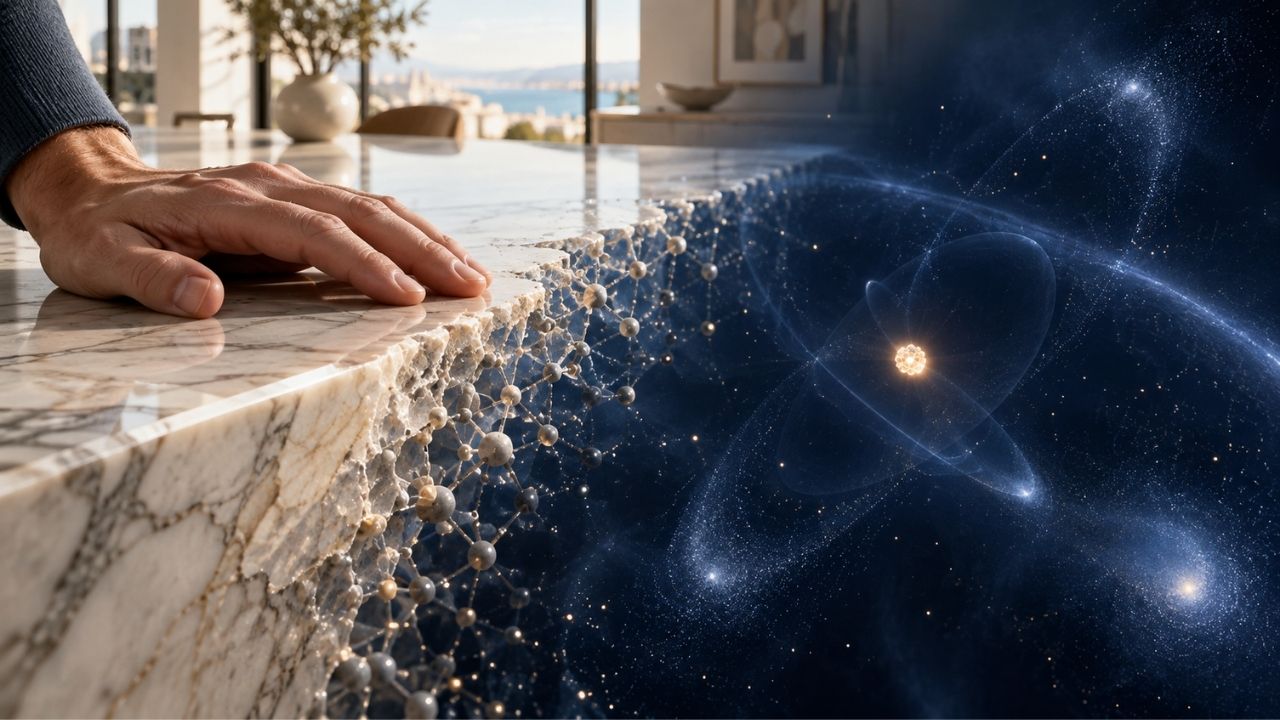
In our daily lives, everything around us appears quite definite and tangible. A table is a table, a chair is a chair and a stone is a stone. When we touch an object, we feel that it is solid. This is how we perceive the world, and this perception seems entirely natural to us. Without realizing it, a person may think, “I see and touch it, so I am dealing with matter itself outside”. Yet scientific facts and the mechanism of perception show us that this is not at all the case.
We live in a world of large objects. We see cars, trees, buildings and human bodies. On this scale, the world appears stable, definite and solid to us. However, the human senses do not possess the capacity to perceive directly the entirety of the physical structure around them. Our eyes cannot see the whole electromagnetic spectrum. Our ears cannot hear all sound frequencies. We cannot perceive many things taking place around us directly through our senses.
There was once no knowledge of the existence of microorganisms invisible to the human eye. Microscopes were later developed, and the world of living things that we cannot see with the naked eye was revealed. Radio waves, infrared radiation and other kinds of waves that the human eye cannot see can be measured with scientific instruments. We observe events in space that we cannot see with the naked eye through telescopes. In other words, the things human beings can directly see and feel do not represent the entirety of what exists.
What, then, leads us into the error of thinking that we see the objects themselves in the external world? The most perfect and explicit way of understanding this is through dreams.
What Do Dreams Tell Us About Reality?
Let us suppose for a moment that you close your eyes and think of your middle school years and the schoolyard of the school you attended. The image of that school suddenly appears in your mind. Although your eyes are closed and there is no concrete school building before you, that image exists in your mind with almost the same clarity.
The fact that this image is brought into existence in the mind, even though there is no eye perceiving it and no material counterpart to it outside, is clear evidence that the perceiver is an entity independent of the eye and matter. The perceiver is the "soul", which our Almighty Lord created independently of matter and bestowed upon human beings from Himself.
Dreams, on the other hand, are a far more profound and striking example in terms of comprehending this subject.
Imagine that you are having a dream. In your dream, you may be in a house, walk through streets or speak with someone for hours. You perceive the space around you in three dimensions, hear sounds, taste delicious foods, smell the scent of fresh grass, and even feel your heart beating rapidly as you flee from danger and experience genuine pain in your body when you are injured. At that moment, all of these appear entirely real to you. While dreaming, you do not say, "I am lying in my bed right now; these are all imaginary". You regard the people, places, fears and excitement there as completely real. Yet at that moment, you are lying in your comfortable bed with your eyes closed. You are in an entirely safe environment; there is no danger chasing you, no rain is falling, nor have you eaten anything. That sequence of events, which you imagine lasted for hours, was in fact experienced during a dream lasting only a few seconds or minutes. Most importantly, despite there being no concrete input from the external world, all these events were created in your mind.
You taste an apple you eat in a dream, but there is no apple on your table. You feel the pain of an injury down to your cells, but there is no wound on your body. The light of a fascinating landscape dazzles your eyes, but your room is pitch-dark.
.jpg)
What, then, is the power that makes you taste that apple, experience that pain and watch that colorful, three-dimensional world when there is no physical factor outside?
It is, of course, Almighty God Who makes your soul experience all these things flawlessly and Who keeps the soul under His control at every moment.
The Same Mechanism in Wakefulness and Dreams: Electrical Signals
This is the most vital lesson the example of dreams teaches us: So long as a person cannot step outside the image shown to him, he assumes that image to be the absolute reality outside. Let us now direct the same question toward the life we experience while awake. In dreams, our eyes are closed, yet we watch a world. While awake, however, our eyes are open, and we watch a world by looking at stimuli that we think come from the external world.
However, there is a fundamental fact here that must not be overlooked: Everything we perceive is not data entering our souls from outside or a direct copy of the external world; it is brought into existence entirely within the soul, that is, in consciousness, by Almighty God. God has created the same instrumental cause for both the real world and dreams: Electrical signals.
While we are awake, our eyes do not take a table outside and place it inside our brains. Light rays assumed to come from outside are converted into electrical signals by the retina and reach our minds. The hardness we touch, the sounds we hear, and all the tastes and smells we perceive are solely electrical signals processed in our minds.
In other words, the things you think you actually see consist of electrical signals, and so do those in dreams. The source of both is the same mechanism, and both are created as images in your mind.
Whether you visualize something in your mind, think that you experience it in real life, or see it in a dream, the fundamental processes taking place in your brain are the same. In a dream, there is no light striking the retina from outside or thorn piercing your hand, yet the image and pain exist flawlessly in the mind. This means that the existence of an image does not require dependence on concrete matter outside.
Therefore, there is no difference between the way we perceive the world while awake and the way we perceive the world in a dream. Just as in a dream, the colorful, moving, audible and three-dimensional world we see while awake consists merely of an illusion, an image that God has “created solely for us” inside our minds. If the five senses possessed by human beings were to disappear, it would become impossible for us to know what matter outside looks like, and only the image shown to us would remain.
What Lies Behind the Image Regarded as Real?
All this requires human beings to reconsider the distinction between the world in which they live and absolute reality.
A person sees houses, streets, people, his body, seas, trees and all material entities. They all appear extremely real and permanent to him. He is born, grows, works, earns, loses, loves, grieves and makes plans within these images, and becomes possessed by the feeling that what he owns will continue forever.
.jpg)
Yet the body, home, job, money and position a person calls "mine", as well as all the people around him, consist merely of temporary perceptions shown to him in his mind, just as in a dream. A person will not be able to keep this world of images he possesses today with him forever. When the time comes, he will awaken from this dream of the world. Death is not annihilation, but that great moment of transition when perceptions concerning the life of this world come to an end and perceptions concerning the life of the Hereafter begin to be brought into existence in our souls. This is precisely the plain truth to which the Qur'an draws attention:
“They will say, “Alas for us! Who has raised us from our resting-place? This is what the All-Merciful promised us. The Messengers were telling the truth.” (Surah Ya-Sin, 52)
“(It will be said:) "You were heedless of this so We have stripped you of your covering and today your sight is sharp.” (Surah Qaf, 22)
These verses clearly indicate that a person's perception in the life of this world is behind a sleep or a veil. While in this world, a person cannot fully see the absolute reality behind the temporary perceptions shown to him. However, with death and resurrection, the veil over him is lifted; just as if awakening from a deep sleep, he passes into the perceptions of the Hereafter and comes face to face with absolute realities.
On that day, a person will understand that the things he saw in this world and regarded as absolute entities were merely temporary perceptions and a test created in his mind. And then, he will fully comprehend the difference between the shadow images in this world and absolute reality.