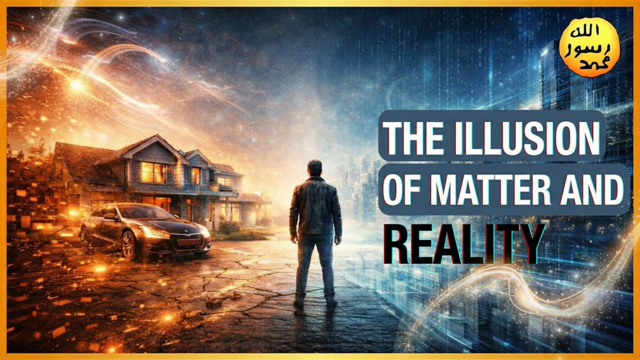
From the moment a person comes into the world, he perceives the beings he sees around him and the events that take place as reality itself. He regards the objects and people around him, and the possessions, property and means he has, as material entities. In time, this perception shapes his entire life. He becomes attached to what he sees, attaches importance to what he possesses, grieves over what he loses, compares himself with what others possess and ascribes meaning to the events he encounters on the basis of the images he sees.
However, the Qur'an reveals that the world a person sees is not the entirety of reality. God has explained the true face of the life of this world and drawn attention to the fact that if a person occupies himself solely with its outward appearance, he may become heedless of the Hereafter. In the Qur'an, God reveals that He is the one absolute Being Who is the Everlasting, the Living, the First and the Last and the Sustainer.
The Everlasting (Al-Baqi) - He Who is permanent and Whose existence has no end.
The Living (Al-Hayy) - He Who is always alive.
The First and the Last (Al-Awwal and Al-Akhir) - He Who has no beginning or end; Who is before all things and after all things.
The Sustainer (Al-Qayyum) - He upon Whom the existence of all things depends and Who sustains all things.
When a person of faith recognizes the attributes of God and comprehends the great truth God reveals in the Qur'an concerning the transitory nature of the life of this world, he cannot continue living by presuming that the appearance he sees is reality itself; he does not ascribe to images a reality and identity independent of God, lives his life according to the truths revealed by God and endeavors to display the attitude that will earn His good pleasure in every situation he encounters.
Faith, therefore, does not merely consist of verbally accepting the existence of God; it means comprehending and putting into practice the truths revealed by God in the Qur'an. Profound faith requires comprehending the reality behind the visible world and living one's life in accordance with this knowledge.
Some people have difficulty overcoming their anger, become arrogant because of the means they possess, envy the blessings of others, dwell excessively on a remark made to them because it offends their lower selves, become filled with a desire for revenge in the face of behavior directed against them and display various other moral weaknesses of this kind. They regard a material loss as the greatest trouble in their lives and may lose all their hopes for the future because of an event they experience. The reason for all this is that they regard the illusion they see as reality itself. However, the image a person sees and the reality behind that image are not the same thing.
The Qur'an constantly directs a person's attention beyond the visible world. It is revealed as follows in Surat ar-Rum:
They know an outward aspect of the life of this world but are heedless of the Next World. (Surat ar-Rum, 7)
Here, the expression “outward aspect” is striking. A person may occupy himself with the visible part of the life of this world; he may assume that the things he sees, possesses, gains and loses are the realities of life. However, the Qur'an reveals that man exists within a far greater reality. The nature of the life of this world is explained as follows in Hadid Suresi:
Know you (all), that the life of this world is but play and amusement, pomp and mutual boasting and multiplying (in rivalry) among yourselves, riches and children... (Surat al-Hadid, 20)
The fact that the life of this world is defined in this manner shows that a person should not ascribe excessive meaning to the appearances he sees. Although a person knows that the things he obtains in this world are transitory, when he makes them the true purpose of life, he mistakes the image to be the actual reality. He assumes his possessions to be reality itself. He imagines his status to be reality itself. He deems beauty to be reality itself. He presumes people's praise to be reality itself. He reckons people's disdain to be reality itself. He regards an evil done to him as an independent event apart from God's creation and test. He thus begins to live under the influence of the appearance.
A Person Under the Influence of the Appearance Succumbs to Worldly Weaknesses
A person sees the face of the person before him, hears his voice, hears the words he says and perceives his behavior. His brain processes all these data, and an experience emerges. He then ascribes meaning to this experience and generally reacts in accordance with the meaning he has given it.
If a person regards the behavior of the other person—may God forbid—as a reality independent of God, he may become angry by concentrating on the thought, “He did this to me.” If he does not pay sufficient attention in his daily life to the fact that God creates everything, he considers events not according to the truths revealed in the Qur'an, but from the perspective of people who do not believe and who evaluate events solely by their outward aspects. He therefore does not consider that the event taking place is an illusion, that it has been created by God as a test and that the essential matter is to display the attitude God desires of him in that situation.
However, a believer's perception and attitude are different. A believer knows that no person and no event before him is independent of God. He also knows that ignoring this truth would open the door to ascribing partners to God. For that reason, he endeavors to bear in mind that every event he encounters takes place within God's knowledge and creation. When he encounters a situation that angers him, instead of acting under the direction of his anger, he endeavors to display the attitude God desires of him. Even if he is caught off guard for a moment and falls into error, he displays determination not to repeat the same error.
When describing those who have fear of God in Surah Al ‘Imran; God reveals that they are “…. those who control their rage and pardon other people…” (Surah Al ‘Imran; 134) and states that He loves those who do good.
A believer will therefore naturally act not according to the illusion before him, but according to God's command, and will display the attitude that will please Him in order to earn His love. No matter how the person before him behaves, he will take the measure of his own behavior not from that person's behavior, but from God's command.
The same applies to all elements of good morality. Humility, for example, means correctly comprehending the reality behind the illusion a person perceives. In other words, it is related to knowing that the image is created by God. When a person regards the beauty, intelligence, knowledge, ability, strength, wealth or status he possesses as absolute qualities belonging to him, he begins to grow arrogant. A person who knows that these are blessings bestowed on him by God does not consider himself superior. That is because he knows that in reality he possesses nothing and that all the qualities and means he has have been granted to him by God.
A person's speaking well, acting justly, keeping his word, watching over those in need, avoiding wastefulness, remaining aloof from suspicion and gossip, respecting the rights of others and many other moral qualities are related to the same fundamental awareness. That is because all these are related to a person's acting not according to the person before him or the event he experiences, but with the knowledge that God encompasses all things and that God is behind the veil of images.
When a person assumes that the image he sees is reality itself, he is swept along in pursuit of images. When praised, he becomes motivated and feels valuable; when criticized, he is devastated; he becomes jealous of what someone else possesses, grows arrogant because of an achievement and falls into despair because of a loss. As the illusion changes, so does his state of mind.
However, the person who grasps that God has created everything, encompasses everything, and that nothing is independent of Him, arranges his life not according to changing appearances, but according to an unchanging truth. He knows that the image comes into being through God's creation and understands that his own responsibility is to display the attitude that will earn God's good pleasure in the face of that illusion.
A person who comprehends that God encompasses all things knows that he is in communion with God alone. He acts with awareness of this great truth, avoids falling into error, refrains from backbiting and hesitates to pass judgment on a matter about which he has no knowledge. Without forgetting that God is the sole Owner of reality, and without being carried away by the illusion, he does not depart from justice even if it is against himself, restrains his anger and forgives. With the same awareness, he does not claim superiority, does not grow arrogant, does not envy and does not become more attached than he should to this world and the images within it. For this reason, good morality is not a collection of behaviors independent of faith. Good morality is the reflection in a person's daily life of the truth in which he believes. Moral qualities such as humility, patience, contentment, gratitude, compassion, forgiveness, justice, fine words, remaining aloof from backbiting, not belittling others and controlling anger are the results of a person's correctly understanding God and his own position before God.
Modern Science Sheds Light on the Truth Behind the Visible World
Through studies conducted over the last century, modern science has produced important findings that shed light on this truth revealed by the Qur'an—that the world a person sees is not the entirety of reality. Thanks particularly to studies conducted by modern science in the fields of physics and neuroscience, a person is better able to understand the true structure of the world he perceives through his senses.
The classical conception of matter that prevailed for centuries has changed significantly as a result of studies conducted by modern science over the last century. When the fundamental structure of the entities we perceive as solid and independent objects in daily life is examined at the subatomic level, a very different picture emerges. Studies on the structure of the atom, the behavior of particles and quantum fields show that matter, in the solid and unchanging form experienced by a person in daily life, does not constitute the foundation of reality.
To a person, a table is a hard, fixed and definite object. Yet when one delves into a more fundamental level of physical reality, behind this experience lies a far more complex structure explained in terms of atoms, subatomic particles and quantum fields. Therefore, what a person perceives as “matter” in daily life does not reveal the ultimate structure of reality as it actually is.
In explaining this change, physicist Sean Carroll states that the idea that the world consists of small and independent particles in the classical sense is inadequate, and that particles must be understood as vibrations in quantum fields. Italian physicist Carlo Rovelli states that modern physics no longer regards the world merely as a structure consisting of material particles in motion, but that we think in terms of quantum fields. According to him, the conception prevalent in the 18th century that “the world consists solely of matter” is no longer valid. [1] [2]
.jpg)
Nobel Prize-winning physicist Frank Wilczek also explains that beneath the apparent structure of matter lies a very different physical reality. The Standard Model reveals that protons and neutrons are also composed of quarks and gluons, and that most of the mass of ordinary matter is connected with the properties of these more fundamental structures. It can thus be seen that the world a person perceives in daily life as solid and independent matter is physically based on far more fundamental and different structures. [3]
Moreover, the matter is not limited to physics alone. Nor does a person perceive the external world as it actually is through his senses. The eye perceives light coming from the surroundings, the ear perceives vibrations at particular frequencies, and the other sensory organs perceive various physical stimuli. All of these are transmitted to the brain through the nervous system, and the brain processes these data and constructs the world the person experiences. A person does not perceive the external world directly and in all its aspects; he experiences a world through the limited sensory information that reaches him.
Contemporary research on perception also reveals that the brain does not merely record incoming sensory data passively, but processes them together with existing knowledge and expectations to produce a perception of the world. A study published in the journal Nature Reviews Neuroscience states that while constructing perception, the brain combines prior knowledge and expectations with sensory data. [4]
The words of neuroscientist David Eagleman are striking in this respect. Eagleman states: “Instead of reality being passively recorded by the brain, it is actively constructed by it.” According to Eagleman, a person does not directly perceive what is outside, but perceives what his brain presents to him. The brain processes sensory data and constructs the world the person experiences. This reveals an important fact: A person does not see reality directly and in its entirety. What a person sees is the experience that emerges when the data reaching him are processed by the nervous system. [5]
Color is one of the clearest examples of this. A person sees a tree as green, the sky as blue and an object as red. Yet this experience of color is related to the image of the object in the external world that forms in the person's mind. A person is able to perceive only a small part of the electromagnetic spectrum. There are forms of radiation he cannot see, sounds he cannot hear and a great many physical phenomena he cannot directly perceive. Despite all this, a person regards the illusion he sees as reality itself. This is where the fundamental error begins.
.jpg)
The Image Is Not Reality Itself
A person's experience of dreams makes this situation easier to understand. In a dream, a person may see himself being insulted, argue with someone, fear that person or become angry with him. During the dream, the illusion he sees and the emotion he experiences appear entirely real. Yet when he wakes up, he begins to evaluate the experience he had in a different way. That is because he has now realized what the appearance he saw actually was.
He understands that the person he saw in his dream was not actually standing before him at that moment and that the event he experienced took place on a plane different from the events he encounters while awake. He thus reevaluates the nature of the reaction he gave to the illusion he regarded as real during the dream.
In the life of this world, however, most people accept the appearance they see as reality itself without questioning it. They regard the person before them, the event they experience and the things they possess as absolute reality, and they rejoice, grieve, become angry or experience fear in accordance with the meaning they ascribe to these appearances.
A word spoken by one person may alter another person's state of mind; the house, car, money or status possessed by someone else may produce a sense of deficiency in him; and a person's behavior may cause him to become angry. At the foundation of this lies the same error: A person supposes that the image he sees is reality itself.
In modern thought, this subject is discussed not only from the perspectives of physics and neuroscience, but also in terms of the nature of reality. Oxford University philosopher Nick Bostrom's study titled “Are We Living in a Computer Simulation?”, published in The Philosophical Quarterly in 2003, is one of the best-known examples of research in this field. [6]
In the peer-reviewed study titled “Simulation Expectation”, published in the journal Erkenntnis in 2024, Teruji Thomas reexamined Bostrom's explanations concerning simulation and put forward a new argument supporting the possibility that we live in a simulation. [7]
It can be understood from all this that, as the Qur'an revealed from the outset and modern science also supports, the fundamental issue confronting man is whether or not he can comprehend the reality behind the illusion shown to him.
References
Carroll, Sean. The Biggest Ideas in the Universe: Space, Time, and Motion. Dutton, 2022.
Rovelli, Carlo. The Order of Time. Riverhead Books, 2018.
Wilczek, Frank. “What Matters for Matter.” Physics at MIT, Massachusetts Institute of Technology.
Teufel, Christoph; Fletcher, Paul C. “Forms of prediction in the nervous system.” Nature Reviews Neuroscience, 21, 231–242, 2020. DOI: 10.1038/s41583-020-0275-5.
Eagleman, David. Incognito: The Secret Lives of the Brain. New York: Pantheon Books, 2011, p. 82.
Bostrom, Nick. “Are We Living in a Computer Simulation?” The Philosophical Quarterly, 53(211), 243–255, 2003. DOI: 10.1111/1467-9213.00309.
Thomas, Teruji. “Simulation Expectation.” Erkenntnis, 91, 427–444, 2026. First published online: December 9, 2024. DOI: 10.1007/s10670-024