Man may doubt the external world; he accepts that what he sees may be deceptive and that what he hears may be misunderstood. Yet when it comes to his own body, all doubt comes to an end. You look at your hand and say, "this is my hand"; you seek no evidence for this and never give it a thought. Yet this feeling does not come from your body either. The feeling that the body belongs to you is a judgment made by the brain by combining the senses. And this judgment can be deceived in the laboratory.
Let us say that your own right hand is resting on the table in front of you. So how do you know at that moment that this hand is yours? From two things: you see it, and you feel it when it is touched. Sight and touch come together in the same place, at the same time. The brain draws a conclusion from this meeting: the thing resting here is my hand. So what happens if these two pieces of information are separated from one another?
This is the point that needs to be considered. Two researchers tested this for the first time in 1998. The participant was seated at a table, and his left arm was placed behind a screen, outside his field of vision. In its place, a left hand made of rubber was placed directly in front of him. The researcher took two brushes; with one, he began touching the unseen real hand, and with the other, the visible rubber hand, at the same time and in the same rhythm. The participant saw only the rubber hand being touched, but felt the touch on his own hand.
Within a few minutes, something strange happened. The participants began to feel the touch not in their own hands, but in the rubber hand before their eyes. Moreover, they adopted that hand as their own; they said, "it was as if it were my hand." The researchers then asked them to indicate the location of their own hands with their eyes closed. The participants indicated the location of the hand not where it actually was, but as shifted toward the rubber hand. In other words, the brain had not merely produced a feeling; it had also altered the record of where its own body was. (1)
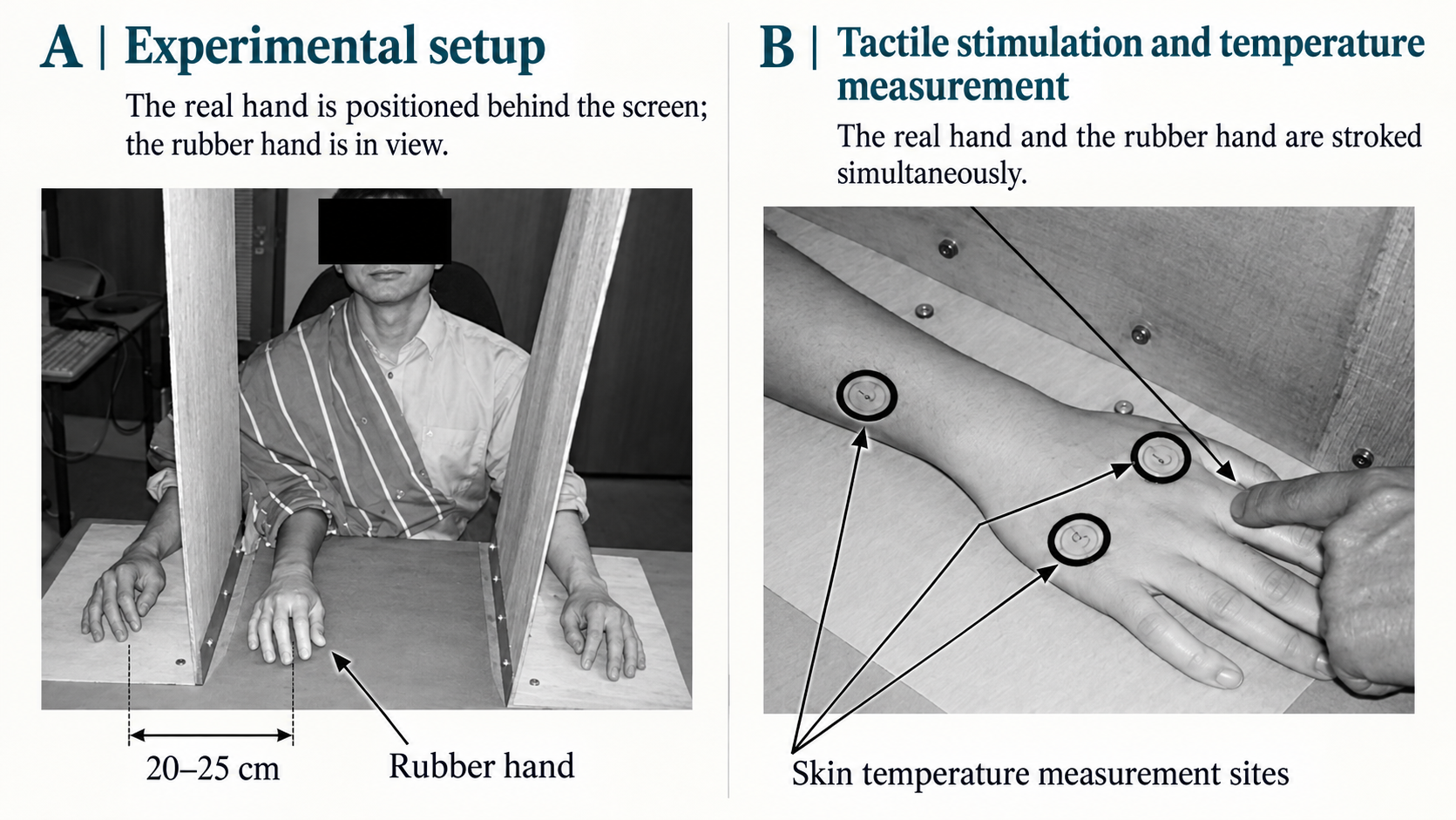
This result revealed that ownership was not merely a matter of words. Yet the real evidence came later. When the researchers brought a knife or needle close to the rubber hand, they measured a genuine anxiety response in the participants' bodies: perspiration increased, and the body behaved just as if its own hand were under threat. Yet the thing being threatened was a piece of rubber, and the participant knew this.
In addition, another astonishing condition was identified in this scientific experiment. The temperature of the unseen real hand of the person who had begun to adopt the rubber hand as his own began to fall measurably. The brain was seemingly abandoning the hand that it no longer regarded as belonging to it and reducing the blood flow to it. Moreover, this cooling was seen only in that hand, and not in the other hand. (2) When the result of this experiment was examined, it was understood that the decision "this is mine" or "this is not mine" was not merely a feeling, but a judgment that produced measurable consequences in the body.
Up to this point, the external world has always been discussed: it has been explained that colors, sounds and distances are formed in the brain. Yet what man imagines belongs to him, namely his body, also reaches him as a perception. You see your hand and feel it being touched; but you are dealing not with the hand itself, but with the hand formed in your brain. Just as you live with a copy of the external world, you also live with a copy of your body. The only difference is that you are so accustomed to this copy that it never occurs to you that it is a copy.
Throughout his life, man regards his body as "me." He works for it, saves for it, fears that it will become ill and trusts in it. Yet that body has been given to him, and he encounters it not directly, but through a representation established in his brain. It is not even he who makes the judgment that the hand he imagines he possesses belongs to him. This feeling can be altered in an instant and transferred to a piece of rubber. True ownership does not belong to man. It is God Who created the body, gave him that feeling of ownership and can alter it whenever He wills. When the time comes, those hands that man imagines to be his own will tell what he has earned, while his feet will bear witness.
"Today We seal up their mouths and their hands speak to us, and their feet bear witness to what they have earned." (Surah Ya-Sin, 65)