The Quantum World on a Visible Scale
Quantum physics has significantly changed our customary way of thinking about nature. In daily life, we accept that objects are in a specific place and a specific state. A ball is either on the table or has fallen to the ground. A door is either open or closed. To say that a person is both at home and at work at the same time appears meaningless to us.
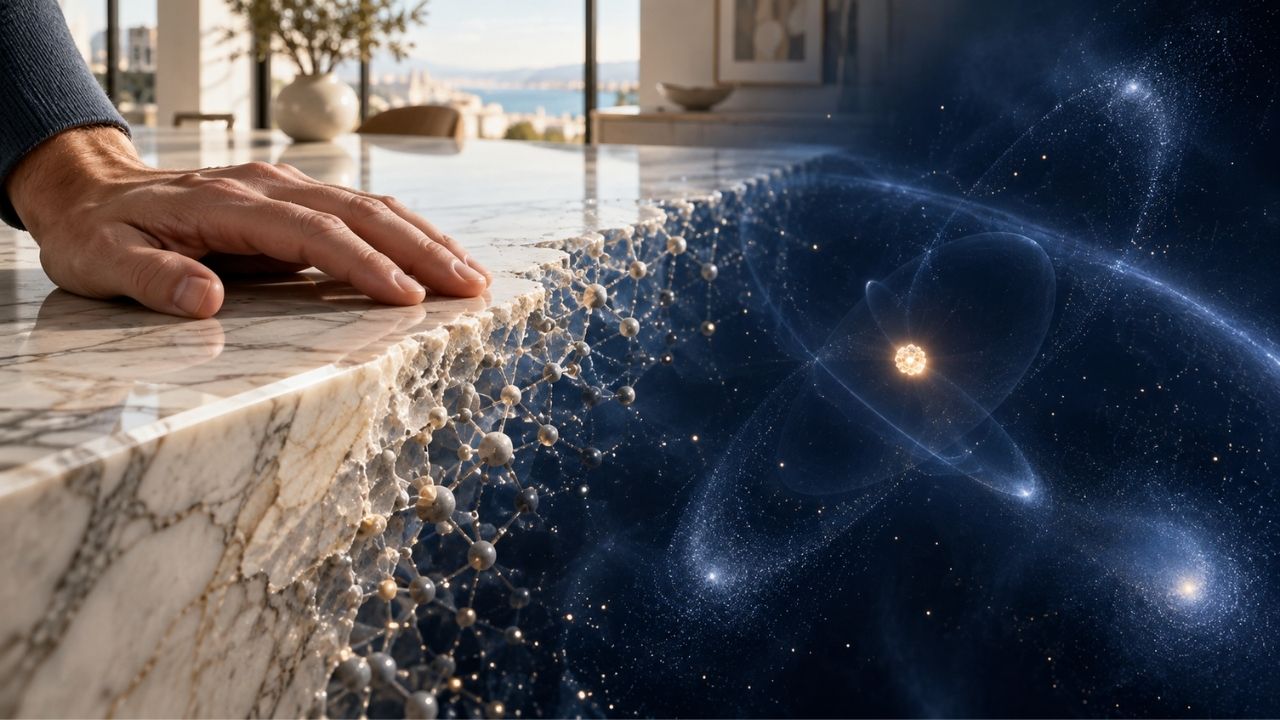
The reason for this is that in the large-scale world in which we live, the positions and states of objects are evident when viewed with the naked eye. However, when we descend to the level of atoms, electrons and particles of light, matter begins to behave in ways different from our daily experiences.
In the quantum world, the state of a particle cannot always be described as “it is definitely here right now.” Instead, physicists use a mathematical structure that defines the different possible outcomes for the particle and the probabilities of those outcomes. This is generally called the ‘quantum’ state, or, to make it easier for the general public to understand, the ‘probability cloud.’
This expression does not mean that a single particle is divided into parts in the sense we know and exists everywhere. A more accurate way of putting it is that ‘before a measurement is made, the position, energy or motion of the particle is not as definite as it is in classical physics.’ Quantum theory describes a state in which different possible outcomes are considered together. This property is called ‘superposition,’ meaning ‘different quantum possibilities existing on top of one another.’
What Did Schrödinger’s Cat Describe?
We can explain this with a familiar example. In 1935, Austrian physicist Erwin Schrödinger proposed his famous cat ‘thought experiment’ in order to show what astonishing consequences could result from applying quantum theory directly to large objects in daily life.
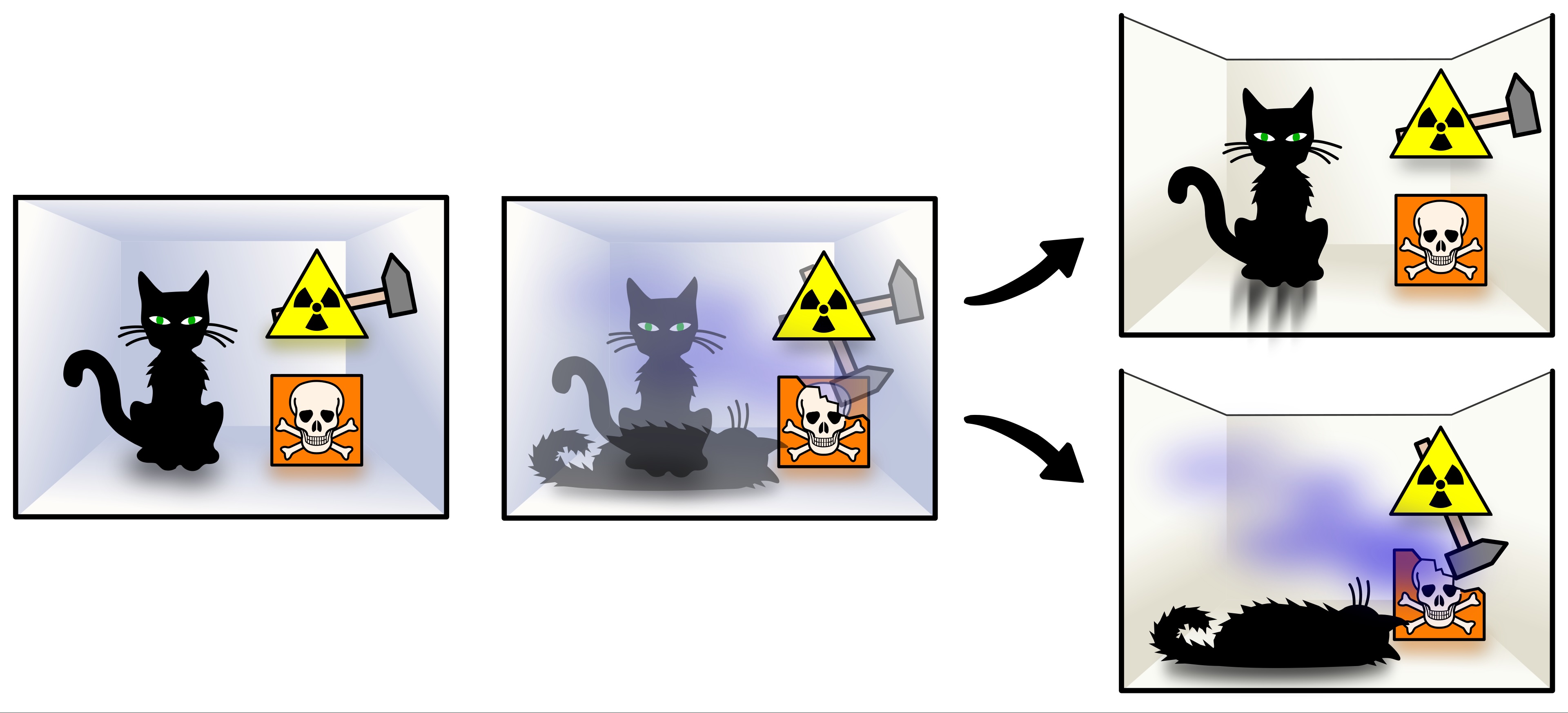
In the experiment, a cat, a radioactive atom and a mechanism that operates depending on the decay of the atom are placed inside a closed box. If the atom decays, the mechanism will be activated and the cat will die; if the atom does not decay, the cat will remain alive.
According to quantum theory, before a measurement is made, the atom can be described as being in a state that contains both the “decayed” and “not decayed” possibilities. If we extend this logic to the cat without imposing any limit, the strange conclusion emerges that before the box is opened, the cat is both alive and dead.
However, there is an important distinction here: Schrödinger did not devise this example in order to argue that a cat is actually both alive and dead. On the contrary, he wished to make visible the difficulty regarding how quantum theory passes from the microscopic world to the daily world. In other words, Schrödinger’s cat is not so much a laboratory experiment as a thought experiment concerning the interpretation of quantum physics.
What Does “Quantum Observation” Mean?
One of the most common misunderstandings encountered when quantum physics is explained is the idea that “nothing is definite unless a human being looks at it.”
In physics, observation does not necessarily mean that a human being looks with his eyes. The interaction of a particle with a detector, a measuring device, another atom or its environment is also a part of the measurement process, as if it had encountered consciousness. Therefore, quantum physics does not make the claim that ‘the universe exists only through human observation.’ The essential issue is why and how a quantum system loses its delicate state of superposition when it interacts with its environment. This process is called ‘decoherence.’
We can explain decoherence with a simple example: In a very quiet room, you can hear a faint whisper. Yet in a crowded and noisy environment, the same whisper is lost among the other sounds. In the same way, quantum superpositions can be preserved when they are completely isolated from the environment; however, as interaction with heat, light, vibrations and other particles in the environment increases, this delicate quantum behavior rapidly becomes invisible. That is why atoms can clearly display their quantum properties, while preserving the same effects in large systems such as a table, a chair or a living cat is exceedingly difficult.
What Did the 2025 Nobel Prize in Physics Change?
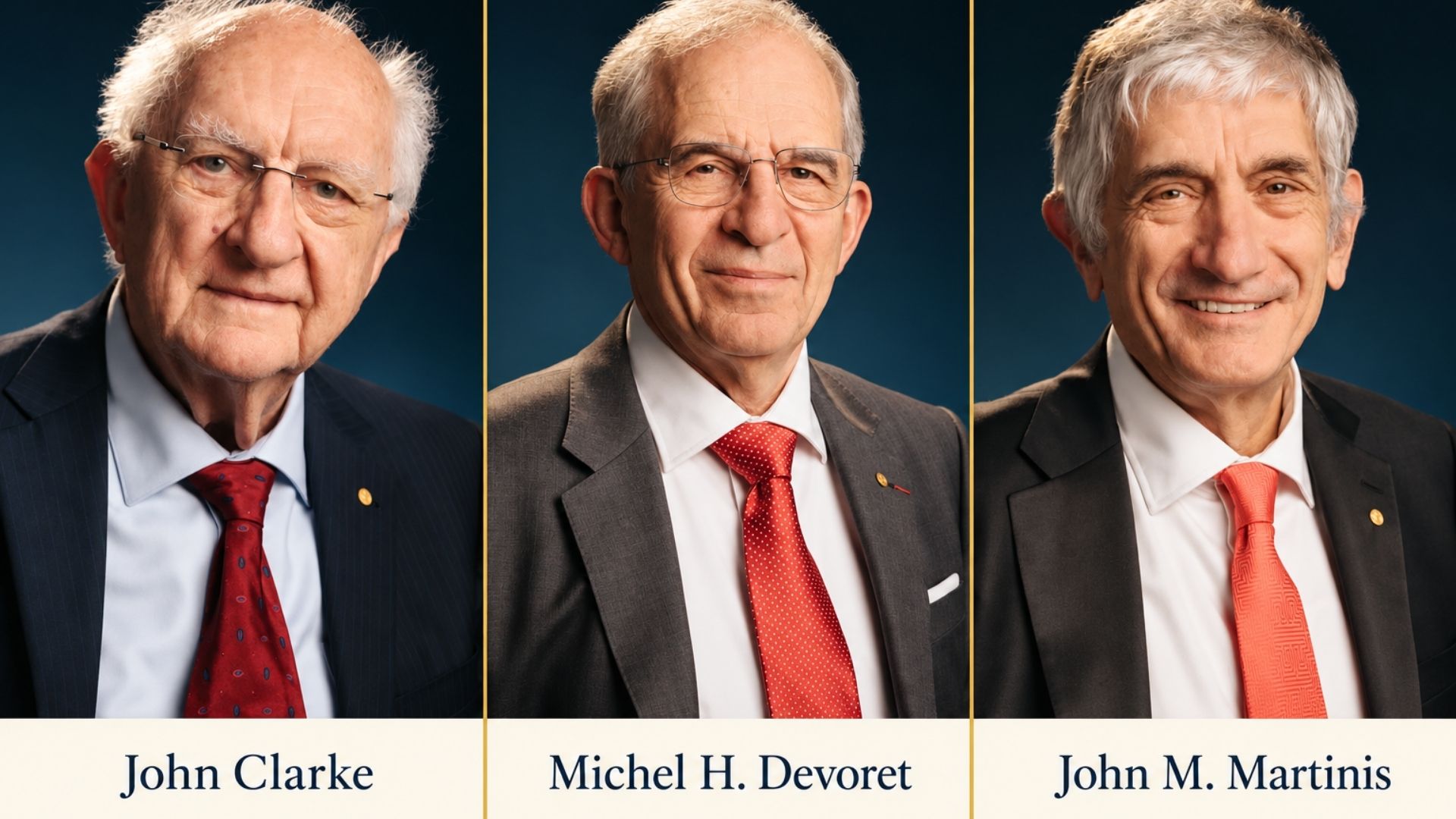
The 2025 Nobel Prize in Physics was awarded to John Clarke, Michel H. Devoret and John M. Martinis for their work demonstrating macroscopic quantum mechanical tunneling and the quantization of energy levels in an electrical circuit. These experiments were first carried out in 1984-1985.
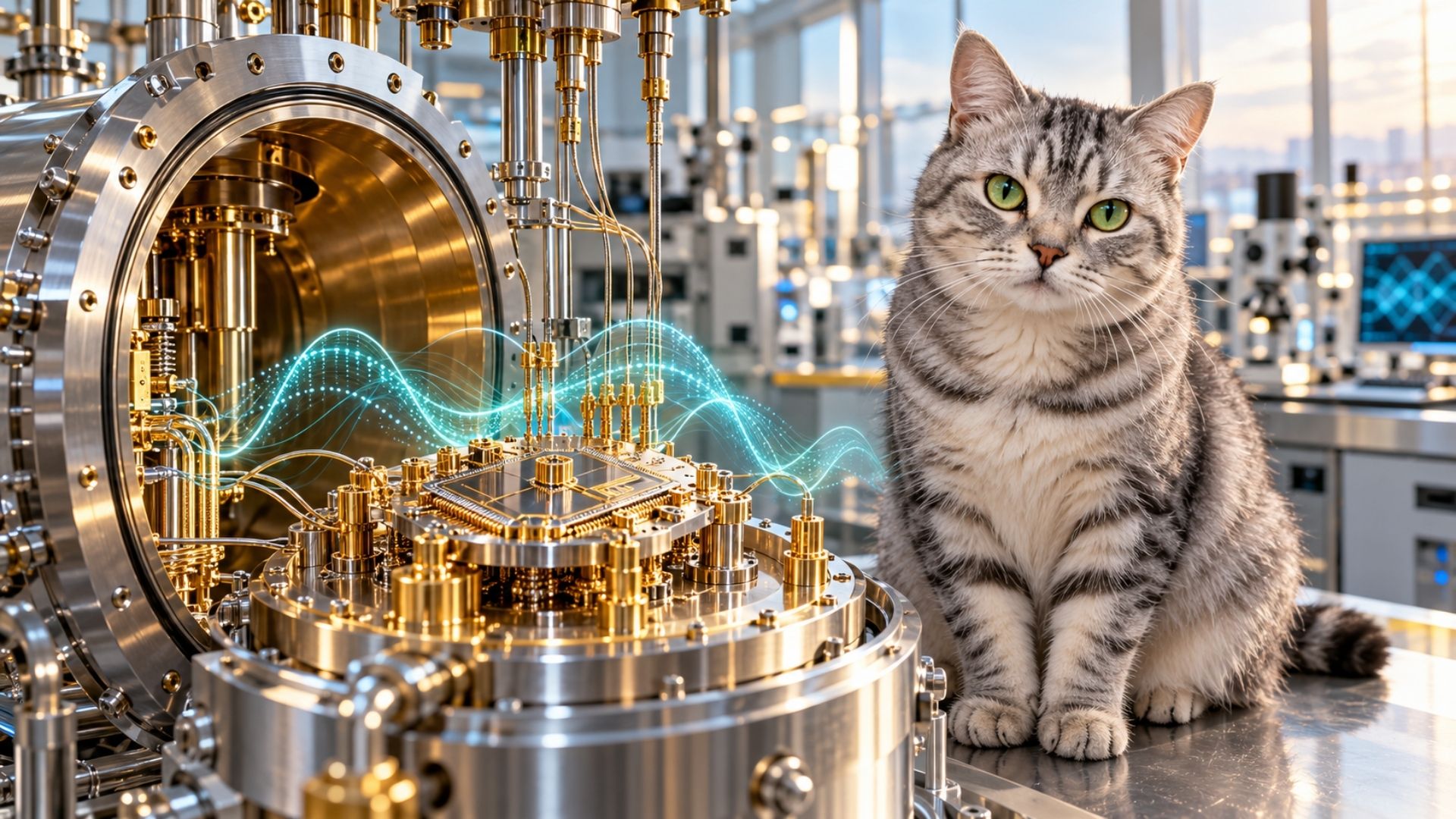
While conducting this experiment, the researchers used electrical circuits in which two superconducting parts were joined by a special connection. Superconductors are substances that can carry electric current without resistance at sufficiently low temperatures. In this circuit, a large number of electrons could display a common quantum behavior instead of moving individually and in a scattered manner. Thus, it became possible to examine the quantum properties not merely of a single atom or electron, but of an electrical system consisting of a large number of particles.
In the experiments, it was observed that the electrical state in the circuit passed through an energy barrier that it could not overcome according to classical physics, by means of quantum tunneling. It was also shown that the system’s energy could not take on just any value, but could exist only at specific energy levels. The Nobel Committee drew particular attention to the fact that this circuit was large enough to be seen with the naked eye and held in the hand.
What Is Quantum Tunneling?
We can explain quantum tunneling with an analogy from daily life.
Let us imagine that we wish to get a ball to the other side of a hill. According to classical physics, the ball must have sufficient energy to pass over the hill. If its energy is insufficient, the ball goes up the slope, stops and rolls back. In the quantum world, however, with a very small probability, the particle can pass ‘through’ the hill by means of the density or harmony of vibration frequencies, without going over it, and emerge behind the hill. It behaves as if a tunnel had been opened through the hill. That is why this phenomenon is called “quantum tunneling.” Of course, there is no tunnel that has actually been opened. What is described here is that the quantum state has a ‘non-zero’ probability of passing to the other side of the energy barrier.
This phenomenon is not merely a theoretical state. In addition to occurring in certain nuclear processes in the Sun, it is used today in many fields, from electronic devices to modern quantum technologies, and plays an important role.
So, Has Schrödinger’s Cat Become Real?
This question can be answered both “no” and “it has been approached to a significant extent.”
No, because in the experiments, a living cat, a table or another large object we see in daily life was not maintained in two separate states at the same time. The Nobel Prize-winning work did not prove that a cat is both alive and dead at the same time, or that a large object exists in two separate places at the same time. However, it has been approached to a significant extent, because the experiment showed that a circuit consisting of a large number of particles and large enough to be seen with the naked eye could behave like a single quantum system.
The term “macroscopic quantum” mentioned above must be understood carefully. The circuit itself is large enough to be held in the hand; however, the quantum variable observed is not the entire circuit physically existing on two separate tables. What is subject to superposition or tunneling is the common electrical state in the circuit. This distinction is important. That is because expressions such as “a visible object existed in two places at the same time” may be used in popular accounts. Yet the scientific meaning of the experiment is subtler than that: A system consisting of the collective motion of billions of particles can behave according to quantum laws under suitable conditions.
This achievement shows that there is no absolute and insurmountable wall between quantum physics and the daily world. Quantum laws exist in large systems and do not disappear; however, they generally become invisible because of strong interaction with the environment.

Why Do We Not See Quantum Superposition in Daily Life?
As we stated above, it is exceedingly difficult for quantum behaviors to be manifested in large systems due to environmental effects. The main reason for this is that large objects cannot easily be isolated from their surroundings. It is possible to isolate an atom to a considerable extent in a special experimental setup. Yet a large object constantly interacts with its environment: Molecules in the air strike the object. Light in the environment is reflected from the object. Heat increases the motion of the particles within it. Vibrations in the ground and the surroundings affect the system. Each one of these interactions carries information about the quantum state into the environment. Thus, the delicate state of superposition breaks down in a very short time, and the system appears to us in the classical, familiar form.
This is also why the Nobel Prize-winning experiments were conducted at very low temperatures and under exceedingly controlled conditions. When heat and environmental noise are reduced, the collective quantum behavior in the circuit can be preserved for longer. Therefore, the quantum world and the daily world are not two separate realms disconnected from one another. The same miracles of creation apply everywhere; however, in large and complex systems, environmental effects make it difficult to observe quantum properties directly.
The Miraculous Order Beyond Our Limited Perception
The human mind is accustomed to perceiving objects in specific positions, within specific boundaries and separately from one another. The fundamental reason for this is that the scales we encounter in our daily lives can be explained sufficiently well by the laws of classical physics.
In order to use a table, we do not need to know the quantum states of its atoms. When we throw a stone into the air, we do not make use of wave functions to calculate its motion. Human perception and the daily manner of thinking have been created in conformity with the order that serves us at the scale in which we live.
However, when we descend into the depths of matter by means of scientific instruments, we see that existence possesses a structure far different from what we are accustomed to and an extraordinary creation. At the fundamental level of matter, we encounter probabilities instead of certainty, specific energy levels instead of continuous energy, and quantum tunneling instead of classical barriers.
This miraculous structure means that the universe was created with our Lord’s infinite knowledge and with extraordinary precision. In other words, quantum phenomena also operate according to the exceedingly precise mathematical laws determined by our Almighty Lord, Who created the universe from nothing. On the other hand, although some results in quantum physics may appear probabilistic, these probabilities are not random. As stated in Surat al-Hadid, which result will occur and at what rate is known by our Lord before it is created.
“Nothing occurs, either in the earth or in yourselves,without its being in a Book before We make it happen.That is something easy for God." (Surat al-Hadid Suresi. 22)
Every Atom and Every Particle in the Universe Is Under God’s Control
The delicate structure revealed by quantum physics is only one of the proofs displaying the superior creation of our Almighty Lord. The measured relationships, energy levels, probability distributions and immutable mathematical order operating even at the smallest scales of matter show just how finely structured the universe is. In the Qur’an, our Lord calls on man to reflect on the creation of the heavens and the earth.
“In the creation of the heavens and earth, and the alternation of the night and day, and the ships which sail the seas to people’s benefit, and the water which God sends down from the sky – by which He brings the earth to life when it was dead and scatters about in it creatures of every kind – and the varying direction of the winds, and the clouds subservient between heaven and earth, there are Signs for people who use their intellect.” (Surat al-Baqara, 164)