Darwinism constructs human history along a line progressing from primitive societies to advanced human civilization. This fictional chronology is a product of the attempt to legitimize the theory of evolution at the societal level. However, contrary to this claim, archaeological findings unearthed from all over the world completely invalidate the evolutionary narrative. For example, the Sumerians and the Ancient Egyptians, who lived around 3000 BC, possessed a civilization that was, in every respect, far more advanced than that of some present-day societies. It is also an obvious fact that different levels of civilization could coexist during the same period of time. Therefore, from the very first day of his existence, man has been a being endowed with intelligence, an appreciation of art and aesthetics, and a structure of culture and morality. Human history reveals not a process of biological or mental evolution, but the existence of civilizations that rose or declined in different periods and in different geographical regions.
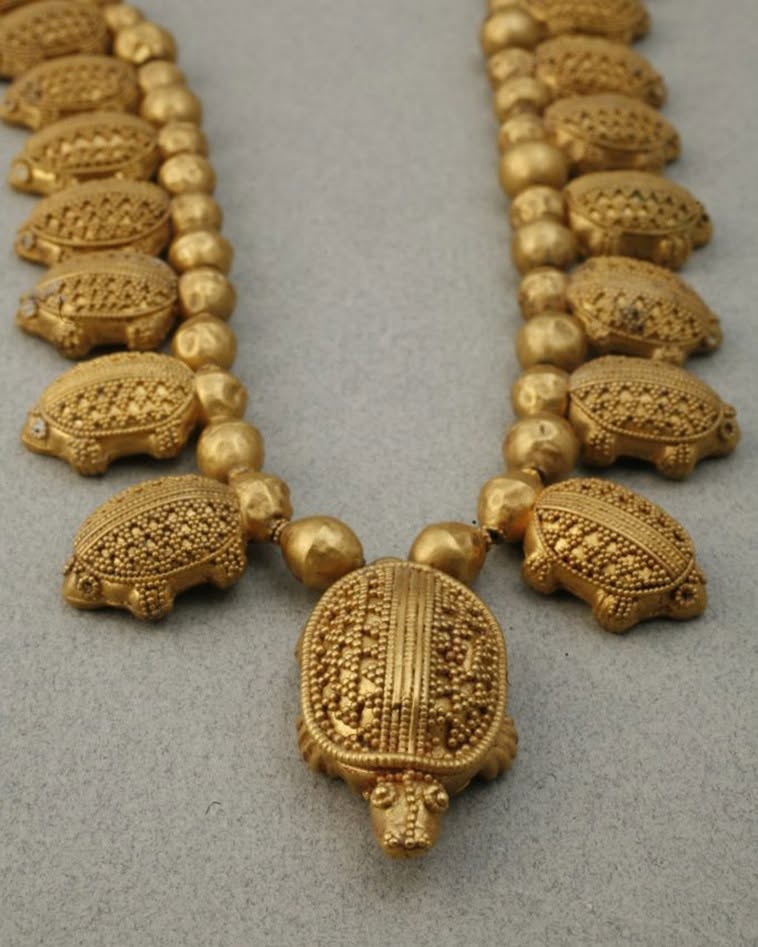
The latest example overturning the claim of ‘primitive history’ is the ancient Kingdom of Colchis, which existed in what is now the territory of Georgia, and the remarkable gold craftsmanship that has survived from this kingdom to the present day. The Kingdom of Colchis was a society renowned for its rich culture and advanced metalworking art. In the so-called Greek mythology, it was the land of legendary wealth to which Jason and the Argonauts traveled in search of the ‘Golden Fleece.’ The Colchis gold artifacts, dating back approximately 2,500 years, are not merely works of art. These artifacts are the products of a genius in metalworking that took shape without modern technology, laboratories, or the advanced furnaces of today. This article will examine, in light of the findings uncovered during the excavations at Vani, how the "nanotechnology" of the ancient world invalidates the evolutionary claims of primitive history.
The Reality of Advanced Mining
The archaeological research in question has brought to light an extraordinary stream-mining technique for its time. Studies conducted in the region have shown that the people of Colchis developed a unique physical filtration system to collect microscopic gold particles from riverbeds. The Colchians spread specially prepared sheepskins across the bottoms of streams and, by sifting gold-bearing gravel and sand carried from upstream through perforated wooden troughs, deposited them onto these skins. While the microscopic gold particles became trapped among the folds of the sheepskin, the sand and gravel flowed away. After the sheepskin had dried, it was shaken, yielding pure gold dust.
This method was not a simple primitive technique; rather, it was a practical synthesis of fluid mechanics, differences in specific gravity, and knowledge of materials. The trasures of Colchis, which is also spoken of with admiration in ancient historical sources, was not, as evolutionary historians claim, ‘gold gathered by chance,’ but the product of intelligent mining.
Micro-Granulation Technology: Art at One-Tenth of a Millimeter
Under the leadership of Professor Otar Lordkipanidze, masterpieces of Colchian gold craftsmanship were discovered during excavations carried out in the Vani ancient Kenri monumental cemetery area. The gold crowns (diadems), earrings, and forehead ornaments unearthed from the rich elite burials, now exhibited in the Vani Museum, reveal an astonishing metalworking technology.
The jewelry in question was decorated using an ornamental technique known in modern literature as granulation. This technique involves forming gold into microscopic spheres and arranging them on a surface with almost laser-like precision and in a flawless geometric pattern. The gold spheres found on the necklaces and temple ornaments from the Colchis burials range in diameter from 0.1 mm to 0.5 mm.
Let us try to visualize this. Without a magnifying glass, a light microscope, precision tweezers, or gas welding equipment, how could you produce thousands of perfectly spherical gold beads, each measuring one-tenth of a millimeter in diameter? Moreover, how could you weld these tiny spheres, one by one, onto another gold plate without melting them or causing them to lose their shape?
Modern simulation experiments have shown that, in order to produce these microscopic spheres, gold must be melted in a specially designed crucible under controlled conditions between layers of carbon (ash), and then immediately transferred into rapid-cooling environments. This indicates that the ancient masters of Colchis were not merely ‘craftsmen’" but advanced metallurgical experts who had technically mastered the crystal structure and surface tension of materials at the microscopic level.
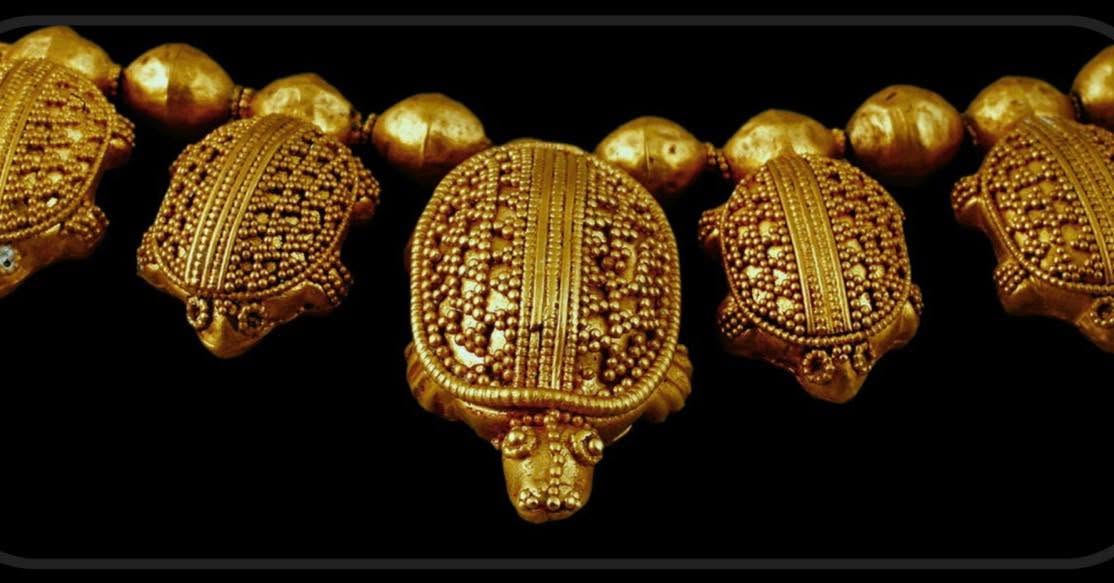
Flawless Chemical Bonding and Heat Control
The real technological marvel of granulation craftsmanship emerges during the stage in which the microscopic spheres are attached (welded) to the main body. If the craftsman were to apply high heat using the logic of ordinary soldering, the delicate spheres, measuring one-tenth of a millimeter, would instantly melt and turn into a flat layer. To overcome this problem, the Colchian masters used a method of thermal bonding through chemical reduction. This process consists of the following steps:
· The gold spheres are fixed to the surface with a special chemical paste consisting of an organic adhesive (for example, tree resin) and a copper salt (such as malachite powder).
· When the piece of jewelry is placed in the furnace, it is ensured that the atmosphere inside the furnace is oxygen-free.
· When the temperature is brought precisely to between 890°C and 900°C, the organic adhesive is carbonized, and the copper salt is reduced to pure copper. This copper combines with the gold at the point of contact, forming a microscopic alloy with a lower melting point.
· While only that tiny point of contact melts and becomes welded, neither the microscopic spheres nor the main body is damaged.
A temperature control error of 5–10 degrees would mean that the entire work of art would melt completely and be destroyed. As far as we know, in the 5th century BC, when thermometers had not yet been invented and today's computer-controlled furnaces did not exist, flawless metallurgical craftsmanship was nevertheless achieved. Nor can this precise technique be explained simply by maintaining the temperature through observing the color of the fire in the furnace. What existed was a laboratory-level knowledge of chemistry and fire technology (pyrotechnology).
A Blow to the Evolutionary Theory of a Single Center of Civilization
The evolutionary view of history claims that advanced technology and art emerged only in certain Western or Mediterranean centers (for example, Classical Greece or Rome), and that the surrounding regions escaped primitive life only through being influenced by these centers. However, the chemical and artistic analyses of the artifacts discovered during the Vani excavations have revealed that the Colchis jewelry was produced entirely in local workshops using techniques unique to that region.
The people of Colchis developed commercial relations with neighboring civilizations, yet preserved their own distinctive technological knowledge and production methods. This demonstrates that civilization was not an evolutionary process spreading from a single center to the periphery; rather, wherever human beings have existed, they have been capable of producing advanced artistic and technological works through the use of intelligence.
Conclusion: Perfect Creation and the True Religion
The thousands of microscopic spheres gleaming on the Colchis gold artifacts once again invalidate the materialist thesis of history. When archaeological findings and the living environments of certain past societies are examined, it is clearly seen that they lived at a level more advanced than even some present-day societies and made tremendous advances in construction technology, astronomy, mathematics, medicine, art, and science. Human beings never underwent a semi-animal stage on earth; beginning with the first human being on earth, Prophet Adam (pbuh), mankind has possessed intelligence, language, culture, art, and an appreciation of aesthetics. Contrary to the claim of the theory of evolution, there has never been a progression in human history from the primitive to the advanced. Rather, God, Who possesses infinite power, knowledge, and wisdom, created man with all his intellectual faculties by His command, "Be."
While referring to societies that lived in the past, the Qur'an informs us that some of them established civilizations that were more advanced and superior:
"Have they not travelled in the earth and seen the final fate of those before them? They were greater than them in strength and left far deeper traces on the earth..." (Surat al-Ghafir, 21)
References
· For detailed information, see Harun Yahya, A Historical Lie: The Stone Age, Araştırma Publishing.
· Lordkipanidze, O., & Braund, D. (2008). Wine, Worship, and Sacrifice: The Golden Graves of Ancient Vani. Institute for the Study of the Ancient World (ISAW), New York University.
· Pataridze, N. (2015). Technological Features of Ancient Colchian Goldsmithing. Proceedings of the Georgian National Museum.
· Okrostsvaridze, A. V., Bluashvili, D. I., & Gagnidze, N. E. (2014). Field Investigation of the Mythical "Gold Sands" of the Ancient Colchis Kingdom and Modern Discussion on the Argonauts' Expedition. Geološki anali Balkanskoga poluostrva, 75, 99–112.
· Lordkipanidze, O. (1991). Vani: An Ancient City of Colchis. Greek, Roman, and Byzantine Studies, 32(2), 151–195.
· Wolters, J. (1983). The Ancient Craft of Granulation: A Re-assessment of Established Concepts. Gold Bulletin, 16(3), 82–91.
· Experimental Simulation of the Ancient Production of Gold Granules. (2023). Journal of Archaeological Science: Reports, Vol. 48.
· Prehistoric Metallurgy in Mountainous Colchis (Lechkhumi). (2018). Bulletin of the Georgian National Academy of Sciences, 12(1), 184–189.