When it comes to theoretical physics, many concepts are unobservable or impossible to test. However, the “Great Explosion,” or Big Bang theory, is one of the most concrete concepts in physics. Although we still do not fully understand what caused the Big Bang that led to the beginning of the universe, the evidence that it occurred is so strong that it has transformed from a theory into an established fact. So much so that you may even have seen one of these pieces of evidence while watching television.
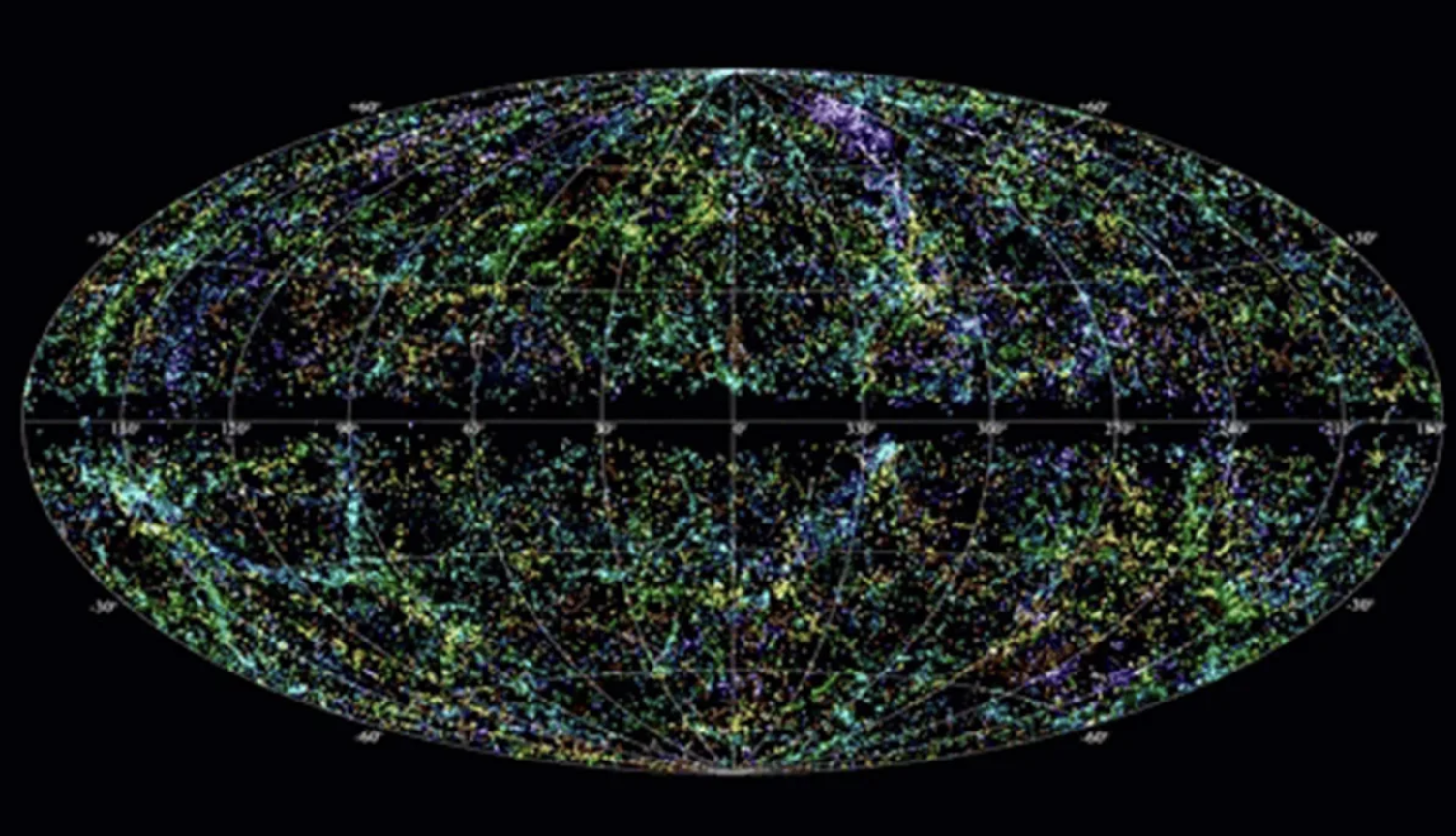
Until the mid-20th century, the dominant view was that the universe had infinite dimensions, had existed eternally, and would continue to exist forever. According to this understanding, called the “Static (stationary) Universe Model,” there was no beginning or end for the universe.
This view, which also formed the basis of materialist philosophy, accepted the universe as a fixed, stationary, and unchanging whole of matter, while rejecting the existence of a Creator. However, the science and technology that developed in the 20th century fundamentally demolished primitive understandings such as the static universe model, which provided a foundation for materialists.
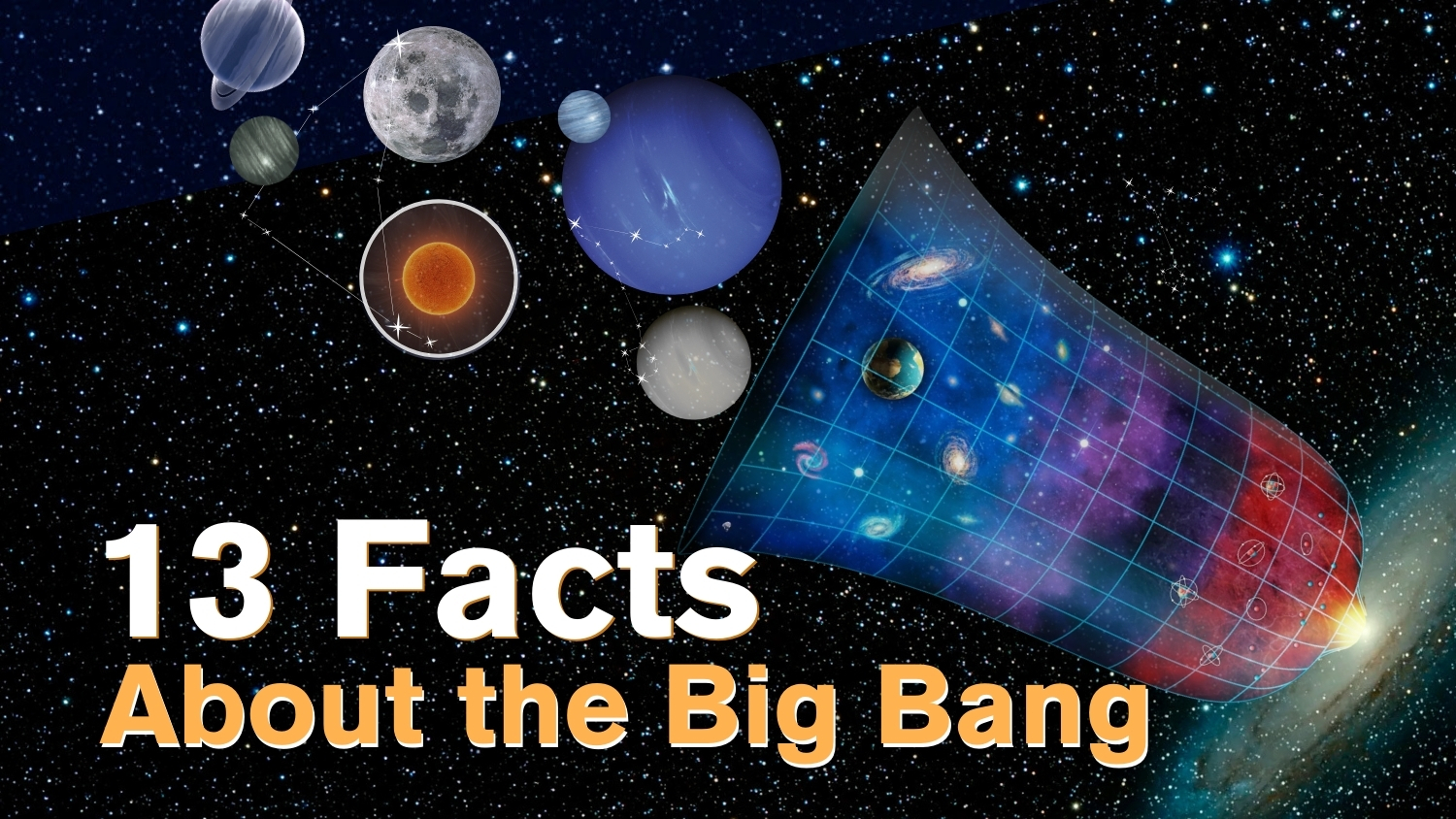
At the present time in the early 21st century, it has been proven by modern physics through many experiments, observations, and calculations that the universe had a beginning and came into existence in an instant, with a great explosion, when previously there was nothing. In addition, it has been determined that the universe is not fixed and stationary as materialists claimed, but on the contrary is in constant motion and change, and is expanding. Today these facts are accepted by the entire scientific world.
In the Holy Qur’an, the emergence of the universe is explained as follows:
“He [God] is the Originator of the heavens and the earth.” (Surat Al-An’am, 101)
This information given in the Qur’an is in complete harmony with the findings of contemporary science. As we stated at the beginning, the ultimate conclusion reached by astrophysics is that the entire universe, together with its matter and time dimensions, came into existence at a moment of zero with a great explosion. The “Great Explosion,” originally called the “Big Bang,” has proven that the entire universe came into existence from nothing approximately 13 billion years ago with the explosion of a single point (Weinberg, 1993).
1. Before the Big Bang, There Was No Such Thing as Matter
Before the Big Bang, there was no such thing as matter. In an environment of non-existence that could be described as completely metaphysical—where neither matter, nor energy, nor even time existed—matter, energy, and time were created in an instant. This great truth, put forward by modern physics in recent history, was reported to us in the Qur’an 1400 years ago (Vilenkin, 1982).
2. The Big Bang Theory Shows That the Universe Had a Beginning
The Big Bang theory maintains that the universe began approximately 13.8 billion years ago from a very dense and hot point (a singularity), expanded, and took its present form. This theory refuted the idea that the universe had existed eternally and showed that the universe had a beginning. The cosmological theorems of Stephen Hawking and Roger Penrose also mathematically demonstrated that the universe must have had a beginning (Hawking, 1988).
3. The Expansion of the Universe Is a Scientifically Observed Fact
In 1929, Edwin Hubble observed that galaxies were moving away from one another and demonstrated that the universe is expanding. This is one of the most important pieces of evidence for the Big Bang (Hubble, 1929). Immediately after the Big Bang, the universe expanded at an enormous speed within a very short period (between 10⁻³⁶ and 10⁻³² seconds). This period, called “cosmic inflation,” explains the homogeneity and flatness of the universe.
The meaning of the expansion of the universe can be better understood with concrete analogies. Suppose space is a one-dimensional elastic string. Objects moving along this space travel forward or backward while the elastic string stretches and lengthens. However, the length of the objects does not change. Similarly, we can imagine two-dimensional space as an elastic plane stretching in every direction. As space expands, the distances between objects increase, but the sizes of the objects do not change (Ocak, 2025).
In the Qur’an, revealed 14 centuries ago at a time when astronomy was not yet developed, it is mentioned as follows:
“As for heaven – We built it with great power and gave it its vast expanse.” (Surat Adh-Dhariyat, 47)
In the above verse, the word “samā’ (heaven/sky)” is used in many places in the Qur’an to mean space and the universe. Indeed, it is used here in this sense as well, and it is stated that the universe is expanding. The Arabic expression “inna la-mūsiʿūn,” translated into Turkish as “gave it its vast expense (We are expanding / We are the Ones who expand),” contains the word “mūsiʿūn,” which is derived from the verb “awsaʿa,” meaning “to expand.” The prefix “la-” adds emphasis to the noun or adjective that follows, conveying the meaning of “vastly.” Therefore, the expression carries the meaning, “We are surely expanding the heaven or the universe vastly.” The conclusion that science has reached today is the same as that conveyed to us in the Qur’an.
Until the beginning of the 20th century, the only prevailing view in the scientific world was that “the universe has a static structure and has existed eternally.” However, research, observations, and calculations carried out through modern technology revealed that the universe has a beginning and is continuously “expanding.”
The Russian physicist Alexander Friedmann and the Belgian cosmologist Georges Lemaître theoretically calculated in the early 20th century that the universe is in constant motion and expanding.
This fact was also confirmed observationally in 1929. The American astronomer Edwin Hubble, while examining the sky with the giant telescope he used, discovered that stars and galaxies are continuously moving away from one another. This discovery is regarded as one of the greatest in the history of astronomy. During these observations, Hubble determined that the light emitted by stars shifted toward the red end of the spectrum in proportion to their distance. According to known laws of physics, the spectrum of light moving toward the point of observation shifts toward violet, while the spectrum of light moving away from the point of observation shifts toward red. In Hubble’s observations, however, a shift toward red was detected in the light of the stars. In short, the stars were continuously receding. Stars and galaxies were moving away not only from us, but also from one another. A universe in which everything continually moves away from everything else is a universe that is continuously “expanding.” The expansion of the universe was confirmed with certainty by further observations in the following years.
This scientific fact was revealed in the Qur’an centuries before it was known by any human being. For the Qur’an is the word of God, the Creator and Sovereign of the entire universe.
4. The Big Bang Has Been Proven by Concrete Evidence
The first piece of evidence for the Big Bang is the expansion of the universe. There are many data indicating that the universe is expanding. One of the most important of these is the results obtained through observations of distant galaxies. The fact that distant celestial bodies in every direction, without exception, are moving away from the Earth and that their distances from the Earth are increasing shows that the universe is expanding and that it began to expand at a certain point in the distant past.
Another piece of evidence for the Big Bang is cosmic background radiation. Also called the cosmic microwave background radiation, this phenomenon—discovered in 1965 by Arno Penzias and Robert Wilson—is one of the strongest pieces of evidence for the Big Bang. The cosmic microwave background (CMB) is the present-day remnant of the heat remaining from the early universe (Penzias & Wilson, 1965).
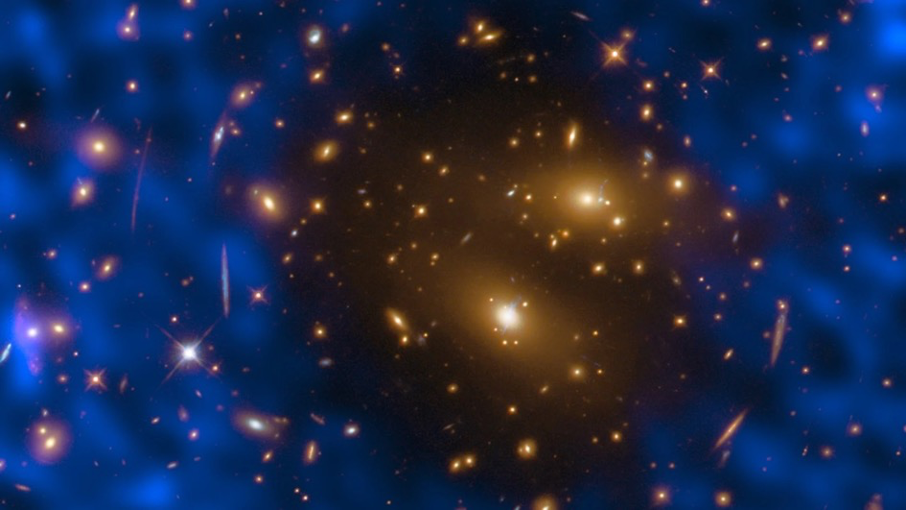
Believe it or not, you have seen the Cosmic Microwave Background with your own eyes. You have probably seen it more than once, because the static signal that you see on analog televisions and hear on radios (also known as “snow”) when tuning between stations is produced due to it (Brinkof, 2023).
The ratio of hydrogen to helium, which is accepted as one of the pieces of evidence for the Big Bang, is a result of the nucleosynthesis process that occurred in the earliest moments of the universe. Under conditions of extremely high temperature and pressure at the beginning of the universe, protons and neutrons combined to form first hydrogen, then helium, and trace amounts of light elements such as lithium. Observations on a cosmic scale indicate that the universe consists of approximately 75% hydrogen and about 25% helium. These proportions are in complete agreement with the values predicted by the Big Bang model (Weinberg, 1993).
5. The Big Bang Surprised Atheist Scientists
The fact that the Big Bang showed the universe had a beginning was an unexpected result for materialist and atheist scientists. The famous atheist astronomer Fred Hoyle mockingly gave this theory the name “Big Bang” (Hoyle, 1949). However, scientific findings supported the fact that the universe had a beginning.
6. Resistance to Viewing the Big Bang as Evidence of Creation
The fact that the universe began with a great explosion and that this clearly points to God’s creation has led some atheist scientists to seek alternative explanations. They claim that the explosion occurred spontaneously, that the universe has expanded and collapsed repeatedly, and then expanded again. Some of them assert that there are many universes like ours, that these universes expand and collapse, and that in this way the eternal existence of matter continues on its own. However, all of these are merely claims that contain no scientific evidence.
7. Before the Big Bang, There Was No Time or Space
Before the Big Bang, there was neither time nor space. Time and space came into existence along with the beginning of the universe. In cosmology, this is referred to as the concept of “timelessness,” and it indicates that the physical laws also emerged at the origin of the universe (Vilenkin, 1982).
8. At the Very First Moment of the Big Bang, All Forces Were Unified (Grand Unification Era)
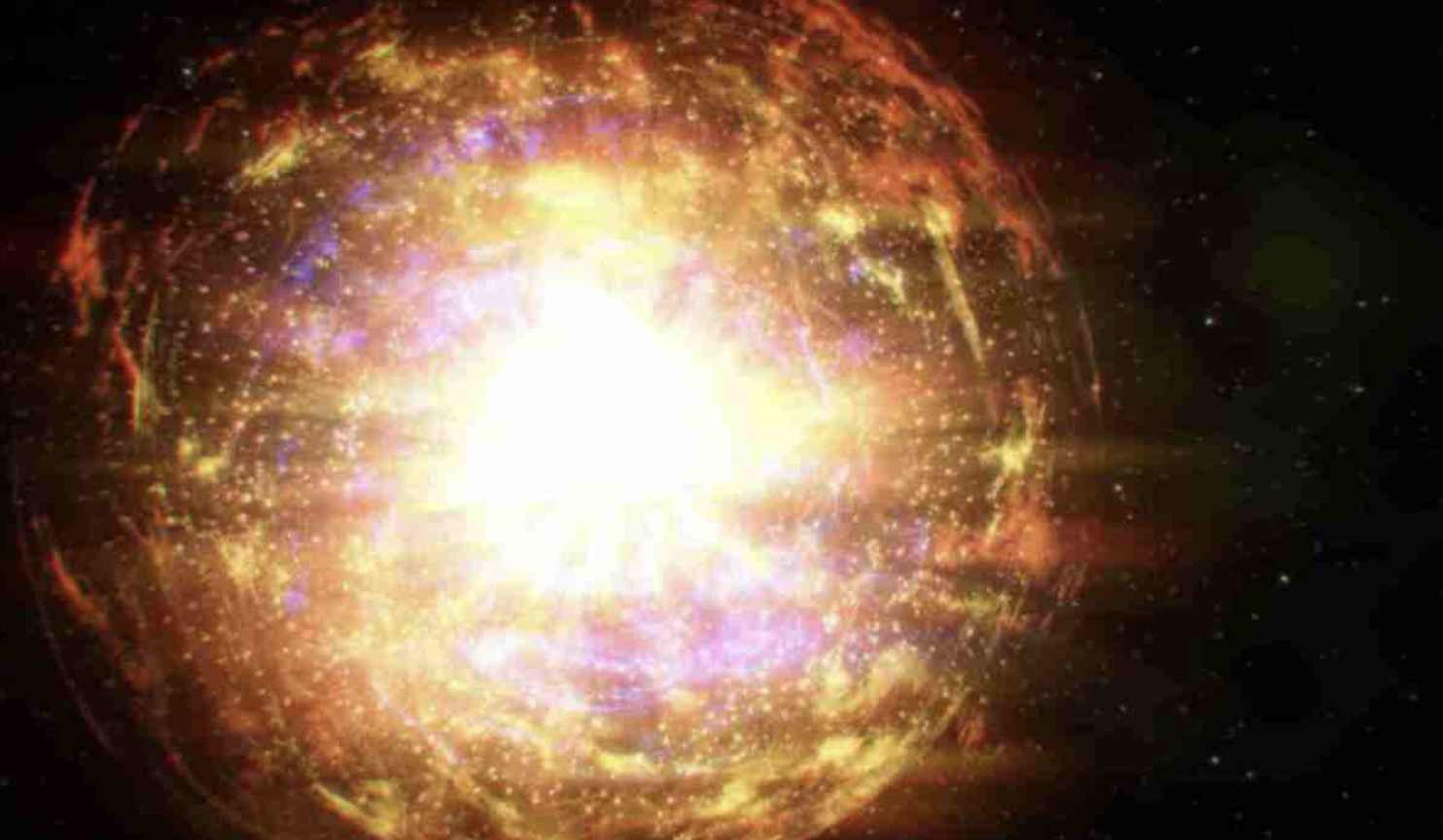
In the first trillionth of a second of the Big Bang (around 10⁻³⁶ seconds), the four fundamental forces of the universe—gravity, electromagnetic, weak nuclear, and strong nuclear—were unified into a single force. This period is called the Grand Unification era. As the universe cooled, these forces separated from one another (Baumann, 2011; Kolb & Turner, 1990).
9. Planck Time: The Moment When the Laws of Physics Break Down
The period from the very beginning of the Big Bang up to 10⁻⁴³ seconds afterward is called the Planck time. During this interval, the known laws of physics do not apply, because quantum gravitational effects dominate and the established physical models are insufficient (Kolb & Turner, 1990; Wald, 1984).
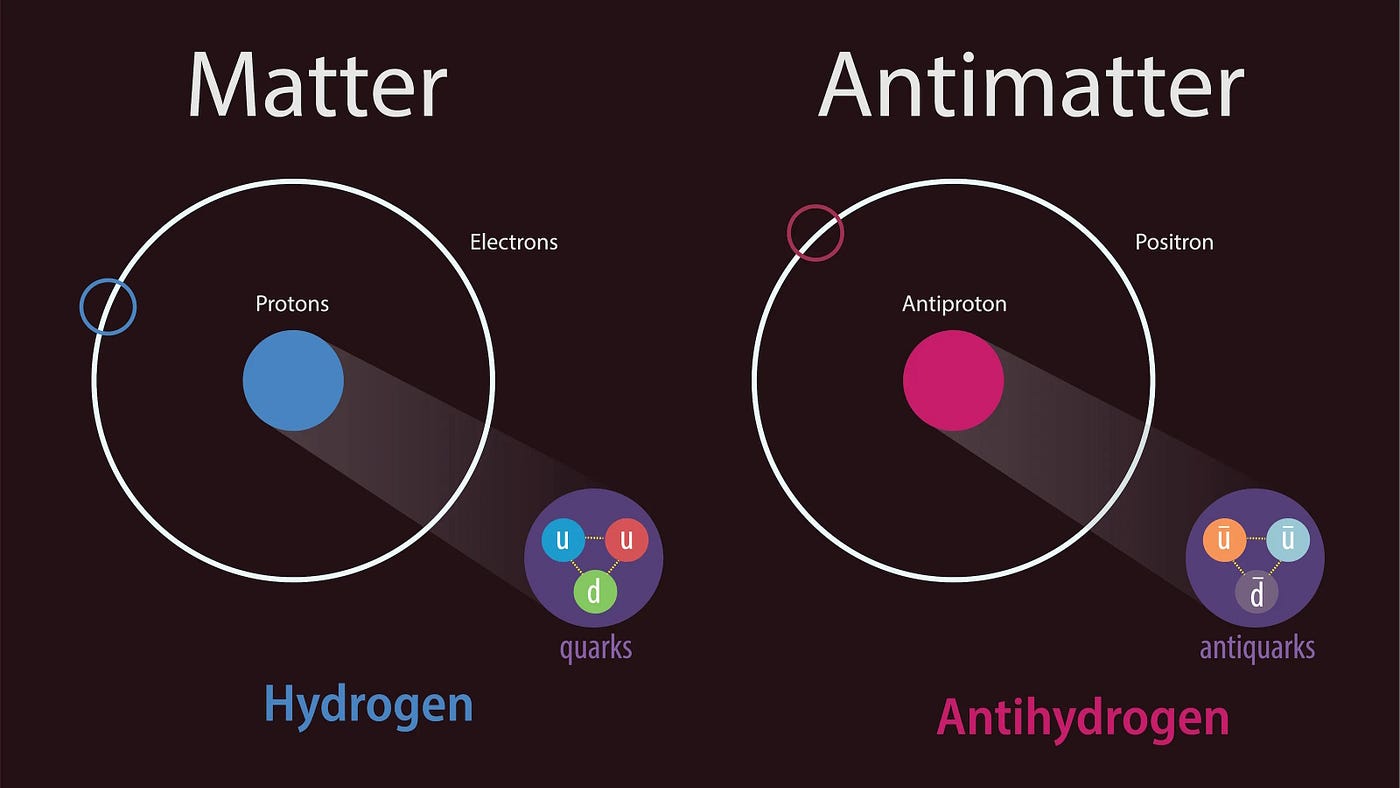
10. Matter and Antimatter Collisions in the Early Universe
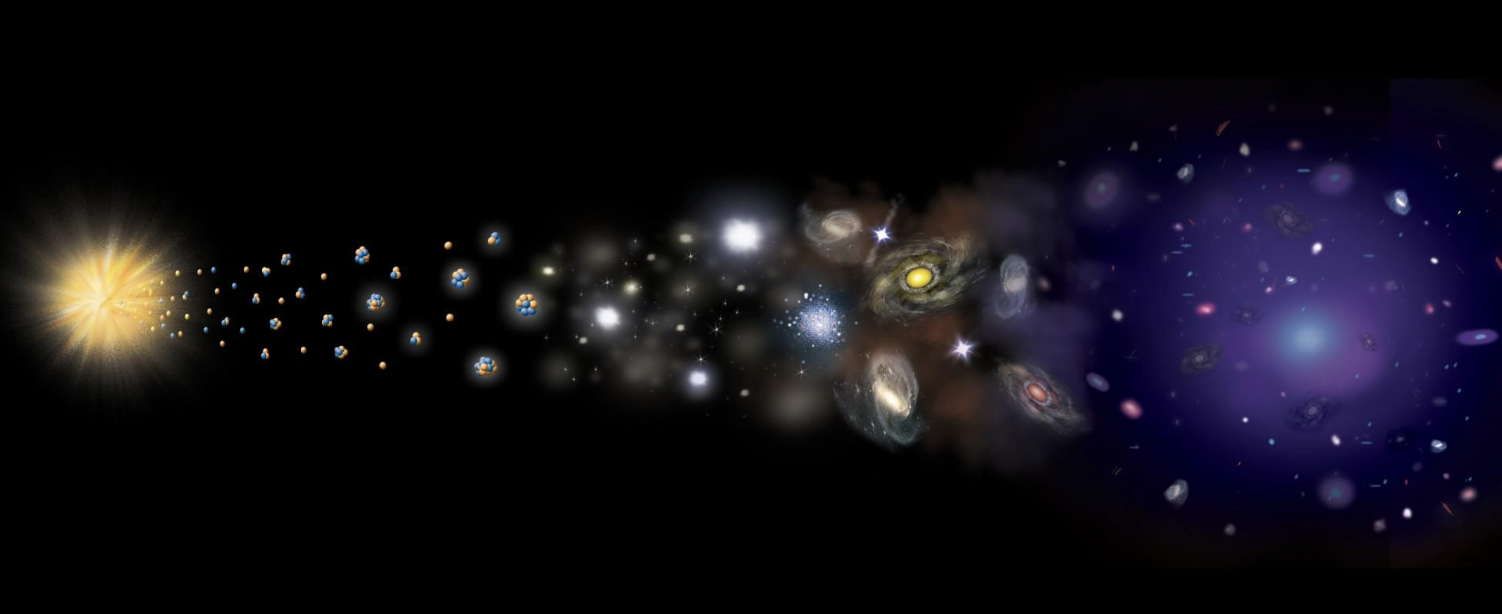
Immediately after the Big Bang, equal amounts of matter and antimatter were created in the universe. However, for an unknown reason, a tiny excess of matter remained, and the universe we observe today consists of this surplus (Kolb & Turner, 1990; Sakharov, 1967).
11. Dark Matter and Dark Energy
Approximately 27% of the universe is composed of dark matter, 68% of dark energy, and only 5% of ordinary matter. The Big Bang model also predicts the existence of these mysterious components (Planck Collaboration, 2018; Peebles, 2020).
12. Formation of the Universe’s Elements: Nucleosynthesis
Within the first three minutes after the Big Bang, light elements such as hydrogen, helium, and small amounts of lithium were formed. This process is called “cosmic nucleosynthesis” (Weinberg, 1993).
13. The Big Bang Produced Temperatures of 1,000 Trillion Degrees Celsius
Although it is almost certain that the Big Bang was the most powerful explosion of all time, fully grasping its approximate magnitude remains difficult. According to Universe Magazine, the force released during the Big Bang was equivalent to 10⁵⁴ megatons of TNT. To put this in perspective, the most destructive weapons humans can produce, hydrogen bombs, release about 50 megatons. The Big Bang also occurred extremely rapidly—so rapidly that energy was propelled at the speed of light, 300 million meters per second, a million times faster than hydrogen bombs. All this incredible speed and power generated an equally incredible amount of heat. Within less than a second after the explosion, temperatures are estimated to have risen to 1,000 trillion degrees Celsius (Brinkof, 2023).
Conclusion: The Heavens and the Earth, Were Separated When They Were Adjacent
Another verse in the Qur’an that provides information about the creation of the heavens is as follows:
“Do the unbelievers not see that the heavens and Earth were sewn together and then We unstitched them, and that We made from water every living thing? So will they not believe?” (Surat Al-Anbiya, 30)
The Arabic word “ratq” translated as “sewn together” in the verse means joined, fused, inseparable. In other words, this word is used to describe two substances that form a complete whole. The word translated as “unstitched” in the verse is the Arabic verb “fatq” which means to split or tear apart an object that is in a joined state so that it emerges. For example, in Arabic, the sprouting of a seed emerging from the soil is expressed using this verb.
Now let us look at the verse again. The verse refers to a state in which the heavens and the Earth were joined together, that is, in a “ratq” condition. Then these two are separated by the verb “fatq.” In other words, one emerges by splitting from the other.
Indeed, when we consider the very first moment of the Big Bang, we see that all the matter of the universe was concentrated at a single point. In other words, everything—even the “heavens and the Earth,” which had not yet been created—was inside this point, intertwined and inseparable. Then this point was unstitched and split by a violent explosion.
Nothing occurred uncontrollably or unconsciously. Everything was created by God dependent on perfect and flawless proportions and extraordinarily precise balances. To emerge suddenly from zero volume means to be created from nothing. The Big Bang is a clear proof of creation and of God’s existence. It is God, the Most High, Possessor of Majesty and Generosity, Who created a flawless work of art and a sublime miracle by ordaining a single explosion as the means.
REFERENCES
- Baumann, D. (2011). TASI Lectures on Inflation. In C. Csaki & S. Dodelson (Eds.), The Physics of the Early Universe (pp. 523–686). World Scientific. https://arxiv.org/abs/0907.5424
- Brinkof, T. (2023, September). 8 Mind-Blowing Facts About the Big Bang. MENTAL FLOSS. https://www.mentalfloss.com/science/space/big-bang-facts
- Hawking, S. W. (1988). A Brief History of Time. Bantam Books.
- Hoyle, F. (1949). The steady-state theory of the expanding universe. Monthly Notices of the Royal Astronomical Society, 109, 365–382.
- Hubble, E. (1929). A relation between distance and radial velocity among extra-galactic nebulae. Proceedings of the National Academy of Sciences, 15(3), 168–173.
- Kolb, E. W., & Turner, M. S. (1990). The Early Universe. Addison-Wesley.
- Ocak, M. E. (2025). What Does the Expansion of the Universe Mean? TÜBİTAK Genç. https://bilimgenc.tubitak.gov.tr/makale/evrenin-genislemesi-ne-anlama-geliyor
- Penzias, A. A., & Wilson, R. W. (1965). A measurement of excess antenna temperature at 4080 Mc/s. The Astrophysical Journal, 142, 419–421.
- Planck Collaboration. (2018). Planck 2018 results. VI. Cosmological parameters. Astronomy & Astrophysics, 641, A6. https://doi.org/10.1051/0004-6361/201833910
- Sakharov, A. D. (1967). Violation of CP Invariance, C Asymmetry, and Baryon Asymmetry of the Universe. JETP Letters, 5, 24–27.
- Vilenkin, A. (1982). Creation of universes from nothing. Physical Review D, 27(12), 2848–2855.
- Weinberg, S. (1993). The First Three Minutes: A Modern View of the Origin of the Universe (Updated ed.). Basic Books.