Sometimes, the true importance of certain things that have been given to us in this world is not fully understood. Soil is always present in our lives; day and night are constantly experienced; rain falls; the air temperature changes according to the seasons; the oxygen level is suitable for the existence of living beings, and so on. When a person who has become accustomed to these things, normalized them, failed to see the perfection in the details, or at times viewed them with prejudice changes his way of thinking, his perspective also changes. When examined carefully, the structures in the universe show us the existence of an order far beyond the human mind. A person who realizes this begins to see wonders, and a dimension of admiration opens before him. This admiration, in turn, leads us to think more deeply and to properly appreciate the details in God's creation.
In verse 164 of Surat al-Baqara, God reveals as follows:
"In the creation of the heavens and earth, and the alternation of the night and day, and the ships which sail the seas to people’s benefit, and the water which God sends down from the sky – by which He brings the earth to life when it was dead and scatters about in it creatures of every kind – and the varying direction of the winds, and the clouds subservient between heaven and earth, there are Signs for people who use their intellect." (Surat al-Baqara, 164)
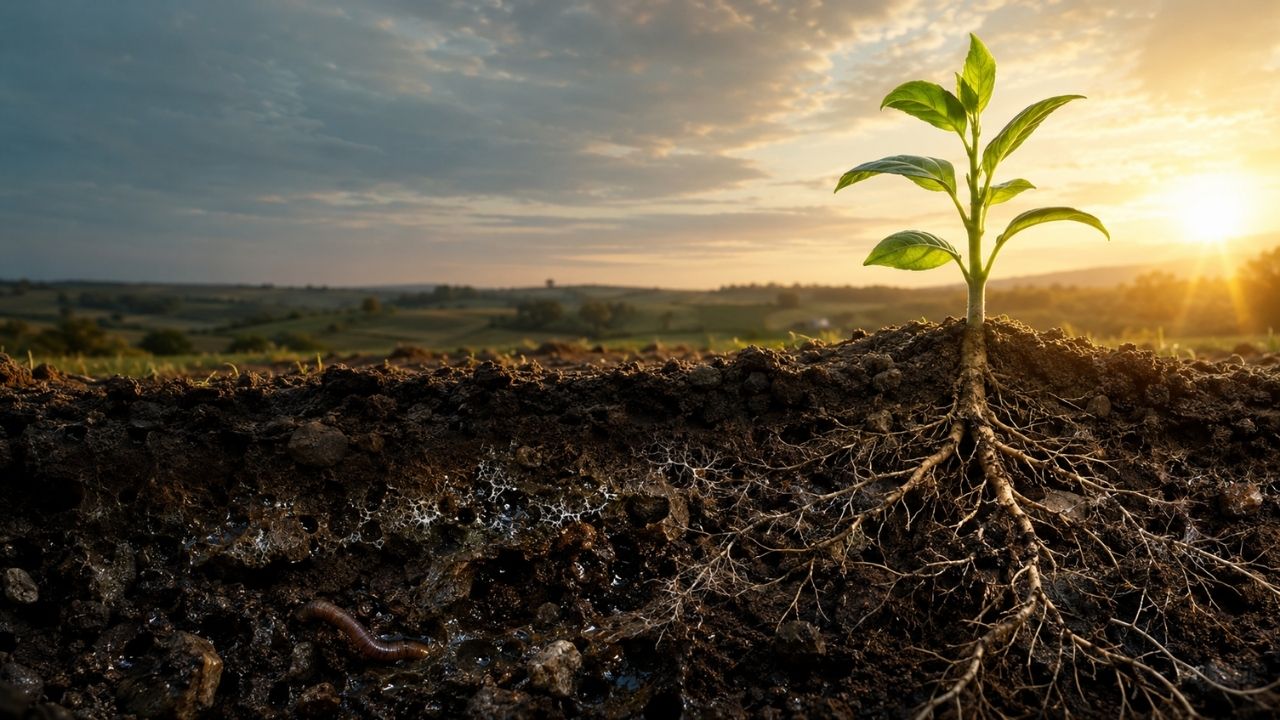
The subject of this article is once again a substance that appears very familiar and is regarded as ordinary. Soil, the basis of agriculture…
Contrary to what is commonly known, soil is a living ecosystem with a complex structure. It may be full of inanimate minerals, but at the same time it also shelters billions of living things such as fungi, bacteria, worms and insects.
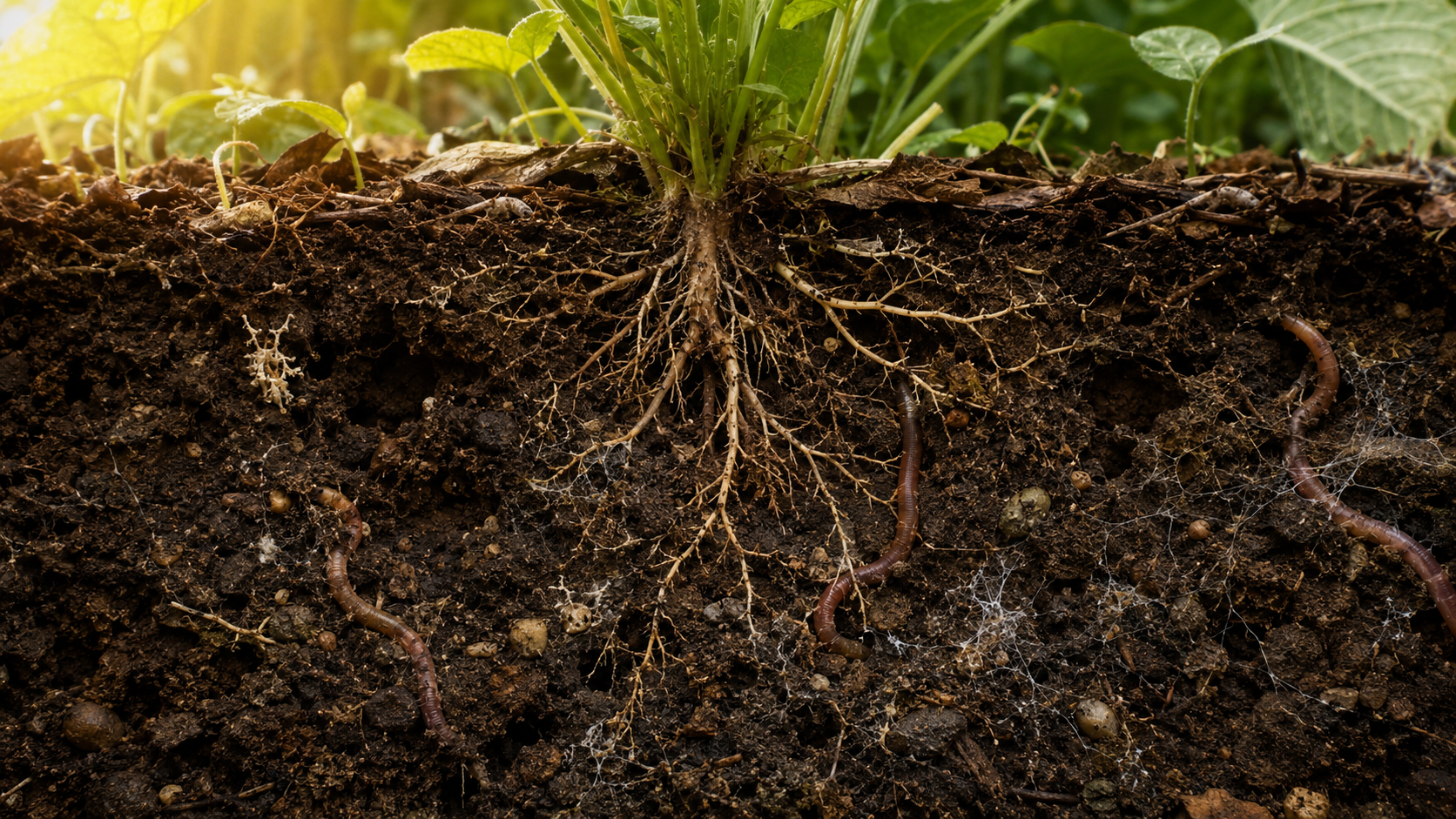
Physical properties such as the dimensions, arrangement and state of bonding of the organic and inorganic substances that constitute the solid part of soil, as well as its temperature, color, air and water, possess a balance created by Almighty God. A small change in the delicate balances that make up the structure of soil would mean that soil would lose its properties that are of vital importance for living things. We may list these physical properties as follows.
The Physical Structure of Soil and the Storage of Air, Water and Nutrients
The solid portion of the soil consists of sand, clay, and silt (which has particles finer than sand but coarser than clay and is formed by the transportation of sediments by rivers). The amounts of these materials, which exist in various sizes, and their proportions relative to one another possess a measure determined by Almighty God. Each of these substances has its own unique function.
Indeed, sand serves as the structural framework within the soil. By increasing the pore volume of the soil, it enables the movement of air and water. As is well known, the water and air (especially O₂) present within the soil are of great importance for the growth of plants. We can summarize the importance of air in the soil under three main headings:
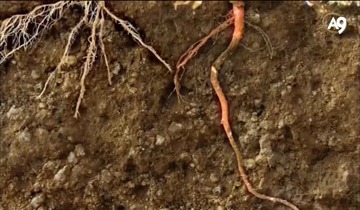
Air in the soil is the greatest factor in the formation of an extensive root system.
There must be sufficient air in the soil for the respiration of the root system. Otherwise, it becomes difficult for the roots to absorb water and nutrients.
- Air affects the activity of soil microorganisms. Under good aeration conditions, microorganism activity increases and has a positive effect on soil fertility (1).
Silt, on the other hand, accelerates decomposition in the soil and plays a more favorable role than sand in the transportation of dissolved nutrients necessary for the growth of plants. It also has an important function in retaining water in the upper parts of the soil against gravity. In other words, it supplies the water that plants will use and ensures that this water is retained in the soil. Besides the growth of plants, water is exceedingly important for the continuation of biological activities in the soil and for various forms of decomposition, particularly ion exchange. In soils that have lost their moisture, the processes mentioned above cease entirely (2). Silt also protects the soil against frost.
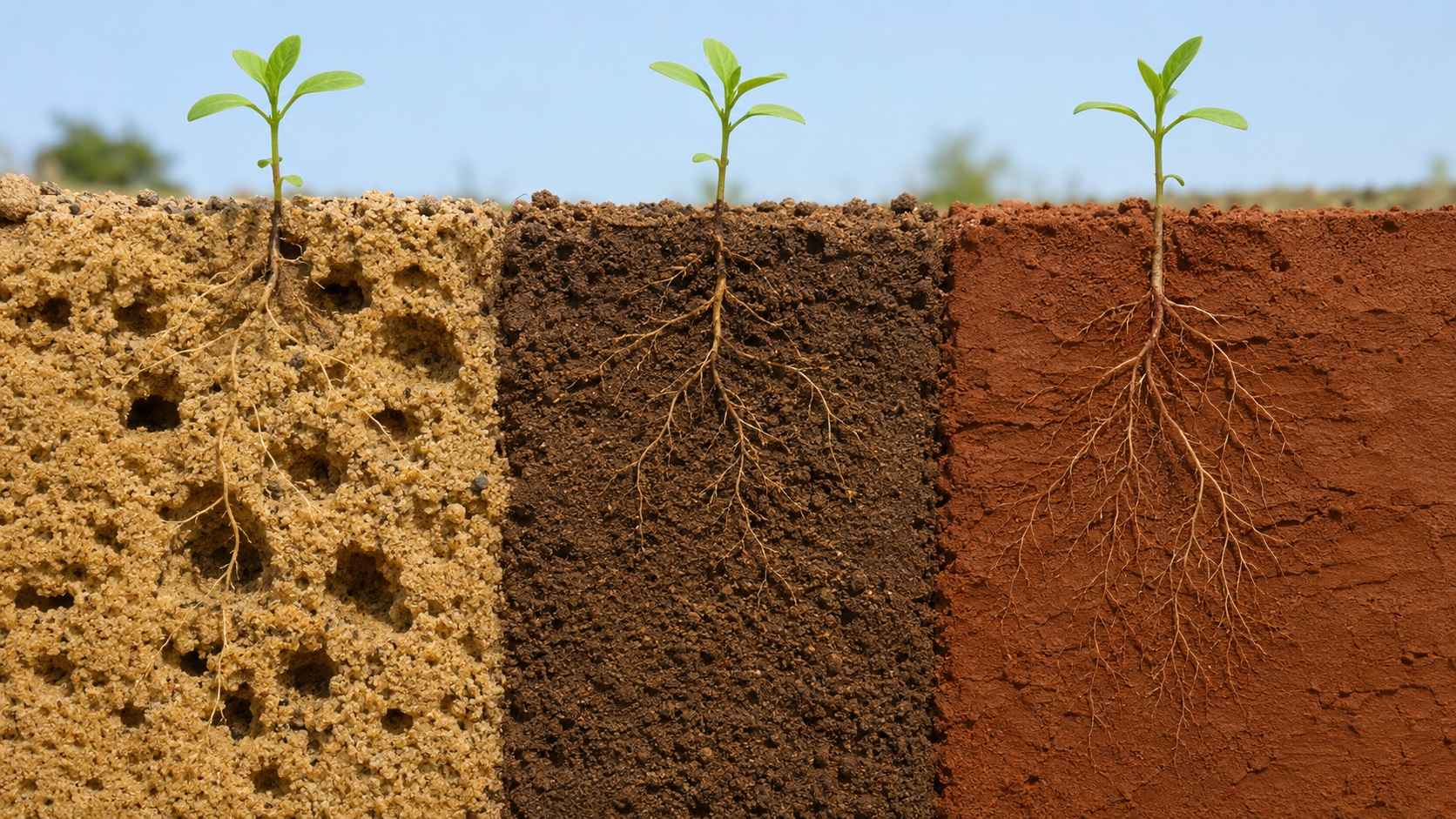
Clays, however, have much finer grains than silt and sand and, by virtue of this property, are like a reservoir that enables both nutrients and water to be stored.
As can be seen, these three elements found in the structure of soil are very important in terms of the nourishment and growth of plants. If soil did not possess the properties mentioned above, it would become infertile and would not be suitable for the growth of plants. The failure of plants to grow would prevent the formation of many elements necessary for our lives, particularly the air we breathe and the foods we eat. Almighty God states in the following verse that, if He willed, He could turn the earth into barren and infertile soil:
“We will certainly make everything on it a barren wasteland.” (Surat al-Kahf, 8)
Soil Temperature Is of Great Importance for Life
The warming of soil depends on the retention and reflection of energy coming from the Sun. Dark-colored soils retain 80% of the incoming energy, while light-colored quartz sands retain 30%. The part of the incoming solar energy retained in the soil is expended in the evaporation of water, the heating of the soil and the air above it, and its return to the atmosphere in the form of long-wave radiation (3). Soil temperature is important for the growth of plants, the activity of microorganisms in the soil, the decomposition and mineralization of organic matter and the continuation of chemical processes in the soil.
The Color of Soil Plays an Important Role in Its Fertility
Soils are identified and classified by means of their colors. There is a close relationship between the climatic regions and soil types in the world. Red-colored soil predominates in hot and humid equatorial regions, light-colored soil in arid regions and dark-colored soil in rainy temperate zones. These soil types, which vary according to climatic regions, allow suitable plant communities to develop on them. Indeed, tropical forests possessing a very delicate balance form on the red soil of the humid tropical region, while steppe and desert plants form in arid hot regions.
All the examples that can be given reveal the diversity and artistry in creation as a manifestation of Almighty God’s title of As-Sani’ (the Artist, Who creates endless beauties within His artistry). However, the diversity of soil colors is not limited solely to climatic regions. Soils of different colors may be encountered within the same climatic region. There are two reasons for this.
The first is that when soil initially forms, it resembles the color of the decomposed parent rock. Soil formed through the decomposition of dark-colored heavy rocks (gabbro, basalt) is dark-colored, while soil formed through the decomposition of rocks such as limestone and quartzite is light-colored. As decomposition and oxidation progress and organic matter becomes mixed into the soil, these colors begin to darken.
Another reason why soil acquires different color properties is the mineral substances it contains. These minerals are manganese and iron compounds, as well as organic matter. Of these, iron compounds give soil a bluish, greenish, yellow or red color. Bluish, greenish and yellow colors indicate soils in which drainage and aeration are not good; in other words, these soils are not very suitable for plant growth. In contrast, red-colored soil indicates that drainage and aeration conditions are good (drainage is the removal of excess water in the soil that is harmful to plants).
Organic matter and manganese compounds, however, are black. As the amount of organic matter increases, the color of the soil darkens and its fertility increases. Almighty God commands as follows in one verse:
“Do you not see that God sends down water from the sky and by it We bring forth fruits of varying colors? And in the mountains there are streaks of white and red, of varying shades, and rocks of deep jet black.” (Surah Fatir, 27)
Soils of different colors reveal not only Almighty God’s artistry of diversity, but also which mineral substances the soil possesses. Thus, through the experience they acquire over time, people can form an idea as to which soil is more fertile by looking at its color and can determine, without wasting time, the plant species that will grow on it. In this way, obtaining a greater yield from the soil in a shorter period is a manifestation of Almighty God’s title of Ar-Razzaq (the Provider, Who bestows blessings for the benefit of people).
Soil Water Possesses Exceedingly Delicate Balances
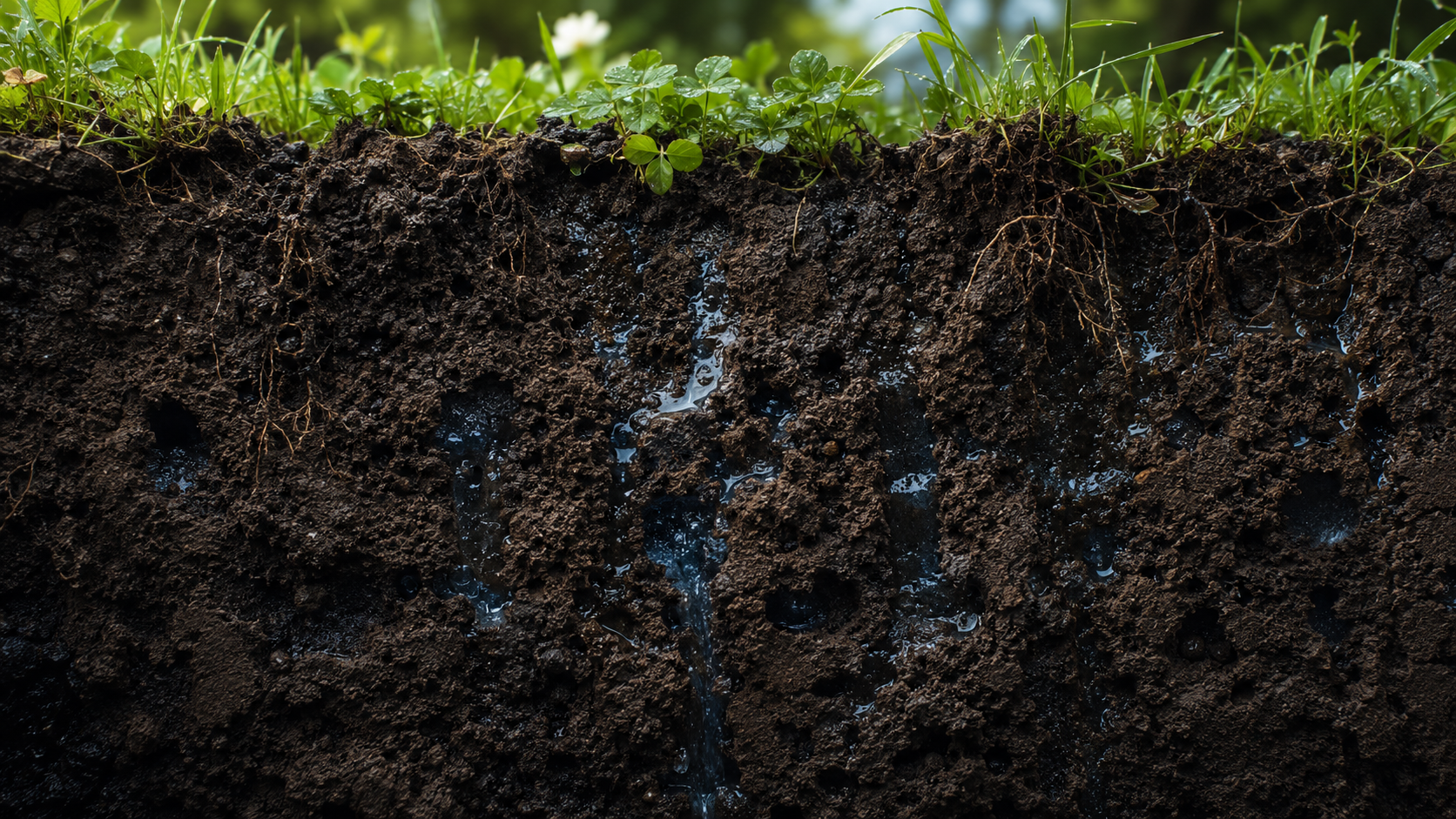
The water found in soil is divided into three groups. Of these, gravitational water is the water that has become completely saturated and leaves the soil by seeping through the spaces under the effect of gravity. In this way, water is prevented from filling all the spaces in the soil and turning it into a swamp.
Capillary water, on the other hand, is what remains after the excess water has drained away under the effect of gravity. This water, which remains in the soil despite gravity, is retained in pores smaller than 30 microns. “Available water” as it is also known, is used by plants. If this water did not exist, it would not be possible for soil to retain the moisture necessary for plants to grow.
The water that is held under high pressure by soil particles is called hygroscopic water. This water, which covers the inner and outer surfaces of soil particles in the form of a thin layer, has lost its liquid state and its property of fluidity. For this reason, it cannot be absorbed by plants. If all of the water in the soil were in this form, then even though the soil contained moisture, we would have to irrigate it continuously in order for plants to sustain their lives.
If the measure of water in the soil had not been determined by Almighty God, it would not be possible for us to regulate the amount of water we supplied from outside. Perhaps all of it would be retained under high pressure or would reach saturation in a short time and turn into a swamp. In addition, as rain seeps into the soil, the air inside the pores is expelled, yet as this wave of water descends, it also carries fresh air with it into the depths of the soil, thus enabling clean air to reach even the lower layers. If water did not move in accordance with the force of gravity and most of it were retained under high pressure, the aeration of the deeper parts of the soil would not be possible. This would mean the prevention of biological activities and the healthy growth of plants.
Soil Air Is of Great Importance for Biological Activities in the Soil
Soil air fills the pores remaining after gravitational water has drained away. In other words, it is the area outside the capillary water. The noteworthy point here is that some of the water must leave this area in order for soil air to form. Indeed, this occurs at precisely the required time and in the proportion needed by the soil. Of course, this situation cannot be explained by coincidences. Soil, which possesses no intelligence or consciousness, cannot know how much air and water it needs or the amount of water it must drain away in order to regulate that quantity. Moreover, it could never think that by doing so it would meet the needs of plants and animals living in the soil. There is no doubt that all these things can be explained by Almighty God’s keeping “the heavens and the earth under His dominion.”
“God keeps a firm hold on the heavens and earth, preventing them from vanishing away. And if they vanished no one could then keep hold of them. Certainly He is Most Forbearing, Ever-Forgiving.” (Surah Fatir, 41)
Microorganisms and plants living in the soil consume oxygen during respiration. For this reason, the oxygen level in the soil is slightly lower than that in the atmosphere, while the carbon dioxide level is slightly higher.
Gases Soil Air (%) Atmospheric Air (%)
Nitrogen 79.20 79.00
Oxygen 20.60 20.90
Carbon Dioxide 0.25 0.03
Source: Mater, 1986
Since the portions of the soil close to the surface are in close contact with the atmosphere, there is a continuous exchange of air between them. As the CO₂-rich gas leaves the soil, O₂ enters in its place. In this way, the organisms in the soil continue their activities, and the roots of plants obtain the O₂ they need. The CO₂ released from the soil is also utilized by plants that carry out photosynthesis. This phenomenon, called soil respiration, has by no means been created "without purpose"; rather, it has been established upon a delicate balance. Furthermore, the fact that the proportions of gases in the atmosphere and those in the soil are remarkably similar is clear evidence that they were planned by a single Source. Our Lord once again shows us His supreme wisdom.
If the soil were not aerated in the manner described above, the activities of aerobic bacteria that produce nitrates, that is, fix nitrogen, and of the animals living within the soil would cease. This would result in the increased activity of anaerobic microorganisms, leading to the production of greater amounts of carbon dioxide, methane gas, and organic acids such as lactic, butyric, and citric acids, as well as the formation of toxic substances such as H₂S, sulfides, Fe, and Mn (4). Due to the deficiency of O₂, plant roots would be unable to grow; consequently, the absorption of water and nutrients would become impossible, the growth of plants would decrease or cease altogether, plant species that are less sensitive than cultivated crops would spread over vast areas, and we would be faced with a serious famine.
Organic Matter Gives Soil Its Soil Properties
Organic matter consisting of plant and animal waste changes the physical and chemical structure of soil, giving it genuine “soil properties.” Aerobic organisms decompose the organic matter in this waste through various biochemical processes. In this way, organic waste begins to decay and forms humus, the most important nutrient in soil. Besides being a nutrient, humus has the property of absorbing rainfall. In this way, surface runoff is largely prevented and erosion is obstructed.
When the physical properties of soil are examined, it can clearly be seen that each element, such as structure, temperature, color and the balance of water and air, has been brought into existence according to exceedingly delicate measures. Even a small change in any one of these properties would produce consequences that would make the growth of plants, and therefore the continuation of living things, impossible. The water-retention capacity, aeration balance, mineral structure and organic matter cycle of soil are of vital importance not only in terms of biological processes, but also in terms of ecological continuity.
This flawless order is a clear cause for reflection for a person who possesses reason and conscience. It is evident that unconscious atoms and mindless processes could not form such a balanced and purposeful system by themselves. The fact that Earth possesses the only soil structure in the Solar System suitable for life is an indication of its miraculous nature. All these details are very important in revealing the existence of God, Who creates all things with superior knowledge and power, and the perfection in His creation.









.jpg)