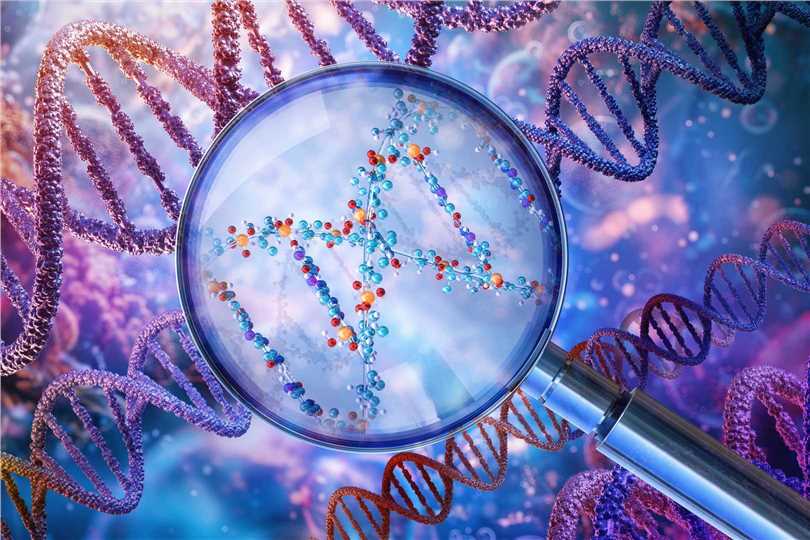
DNA is a very large molecule that is meticulously protected within the nucleus of cells. All structural characteristics of living beings are stored in this information bank called “DNA.”
It is such an information bank that everything from the scent of a rose to the feathers of a peacock, from the sonar system of dolphins to the honey production of bees, is encoded in DNA.
Scientific research has shown that DNA:
- possesses a perfect order and a structure that cannot be reduced to simplicity,
- contains an extraordinary information capacity,
- stores information with a level of precision that humans cannot even imagine, and
- transfers information to future generations exactly as it should be.
The order and information storage capacity created within DNA, which exists inside cells invisible to the naked eye, cannot be produced with today’s technology. This situation is one of the most important evidences that living beings have been created by God, Who possesses superior power and knowledge.
At the time when Darwin proposed his theory, not only DNA but even the fundamental structure of the cell was unknown. During that period, it was not possible to foresee the stages that would later be reached in the field of molecular biology. The interior of the cell had not yet been observed. Even the helical structure of DNA was discovered nearly 100 years after the publication of Darwin’s book Origin of Species.
In this respect, the structure of DNA, which has left scientists in admiration, was not even known by a theory that was fundamentally invalid, based on information and assumptions, and built upon imagination. The discovery of the structure of DNA, in fact, opened a new chapter in the scientific world. Likewise, world-renowned scientists from many countries, from the United States to China, have been studying human DNA for years; however, they still have not been able to fully unravel the mystery of DNA.
With its astonishing structure and characteristics, it is IMPOSSIBLE for such a molecule to have formed as a result of coincidences, as evolutionists claim. IF DARWIN HAD KNOWN ABOUT DNA, IT IS CLEAR THAT HE COULD NOT HAVE PUT FORWARD SUCH A DECEPTION AS THE THEORY OF EVOLUTION.
EVIDENCES OF THE EXISTENCE OF GOD IN THE STRUCTURE OF DNA AND CHROMOSOMES
DNA exists in all living beings — humans, flowers, birds, flies, and even bacteria. DNA is a molecule that contains all the necessary information regarding the characteristics and proper functioning of a living cell.
In other words, the comprehensive plans and designs that determine how every living organism will be constructed and how it will function are encoded within the information contained in DNA.
The important point that should be emphasized here is the understanding that living beings have existed together with the perfect order and information in their DNA from the very first moment they were created. Because the structure of DNA is planned, ordered, and complex to a degree that cannot be explained by coincidences.
A person who learns the details of the extraordinary structure of DNA will understand more deeply the infinite greatness of God, the Lord of the worlds, the uniqueness and vastness of His knowledge, and His dominion over His creations.
THE INFORMATION WITHIN DNA
- The organic information storage unit found within cells is called DNA.
- DNA contains all kinds of details regarding a person’s height, eye color, and body structure, as well as information about how the body will respond to various dangers, and how the cell will produce proteins, which are the building blocks of the body.
- A single DNA molecule in a human being contains an amount of information equivalent to filling exactly 1 MILLION encyclopedia pages, or in other words, approximately 1,000 books.
- Within a molecule located in a nucleus much smaller than the microscopic cell itself, there exists an information storage system that is 40 times larger than the world’s largest encyclopedia, containing millions of pieces of information.
- If, every day, 24 hours a day, without interruption, one of the human genetic codes were read every second, it would take 100 years for this process to be completed.
- If we assume that the information in DNA were turned into books and these books were stacked on top of one another, the height of the books would reach 70 meters.
- If we were to write down the information contained in a single DNA molecule on paper, the length of the papers would extend from the North Pole to the Equator.
- The information storage system mentioned here is not a computer or a library; it is merely a molecule consisting of phosphate, sugar, and nitrogenous bases, fitting into an area that is one hundred thousand times smaller than a millimeter.
THE ALPHABET OF DNA
- In every cell of our body, an astonishing information treasure written in a language that no one in the world speaks is stored.
- The alphabet of this language consists of 4 letters.
- Each “letter” that forms the coding is actually a nucleotide molecule with specific chemical properties and a three-dimensional structure.
- Nucleotide molecules consist of phosphate, sugar, and organic bases.
- Nucleotides are named Adenine, Guanine, Cytosine, and Thymine according to the type of organic base they contain.
- Organic bases are divided into two groups due to the differences in their chemical structures. Adenine and Guanine are called PURINES, while Cytosine and Thymine are called PYRIMIDINES. This structural difference is important in the formation of the overall shape of DNA.
- There is a total of 3 billion letters in human DNA.
- The words and sentences of the DNA alphabet are also unique to itself.
- For example, the words of the DNA language emerge by reading the letters A, T, G, and C in groups of three, and these words are called “CODONS.”
- When hundreds of codes in DNA come together, long and meaningful sentences emerge. These sentences are called “GENES.”
- Each amino acid involved in protein production has a CODE consisting of 3 letters on the DNA.
- Each sentence (that is, each gene) consisting of numerous codes contains SPECIAL PLANS that describe how a protein needed by the living organism will be produced.
- Each gene is composed of the special arrangement of letters (nucleotides), the number of which varies between 1,000 and 186,000, according to the type of protein it corresponds to.
- Approximately 30,000 genes are found in human DNA.
- These genes store the codes of approximately 100,000 proteins that perform functions in the human body and regulate their production.
- The information contained in these 30,000 genes constitutes only 3% of the total information in DNA. The remaining 97% is still unknown today.
- This enormous work, written in coded form, possesses information about the entire body of a person even when the human being is still only a single cell.
- In other words, even before a human being is formed, the comprehensive plan of the body is already prepared ON A SINGLE MOLECULE.
- The arrangement of letters in the DNA of every human being is different. This is the reason why all of the billions of people who have lived on Earth up to now are different from one another.
The basic structures and functions of organs are the same in every human being. However, every person is created with such subtle differences and such detailed and unique characteristics that, although all people possess the same basic structure, billions of different human appearances emerge.
THE SHAPE OF DNA
- The shape of the DNA molecule has an architectural order that astonishes scientists.
- The 3 BILLION LETTERS that form the information are arranged in a specific sequence, creating a thin strand.
- The length of the single strand containing 3 billion letters is 1 METER.
- Opposite this arranged strand, a second strand is formed, containing the same information but arranged in reverse order. The length of the second strand is also 1 METER.
- These two strands, consisting of a total of 6 BILLION letters, wrap around each other.
- By combining with perfect proportions and calculations, they form a spiral-shaped ladder structure.
- One of the most important features that enables the formation of this ladder is, as explained above, the chemical structures of the letters that make up DNA.
- The parts of the letters containing SUGAR AND PHOSPHATE form the supporting points of the ladder, while the middle steps are formed by the parts of the letters consisting of ORGANIC BASES. In short, the variable parts of the letters are INSIDE.
- Since the steps of the ladder are formed by letters arranged opposite each other, it can be compared not so much to a classical ladder, but rather to a ZIPPER THAT OPENS WHEN NEEDED.
- The arrangement of the letters forming the steps is in a special order. Only two types of pairings are possible: Adenine (A) always binds with Thymine (T), and Cytosine (C) always binds with Guanine (G).
- When the steps consisting of letters pair with each other, HYDROGEN BONDS are formed between them. Two hydrogen bonds are formed between Adenine and Thymine, while three hydrogen bonds are formed between Guanine and Cytosine.
- The formation of hydrogen bonds within this structure is a very great wonder. Because the hydrogen bond is the ONLY TYPE OF BOND that is strong enough to hold the DNA molecule together, yet weak enough to allow the letters to open like a zipper when necessary.
- Furthermore, one of the most important reasons that provides the helical shape of DNA is the presence of HYDROGEN BONDS.
- If hydrogen bonds had not been formed between the letters, DNA would have had a completely different structure.
- The presence of sugar and phosphate molecules in the structure of DNA is also NOT A COINCIDENCE.
- The bond between phosphate and sugar molecules is a PHOSPHODIESTER BOND, and it is one of the strongest bonds in nature. It does not open or change unless DNA is broken down. Thus, the sugar-phosphate backbone present in the strands of DNA is always PRESERVED.
- In addition to the extraordinary function of the DNA molecule and the perfection in its structure, ITS APPEARANCE ALSO RESEMBLES A WORK OF ART.
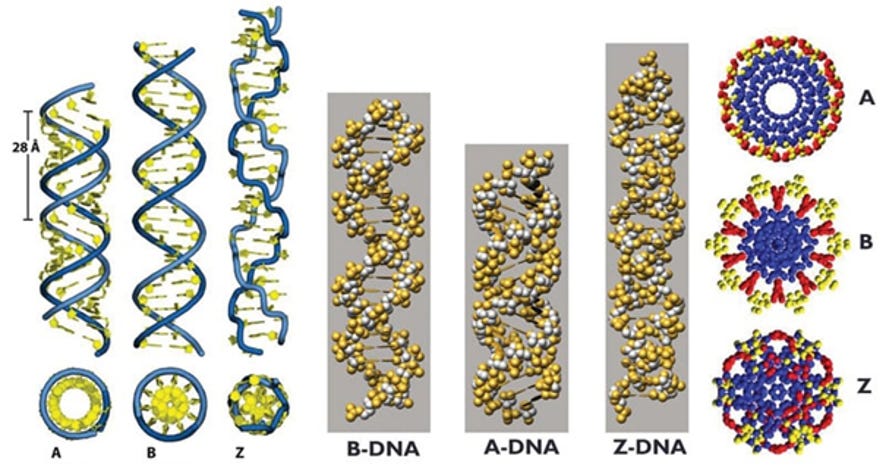
- Due to the way the sugar-phosphate backbone is connected, DNA makes turns in a right-handed or left-handed helical direction. The phosphodiester bond facilitates the right-handed turn, and the normal form of DNA is in the right-handed helical direction. This is called B-DNA.
- The strands of DNA are so thin that the distances between the letters and the structure of the resulting shape can only be expressed using the unit “ångström,” which is one hundred millionth of a centimeter (10⁻¹⁰ m).
- The distance between two steps of DNA is 3.4 ångströms, the diameter of the helical structure is 20 ångströms, and one complete turn containing 10 steps is 34 ångströms.
- These turns are not only for an aesthetic appearance and order. As a result of one complete turn, repeating regions called the MAJOR GROOVE (22 ångströms) and the MINOR GROOVE (12 ångströms) emerge. These regions provide the proteins that will read the code on DNA with the ability to attach and identify the correct location.
- It has been discovered that under difficult conditions such as environments with very high salt concentrations or a lack of water, the geometry of DNA changes and it transitions into a more compact form. This is called A-DNA.
- Even under extremely harsh conditions, DNA has been created in such a way that it preserves its structure. The A form of DNA is flatter and wider compared to the B form. Although its diameter has increased and the spaces between the steps have expanded, it does not become disrupted.
- The form of DNA in which it turns to the left instead of the right is called Z-DNA. Although its function is not fully known, this structure is thought to form during DNA replication. In Z-DNA, the lengths of the major and minor grooves are equal. The direction of the helix has changed, its diameter has narrowed, and each complete turn contains 12 steps.
In the image below, the magnificent artistry of the different DNA forms can be seen in both their vertical and horizontal views
- As seen at every stage, the structure, number, and sequence of the letters that form the arrangement of DNA MUST BE PERFECT.
- The bonds formed between the letters must be CORRECT and COMPLETE.
Therefore, there is ABSOLUTELY NO ROOM FOR COINCIDENCES in the formation of DNA.
HOW DOES A 2-METER-LONG STRAND FIT INTO ONE-MILLIONTH OF A METER?
- The structure of DNA has a superior design that enables the maximum amount of coding to be carried within the minimum space.
- A typical human cell contains 2 meters of DNA.
- This 2-meter-long DNA is contained inside the nucleus, which has an approximate diameter of 6 microns.
- 1 micron is one-millionth of a meter.
- To better understand this ratio, you can imagine that a cell fits approximately 300 meters of rope into a single point.
- Considering that a human being cannot even fold a 1-centimeter-long piece of rope in their hand, this is a great MIRACLE.
- Cells, however, can fold DNA perfectly in a way that reduces it millions of times in size.
- Moreover, cells perform this process WITHOUT DAMAGING THE STRANDS AT ALL, WITHOUT TANGLING THEM, and in a PERFECT ORDER, in such a way that they can open and close them hundreds of times every second.
- Considering that there are approximately 50 trillion cells in the human body, this means that a single human body contains 100 TRILLION METERS OF DNA.
- Considering that the distance from the Earth to the Sun is 150 billion meters, when the DNAs in your body are joined end to end, they could travel to the Sun and return MORE THAN 300 TIMES.
- The same DNAs could circle the Earth’s equator 2.5 MILLION TIMES.
This is the magnificent evidence of creation found within the human being.
The ability of DNA to fit into an area millions of times smaller than itself is only possible through a perfect organization and the presence of all necessary proteins.
HISTONE PROTEINS
- The first folding process of the DNA helix begins with HISTONE PROTEINS.
- The presence of PHOSPHATE in the structure of DNA makes it a NEGATIVELY CHARGED molecule. Histone proteins, which are responsible for packaging DNA, easily bind to DNA strands because they are POSITIVELY CHARGED.
- The best way to store a long strand is to coil it. Histone proteins are also similar to spools; they coil around themselves by wrapping the long chain of DNA around them.
- There are 5 types of histone proteins. These are named H1 (or H5), H2A, H2B, H3, and H4.
- The core histones around which DNA is wrapped like a spool are H2A, H2B, H3, and H4.
- H1 is the linker histone that prevents this spool from opening.
- The histone spool consists of 2 copies each of H2A, H2B, H3, and H4 proteins, meaning it is composed of a total of 8 HISTONE PROTEINS.
- The DNA strand wraps around this spool, which has a diameter of 10 nanometers, by making 2 TURNS. These turns correspond to a length of 146 base pairs of DNA.
- When the turn is completed, H1 closes the spool.
- The form of DNA in which it is wrapped around histones like a spool is called a NUCLEOSOME.
- Between the nucleosomes, there are DNA strands containing approximately 200 base pairs. This is called LINKER DNA.
- DNA that is entirely covered with histone spools becomes 7 TIMES SHORTER compared to its open form.
- It should not be forgotten here that the code for the PROTEINS THAT WRAP DNA is also written in DNA itself. In short, without DNA, the proteins that wrap it and enable it to fit into the cell CANNOT EXIST EITHER.
DNA and the histone proteins that wrap DNA were CREATED AT THE SAME TIME.
SOLENOID MODEL OF THE CHROMATIN FIBER
- After histone proteins wrap DNA, they resemble beads arranged on a string.
- These beads begin to move closer to one another and form a helix within themselves with the help of the “linker DNA” between them and the H1 protein.
- When 6 nucleosomes form a hexagonal structure by positioning the H1 histones in their center, the SOLENOID structure with a diameter of 30 nanometers is obtained.
- When the DNA strand is in the form of a solenoid, it has become 40 TIMES SHORTER compared to its original state.
- In the formation of the solenoid, the presence of ions such as Calcium, Magnesium, Sodium, and Potassium is vital. Without one of these, THIS FOLDING CANNOT TAKE PLACE.
- Solenoids overlap with one another to form the CHROMATIN FIBER with a diameter of 30 nanometers.
- The chromatin fiber is formed through the two-stage folding of DNA upon itself.
The folding of DNA does not end here; the chromatin fiber continues to bend within itself like a telephone cord with the help of other proteins that are not histones.
LOOP FOLDING BY SCAFFOLD PROTEINS
- After the chromatin fiber is formed, other proteins inside the cell begin to come into action. The number of proteins involved in this extraordinary folding process is not yet known; therefore, these proteins are generally called SCAFFOLD PROTEINS.
- Acting like origami artists, these proteins form LOOPS containing DNA segments of approximately 20–100 kilobases each.
- One of the proteins responsible for folding the chromatin fiber, which is many times larger than itself, is DNA Topoisomerase IIα. This tiny protein opens the regions where DNA is excessively folded, corrects the regions where it is insufficiently folded, and has a vital role in the FORMATION OF THE CHROMOSOME SHAPE.
- It has been discovered that even the absence of only the DNA Topoisomerase IIα protein causes cell division to stop and causes the DNA structure to become disrupted in a way that cannot be corrected.
- Other known scaffold proteins are the CONDENSIN PROTEIN FAMILY. These proteins are responsible for the TIMING OF FOLDING. They prevent incorrect and untimely folding. They are responsible for the formation of the correct chromosome loops.
- Another known scaffold protein is KIF4A. This protein CONTROLS the behavior of condensin proteins. By binding to them, it enables them to perform the correct movements in the correct location.
- These are only partially known proteins. It is estimated that many more proteins are responsible for DNA folding.
- This perfect organization, which humans have not yet been able to discover despite all their technological capabilities, has been carried out by DNA AND PROTEINS SINCE THE VERY FIRST DAY THEY WERE CREATED.
A HIGHER LEVEL OF FOLDING
- Following the loop folding, ADDITIONAL SCAFFOLD PROTEINS become involved in the process.
As a result of the folding processes up to this stage, CHROMATIDS are formed. The diameter of chromatids is approximately 700 nanometers.
CHROMOSOME
- Chromosomes are the 10,000 TIMES SHORTENED form of DNA.
- Chromatids join together at their central points called centromeres and form CHROMOSOMES.
- When a chromosome is formed, it is of vital importance that the centromere is located exactly in the middle and that the telomeres are positioned at the very ends.
- Centromeres are generally located in the central regions of chromosomes and are formed by the repetition of approximately 130-base-long A-T letter sequences in different arrangements.
- Finding a region on the enormous length of DNA where the letters A and T are repeated, and folding it so that this region comes exactly to the center, requires special expertise and ability.
- Without centromeres, the “X”-shaped chromosome structure of DNA cannot be formed, and the correct distribution of genes during cell division cannot occur.
- Telomeres, on the other hand, are repeating 5′-TTAGGG-3′ sequences located at the very ends of chromosomes. Telomeres are sequences that indicate the age of cells. As the number of repetitions of this sequence decreases, the cell becomes unable to divide further and dies.
When viewed with a light microscope, the X-shaped structure of the chromosome can be observed.
FROM DNA TO CHROMOSOME
- The fruit fly has 8, the frog has 26, the mouse has 42, and the dog has 78 chromosomes. The number of chromosomes in humans is 46.
- There are 22 pairs of non-sex chromosomes and 1 pair of sex chromosomes that determine sex.
- Sex chromosomes are XX in females and XY in males.
- When viewed under a microscope, they appear as shown below.
Since the first creation of living beings, the trillions of DNA molecules possessed by billions of living beings have been written in their most perfect form without any flaw, fitted into an extremely small space invisible to the eye, and used in the most rational manner. The Creator Who has planned and organized the human being, his cell, and his DNA in a flawless and perfect manner is GOD. To claim otherwise means going beyond the limits of reason and attacking reality, reason, and logic.
THE INFORMATION IN DNA HAS DESTROYED MATERIALISM
At the foundation of the theory of evolution lies the materialist philosophy. Materialism is based on the assumption that everything that exists is only matter. According to this philosophy, matter has existed eternally, will always exist, and there is nothing other than matter. Materialists use a line of reasoning called “reductionism” to support these claims. Reductionism is the idea that things that do not appear to be matter can also actually be explained by material factors.
However, the human mind, emotions, and thoughts do not have a material existence. As the materialist philosopher Karl Vogt claimed, “The brain DOES NOT SECRETE THOUGHT.”
The astonishingly comprehensive “information” within DNA also cannot be reduced to a material equivalent. Furthermore, there exists a system within living organisms that reads, interprets, and performs “production” according to this information. In all living cells, the information contained in DNA is “read” by various enzymes, and proteins are produced according to this information.
Accepting that DNA is merely a mass of matter and that the information it contains emerged through random interactions of matter is similar to thinking that the information in a book was not created by a mind, but was formed by the random printing of complex letters. Information is something separate from matter. It can never be reduced to matter.
Moreover, modern physics has rejected the existence of matter itself, as clearly demonstrated by the laws of quantum physics. With the proof that electrons exhibit wave-like properties, it has been revealed that matter is not made of matter, that it does not possess a material existence, and that the universe we observe is merely an ILLUSION.
The source of information is not matter, but a superior Mind BEYOND MATTER. This Mind existed before all created things and has dominion over all created things. The entire universe has come into existence through Him, taken shape through Him, and been organized by Him. The possessor of this Mind is GOD, the Lord of all the worlds.
THE INFORMATION IN DNA HAS DESTROYED EVOLUTION
Considering the highly sensitive order and balance possessed by the information contained in DNA, it becomes even clearer that this information could not have formed by chance.
In this sequence, which is formed by the arrangement of a total of 3 billion letters in a meaningful order, not even a single letter error can be made.
In a book consisting of hundreds of pages, a wrongly written word or a spelling mistake may be considered insignificant and is often not even noticed. However, an error such as the incorrect coding of even a single letter in DNA can lead to devastating consequences for the cell and therefore for the human being.
For example, the disease called “sickle cell anemia” observed in children is the result of such an incorrect coding. This disease occurs as a result of the CHANGE OF A SINGLE LETTER (the letter T changing into the letter A) located on the short arm of the 11th chromosome, causing the INCORRECT PRODUCTION of the Hemoglobin molecule, which carries oxygen in the body.
As a result, protein production systems add the amino acid “Valine” to the structure instead of the amino acid “Glutamic acid” due to a SINGLE-LETTER ERROR, and a Hemoglobin molecule that cannot carry oxygen is produced. This condition also disrupts the shape of red blood cells and causes them to appear like a SICKLE. Therefore, the name of the disease is Sickle Cell Anemia.
As a result of this disease, red blood cells, which should normally be round and flexible, become crescent-shaped and rigid; therefore, they block capillaries. Since the body detects that the red blood cells are damaged and continuously breaks them down, iron accumulation in the blood increases greatly. Just as it is necessary to remove iron from the body, finding a solution to the lack of oxygen is also quite difficult. There is currently no known permanent treatment for this disease, which appears in children and can cause paralysis or death if not diagnosed early.
Both losses of information in DNA and random additions of information CAUSE DAMAGE. For example, DOWN SYNDROME, known in society as MONGOLISM, is the presence of an additional chromosome in the 21st chromosome pair.
The uncontrolled increase of information, just like its reduction, CANNOT PROVIDE LIVING BEINGS WITH AN ADDITIONAL ABILITY OR CREATE AN ORGAN THAT THEY DO NOT POSSESS. On the contrary, it causes diseases that affect their entire lives.
There are many hereditary diseases caused by mutations in DNA. The sole cause of these diseases, each of which can be very serious, is that only one or several of the billions of letters in the genetic code are located in the wrong place.
The important reality demonstrated by all these genetic diseases is this: The genetic code has been planned with such a sensitive, balanced, and flawless calculation that even the smallest change in this order can create serious problems.
Therefore, it is ABSOLUTELY IMPOSSIBLE to claim that such a sensitive balance and order formed by coincidence and developed through mutations as claimed by the theory of evolution.
THE COPYING OF DNA IS A MIRACLE
- Cells, like humans, are born, reproduce, and die.
- For example, the vast majority of the cells that formed your body six months ago are no longer alive today.
- Any error that occurs UNCONTROLLED during cell reproduction and DNA copying can lead to fatal consequences.
- For this reason, during cell reproduction, there are ENZYMES that control both the production of DNA and the accuracy of the information it contains.
- These enzymes are also PROTEINS produced according to the information recorded in DNA and under the control of DNA.
- There is such a magnificent interconnected system that it is in NO WAY POSSIBLE for such a system to have reached this state through gradually occurring coincidences.
- Because for the enzyme to exist, DNA must exist; for DNA to exist, the enzyme must exist; and for both of them to exist, THE CELL MUST EXIST COMPLETELY and without deficiencies.
- The theory of evolution, which claims that living beings developed “step by step” as a result of successive “beneficial coincidences,” is definitively disproved by this DNA-enzyme paradox.
- The SIMULTANEOUS EXISTENCE OF DNA and enzymes for accurate cell reproduction demonstrates the existence of an obvious creation.
- During cell division, DNA produces a copy of itself for each new cell.
- The replication of DNA occurs through a special method called SEMICONSERVATIVE REPLICATION. In this way, both strands of DNA separately serve as templates.
- When replication is completed, two new DNA helices are formed, each containing one old strand and one new strand. This system is a PERFECT METHOD FOR MINIMIZING ERRORS.
- DNA is a very long molecule measuring 2 meters in length. The fact that the cell can fit it into an area at the level of one-millionth of a meter is already a great miracle.
- When DNA replicates itself, there is a total length of 4 meters inside the cell. Therefore, the COPYING PROCESS ITSELF IS A MIRACLE OF CREATION.
The copying process takes place in 3 stages: INITIATION, ELONGATION, and TERMINATION.
INITIATION
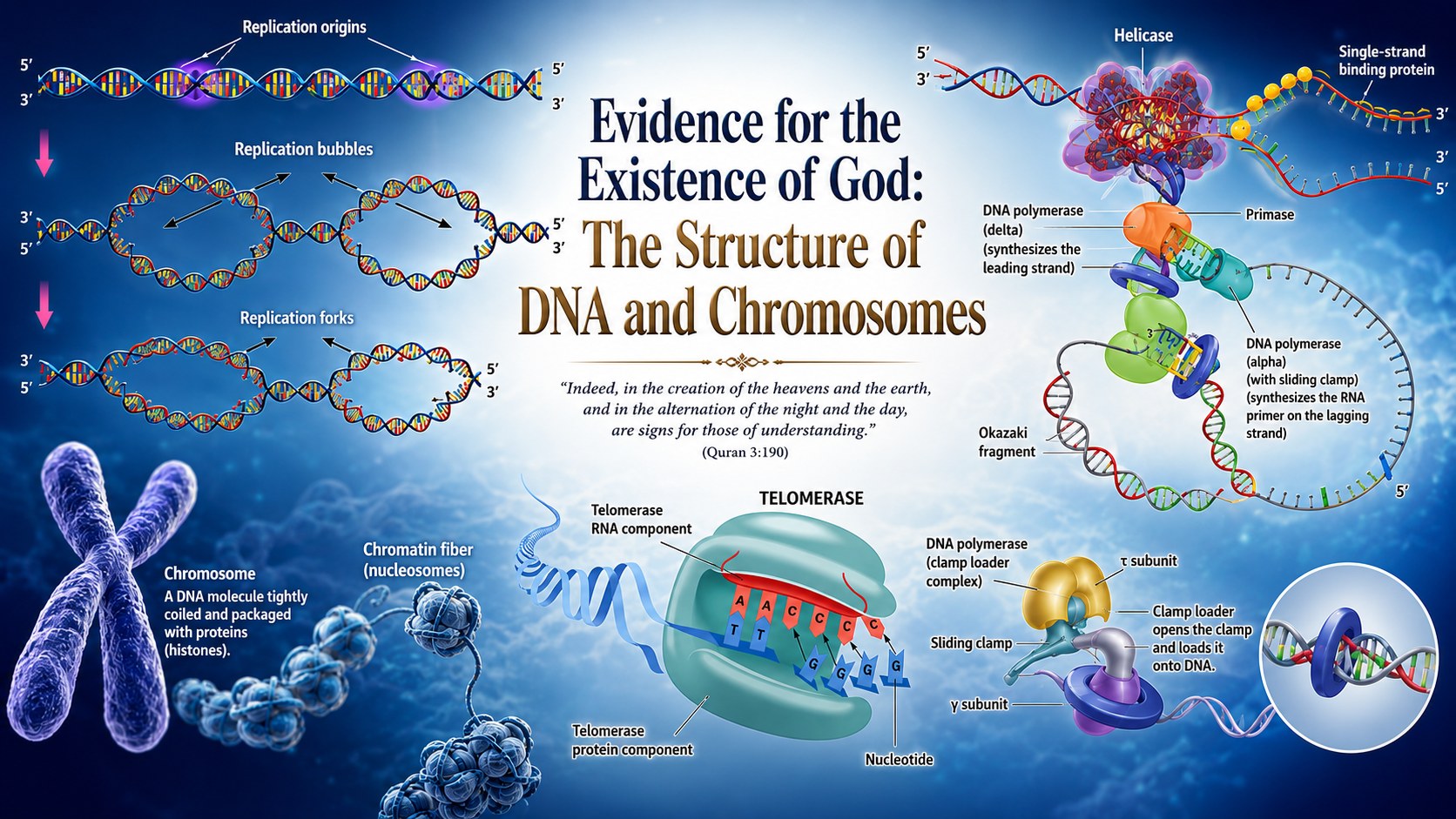
- Since DNA is a very long structure, the copying process begins simultaneously at many regions called REPLICATION ORIGINS.
- These regions are not selected randomly; they contain SPECIAL SEQUENCES consisting of A and T letters. Because the A and T letters have only 2 hydrogen bonds between them, they separate more easily.
- The number and density of nucleosomes in the adjacent region are also very important in recognizing these regions.
- As a result, ENZYMES that recognize the sites where DNA replication begins bind to these regions. They unwind the DNA double helix, forming replication BUBBLES. As these bubbles enlarge, they form REPLICATION FORKS, where the synthesis of new DNA strands begins.
- Before the replication fork is formed, special ENZYMES become involved to ensure that the opening of DNA occurs properly and without tangling the strands. TOPOISOMERASE is the enzyme that corrects the supercoiling of DNA.
- If we consider DNA as being composed of two strands that are wrapped around each other, when we try to separate these strands, the structure would become even more twisted and tangled, as shown in the image below. However, this does not happen during DNA replication.
- Topoisomerase is the enzyme that prevents DNA from being subjected to supercoiling during these advanced stages. It holds and cuts the overlapping folded structures of DNA, allowing the DNA to become more relaxed.
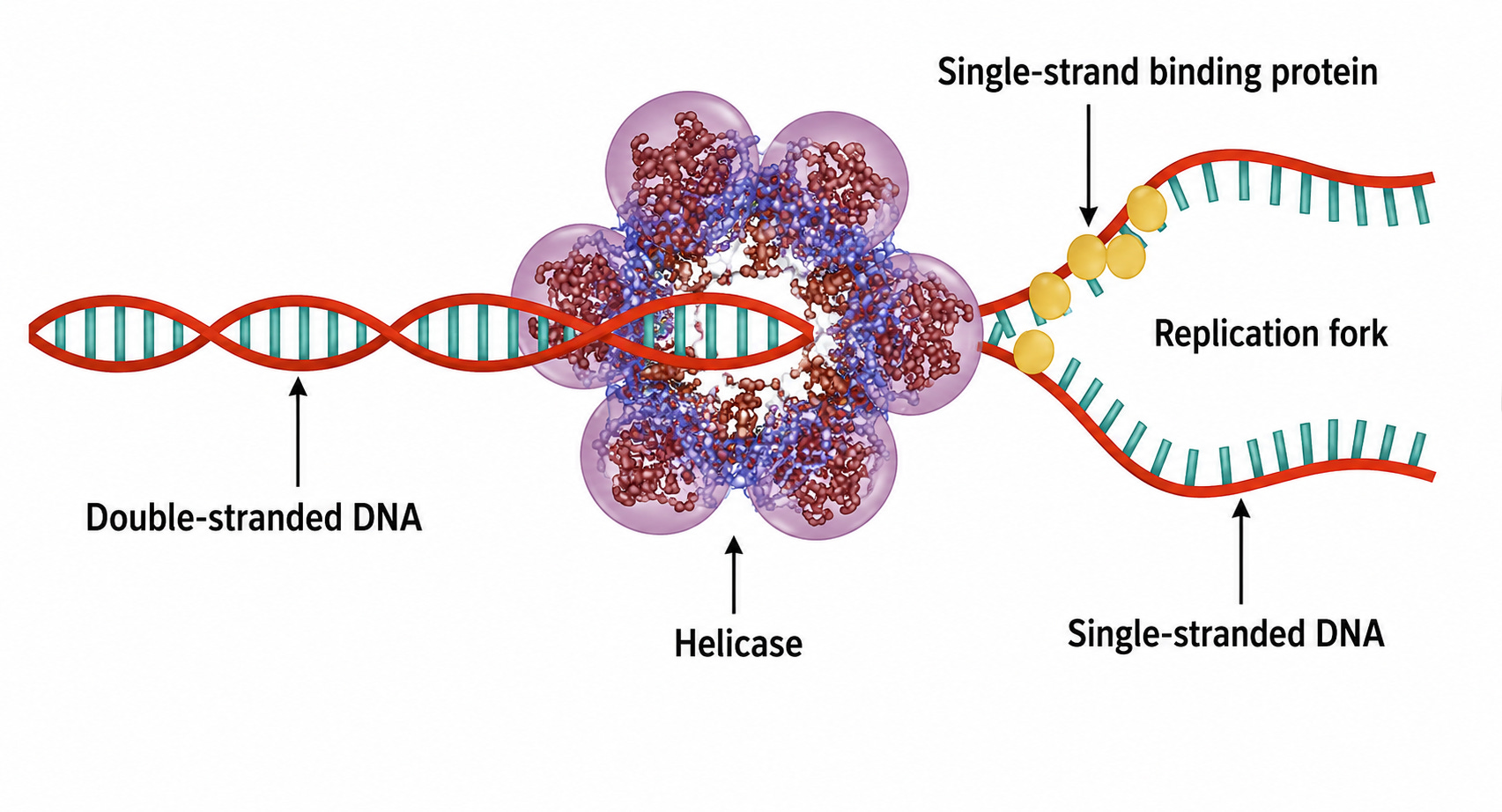
- One of the many enzymes involved in the opening and initiation process is the HELICASE enzyme group.
- The helicase motor protein breaks the HYDROGEN BONDS between the two strands of DNA. As helicase moves along the DNA strand, SINGLE-STRAND BINDING PROTEINS become involved to prevent the separated strands from rejoining and hold the strands through electrostatic interactions. Thus, the replication fork is formed.
ELONGATION
- After the replication fork is formed, the two strands of DNA begin to be copied separately through different methods. Dozens of proteins take part in this process.
- During this process, the Topoisomerase, Helicase, and Single-Strand Binding Proteins, which were involved at the beginning, continue to perform their functions in the same way.
- The group of enzymes that reads DNA, combines the nucleotides present in the environment, and produces its copy is called DNA POLYMERASE.
- There are 15 different types of DNA Polymerase. Most of them are involved in repair processes. Below, you can see the functions of several DNA polymerases.
- DNA polymerase α (ALPHA) is responsible for recognizing RNA primers and DNA repair.
- DNA polymerase β (BETA) similarly performs DNA repair.
- DNA polymerase δ (DELTA) is a highly active enzyme. It is responsible for producing the lagging strand (in the 5’-3’ direction) at the replication fork. It is 100 times faster than DNA polymerase α (ALPHA).
- DNA polymerase ε (EPSILON) has the same characteristics as δ (DELTA). Differently, it is responsible for producing the leading strand (in the 3’-5’ direction).
- After the replication fork is formed, the first enzyme to become active is PRIMASE.
- Primase assists DNA polymerase α (ALPHA) by showing it where to begin production. It reaches the open end of DNA and produces and leaves an RNA sequence of 10–15 letters. DNA polymerase α (ALPHA) recognizes these RNA sequences, called PRIMERS, and adds the first DNA letters. Afterwards, it leaves its place to the highly active δ (DELTA) and ε (EPSILON) polymerases.
- The replacement of DNA polymerase α (ALPHA) by polymerases that are 100 times faster is called POLYMERASE SWITCHING.
- In the presence of helicase, the effectiveness of primase increases 1,000 times.
- Before DNA polymerase begins processing, the HISTONE PROTEINS responsible for folding are removed from the environment.
- DNA polymerase ε (EPSILON) reads the leading DNA strand directly in the 3’-5’ direction and produces the new complementary strand. This process is called ELONGATION.
- The production of the lagging strand occurs in a slightly different and special manner.
- In the lagging strand, the main enzyme responsible is DNA polymerase δ (DELTA); however, the reading process does not occur continuously as in the other strand, but rather in a discontinuous manner.
- Primase continuously produces RNA primers of 10–15 letters and shows DNA polymerase α (ALPHA) the starting points.
- DNA polymerase α (ALPHA) again adds the first few DNA letters after the primers, while DNA polymerase δ (DELTA) matches DNA letters until it completes a section of 100–400 letters. Then Primase creates a new starting point, and the same process continues repeatedly.
- In the lagging strand of DNA, the DNA chains formed piece by piece in this way are called OKAZAKI FRAGMENTS. These are joined together at the final stage, forming a completely proper DNA helix.
- The production process in human cells requires such complex and superior engineering that it is thought that dozens of additional proteins, which have not yet been scientifically identified, also take part in this process.
- It is not possible for proteins too small to be seen with the naked eye to act consciously like scientists or engineers.
It is THE ALMIGHTY GOD Who inspires them continuously regarding what they must do.
TROMBONE MODEL
- In human cells, DNA replication takes place in a manner called the TROMBONE MODEL.
- At the replication fork, the presence of DNA polymerases alone is not sufficient for both strands to be produced simultaneously.
- Different DNA polymerases that extend both chains bind to a protein complex that holds them like a pair of pliers.
- This protein structure, which is an engineering marvel, is called the DNA POLYMERASE HOLOENZYME.
- The two mobile arms of the holoenzyme, called τ-proteins, hold two different DNA polymerases.
- In the lower part of the holoenzyme, called the γ complex, there is another component that holds “CLAMP PROTEINS” and attaches them to DNA polymerases when necessary.
- CLAMP PROTEINS are special proteins shaped like a horseshoe that tightly attach DNA polymerase enzymes to the strands during production. Without clamp proteins, it is not possible for DNA polymerase to perform its function completely and accurately.
- The holoenzyme interacts with helicase through its flexible τ subunit. Following this interaction, helicase begins to function 10 times faster.
- DNA polymerase α (ALPHA) first binds to both sides of the holoenzyme. After the primers are produced, α (ALPHA) leaves its place to ε (EPSILON) on the side where the leading strand is produced and to δ (DELTA) on the side where the lagging strand is produced.
- Single-strand binding proteins, on the other hand, are arranged like beads and ensure that the exposed DNA strand does not become tangled.
- The Primase enzyme interacts regularly with the Helicase enzyme and adds the RNA primers it produces onto the strand where discontinuous production takes place.
- In the image below, the production of RNA primers by Primase on the lagging strand can be seen.
- After DNA polymerase δ (DELTA) produces each OKAZAKI FRAGMENT on the lagging strand, the DNA strand is also released.
- In the image below, the release of Primase, the separation of the clamp protein from DNA polymerase δ (DELTA), and the release of the DNA strand by DNA polymerase δ (DELTA) can be seen.
- DNA polymerase δ (DELTA) cannot remain attached to the DNA strand without the clamp protein. Therefore, it should not be forgotten that every protein has a vital role at every stage of this production process.
- The DNA region where the primer has been added is recognized by the γ complex part of the holoenzyme, which holds the clamp proteins.
- The γ complex captures the DNA containing the primers, as if holding something precious that must not be broken, and places it inside the clamp protein.
- In the image below, the position of the primers, shown in green, inside the clamp protein can be seen. The enzyme that adds the first letters after the primer is DNA polymerase α (ALPHA).
- Afterwards, through polymerase switching, it is replaced by DNA polymerase δ (DELTA).
- After the clamp protein through which DNA passes binds to DNA polymerase α (ALPHA) and the first letters are formed, the production of a new Okazaki fragment begins with δ (DELTA).
- Under normal conditions, the opening of the helical structure and the situation in which one of the strands containing vital codes is being produced while the other remains exposed can cause the letters to break, detach, or become damaged.
- In the trombone model, both the leading strand and the lagging strand are produced simultaneously.
- Simultaneous production provides a perfect protection by MINIMIZING THE POSSIBILITY OF DAMAGE to the information contained in DNA.
- Moreover, throughout this production process, all DNA polymerases continuously perform READING AND CHECKING to ensure that NO ERRORS OCCUR.
- The aim is to immediately correct even a single error that may occur in between.
- As a result, the two strands of DNA are produced exactly as required.
- DNA polymerase enzymes RECOGNIZE, KNOW, and DETERMINE THE LOCATION of the 3 billion letters of DNA.
- If DNA polymerase makes an incorrect pairing in any way, the ACTIVITY OF THE ENZYME DECREASES 10,000 TIMES. Therefore, it immediately recognizes its mistake and performs correction in order to become active again.
- DNA polymerase can perfectly distinguish the DNA letters A, T, G, and C from other nucleotide-based structures.
Although molecules such as rNTP and dNTP, which do not become part of the DNA code within the cell, are found at levels 10 times higher than the letters that participate in the DNA code, NO ERROR OCCURS.
TERMINATION
- While DNA is being copied, a great deal of attention and precision is required. The cell produces 50 base pairs per second. Nevertheless, this speed is not sufficient.
- If copying started at only one location and production occurred at only 50 letters per second, copying a single DNA molecule could take more than one month.
- However, there are 50,000 replication centers on DNA.
- The process described above is carried out SIMULTANEOUSLY, AT 50,000 ORIGINS, WITHOUT ERROR.
- As a result, the copying of one DNA molecule is completed in 8 HOURS.
- The engineering and technology here operate with an accuracy and efficiency that cannot be reached in today’s production facilities.
- And this can only occur through the coordinated operation of complex molecules.
- The absence of even one of the proteins mentioned above would DISRUPT THE SYSTEM and prevent PRODUCTION.
- Every stage of this process takes place UNDER THE CONTROL OF THE ALMIGHTY GOD.
- After the elongation process is completed, the DNA strands must regain their classical helical structure.
- Until DNA polymerase completes its task, clamp proteins hold it tightly; however, when it reaches the end of the strand, they UNDERSTAND THAT THERE IS NO LONGER A NEED FOR HOLDING and release DNA polymerase.
- The Okazaki fragments must be joined, the primers must be removed, and their places must be filled with DNA letters.
- The RNASE enzyme recognizes DNA-RNA hybrids and cuts the BOND BETWEEN RNA PRIMERS.
- The enzyme that removes the primers, adds the missing nucleotides in their place, and joins the Okazaki fragments is DNA polymerase α (ALPHA).
- DNA polymerase α (ALPHA) is of vital importance because it can perform VERY ACCURATE ERROR READING AND CORRECTION on DNA.
- A cell must contain at least 10,000 copies of each type of DNA polymerase.
- After every replication, a SHORTENING of approximately 50 letters occurs at the very end of DNA. If no precaution were taken against this, DNA would continuously become shorter, and this situation would lead to a vital danger.
- However, this DOES NOT HAPPEN. The cell continuously produces structures called TELOMERES at the very ends of each chromosome by repeating the sequence 5’-TTAGGG-3’.
- Telomeres extend slightly outward as a single strand from the 3’-5’ end.
- A special type of DNA polymerase, the TELOMERASE enzyme, becomes active.
- TELOMERASE is an enzyme with extraordinary properties.
- It contains both proteins and RNA molecules. The RNA sequence within it has the exact complementary characteristics to match the TELOMERES extending from the end of DNA, and it attaches to them.
- The enzyme portion within telomerase possesses the REVERSE TRANSCRIPTASE property, which is found only in very special enzymes.
- Through this property, it can produce a DNA segment from its own RNA template that exactly matches the length of the strand extending outward. Thus, it ensures that no protruding incomplete segment remains.
- The existence of such a system within the cell is a great miracle. The telomerase activity of a cell is limited to 50–70 cell divisions. After dividing this many times, cells are considered OLD, and they must die so that new cells can replace them.
- However, this situation differs under several conditions. A human being develops in the mother’s womb by multiplying from a single cell through millions of divisions, and development continues until birth. The reason why the baby’s cells DO NOT AGE AT ALL until birth is that telomerase activity only becomes limited after birth.
- However, the slowing down of telomerase activity after birth is also of vital importance for humans. Because if telomerase never stopped and continued constantly, EVEN IF A CELL WERE DAMAGED, IT WOULD NOT AGE AND WOULD NOT DIE.
- Indeed, it has been proven that tumor cells possess endless telomerase activity.
Neither DNA itself, nor the proteins that fold it, copy it, hold it, release it, read it, and correct its errors have brains; yet they come together and make accurate decisions, follow strategies according to circumstances, and take precautions against dangers.
They have no memory, yet they recognize their friends and enemies, follow methods accordingly, and distinguish what is necessary from what is unnecessary, and what is beneficial from what is harmful. While carrying out their activities, they also do not allow waste or pollution, they work efficiently, and they clean their surroundings after completing their tasks.
On the other hand, they continuously communicate and perform harmonious teamwork; they can make common decisions and act accordingly, and they know when and where they need to go and how they should solve each problem.
They perform all these tasks without sleeping or resting, with astonishing speed. In short, they accomplish activities that humans cannot perform, with extraordinary success and by displaying a superior intelligence.
Those who carry out all these tasks are unconscious molecules composed of atoms, just like those found in air, soil, or water.
By the will of God, these molecules come together in a certain order and display conscious behaviors under the direction of our Almighty Lord.
Every person who possesses reason and conscience will appreciate that the perfect systems in the human body and the astonishing activities in DNA cannot have formed on their own through unconscious atoms. The systems that operate continuously in each of the trillions of cells in the human body demonstrate to humanity God’s infinite wisdom, knowledge, power, and the infinite perfection in His creation.