Many industrial establishments, from leather and textiles to paper and mining, set up complex structures and special facilities based on chemical cleaning in order to treat and reuse the wastewater they produce. These facilities, which require high costs, are investments in technology and engineering. Nevertheless, the water capacity they can put into use is limited, and they also require a considerable amount of energy for this. Yet tens of billions of people who have lived for thousands of years, from the past to the present, have always used water in their daily lives. This water is purified without the need for any facility, energy or chemical process and, through the mercy of our Lord, is perfectly cleansed and placed at our disposal.
Even as you read these lines, millions of cubic meters of water are being carried from the oceans to the atmosphere and from there to the land. The lives of us and all other living things on Earth can continue only by means of this immense water circulation and purification system. If we attempted to organize this work ourselves, we would undoubtedly fail even if we brought together all the technology in the world. Yet water, which enters our lives through natural evaporation and condensation methods, is given to us by our Lord regularly, effortlessly and free of charge.
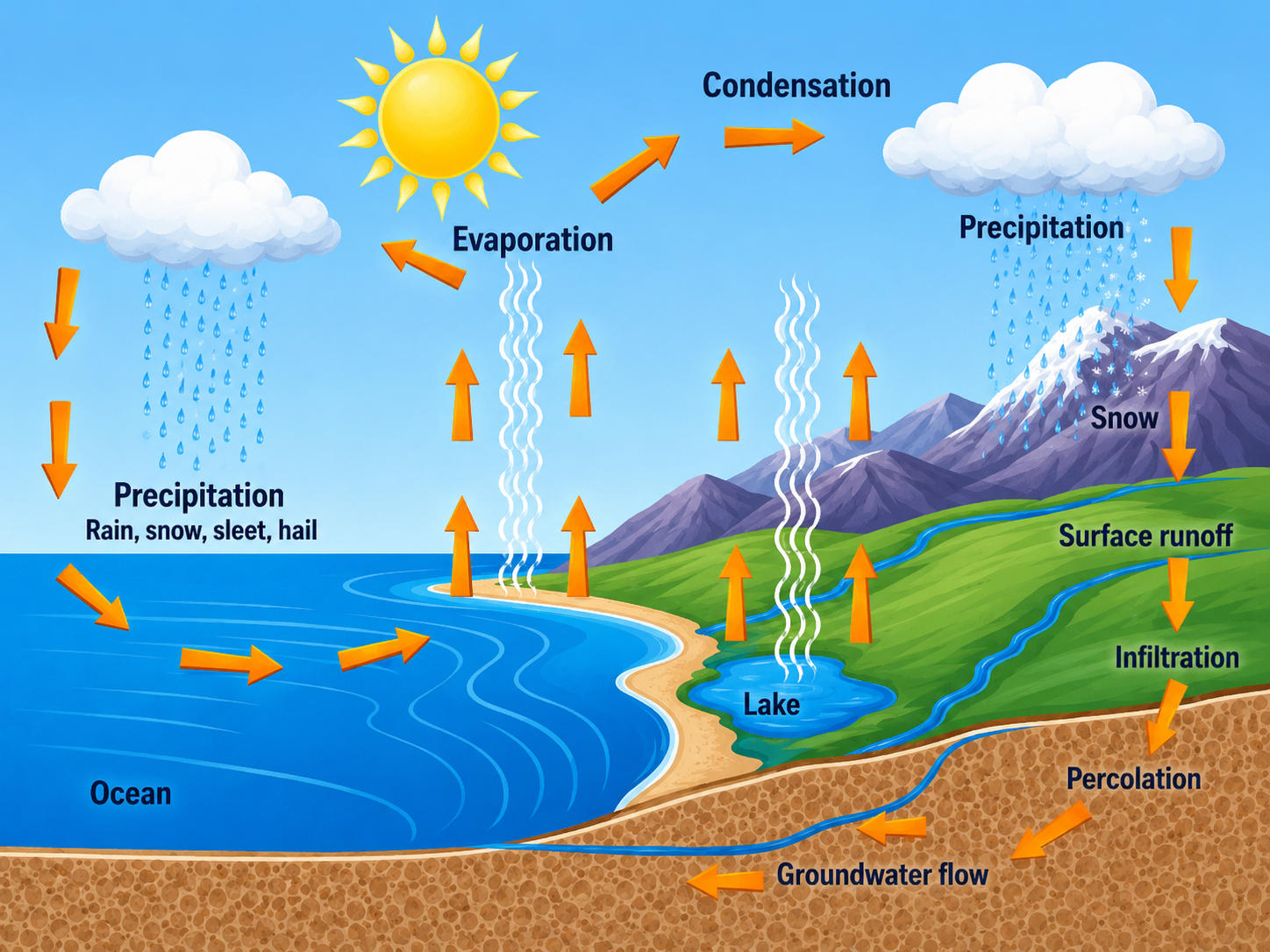
Rain is one of the most important elements for the continuation of life on Earth. During the formation of rain, water circulates among the oceans, seas, atmosphere and land. During this circulation, the waters that make up the oceans, seas, glaciers, snow cover, rivers, lakes—in short, all sources—evaporate and mix with the atmosphere. In addition, a certain amount of water vapor produced by evaporation from the soil surface and plants also joins this cycle. Water vapor that enters the atmosphere in various ways condenses under suitable conditions and returns to Earth in the form of rain, snow and hail. In the Qur'an, Almighty God informs as follows of the processes related to the formation of rain that we have briefly mentioned above:
“It is God Who sends the winds which stir up clouds which He spreads about the sky however He wills. He forms them into dark clumps and you see the rain come pouring out from the middle of them. When He makes it fall on those of His servants He wills, they rejoice.” (Surat ar-Rum, 48)
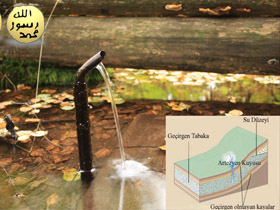
Some of the precipitation that falls on the land surface in various forms (rain, snow, hail) fills depressions on Earth, forming lakes, or follows the slopes on the surface of the Earth and forms rivers. However, not all precipitation that falls on Earth forms surface waters; some of it seeps underground when there are “suitable conditions” and forms groundwater. Here one needs to stop and reflect. How does this water seep underground, pass into the relatively deep parts of the earth and collect in a certain layer beneath the ground? Through which stages and for what reason does this water collected underground return to the surface? Although it passes through various layers of soil, how is it that the water is not muddy and murky when it emerges at its source, but on the contrary is clear, sparkling and ready to drink? By what mechanism does this water trapped underground return to the surface? There is no doubt that the number of these questions could be increased. Yet Almighty God gives us the answer to all these questions in a verse of the Qur'an as follows:
"Do you not see that God sends down water from the sky and threads it through the earth to emerge as springs and then by it brings forth crops of varying colors, which then wither and you see them turning yellow and then He makes them into broken stubble? There is a reminder in that for people of intelligence.” (Surat az-Zumar, 21)
As can be understood from the verse, the existence and movements of water on Earth are part of an extraordinarily finely calculated miraculous system. The transformation of surface waters into groundwater and the preservation of these sources are not random natural events; they are the result of the laws of physics, geology and meteorology created by our Lord operating in flawless harmony.
In order to understand how this miraculous harmony comes about, it is necessary to carefully consider from beginning to end the stages through which water passes.
Has the Amount of Water Cycling for Thousands of Years Always Remained the Same?
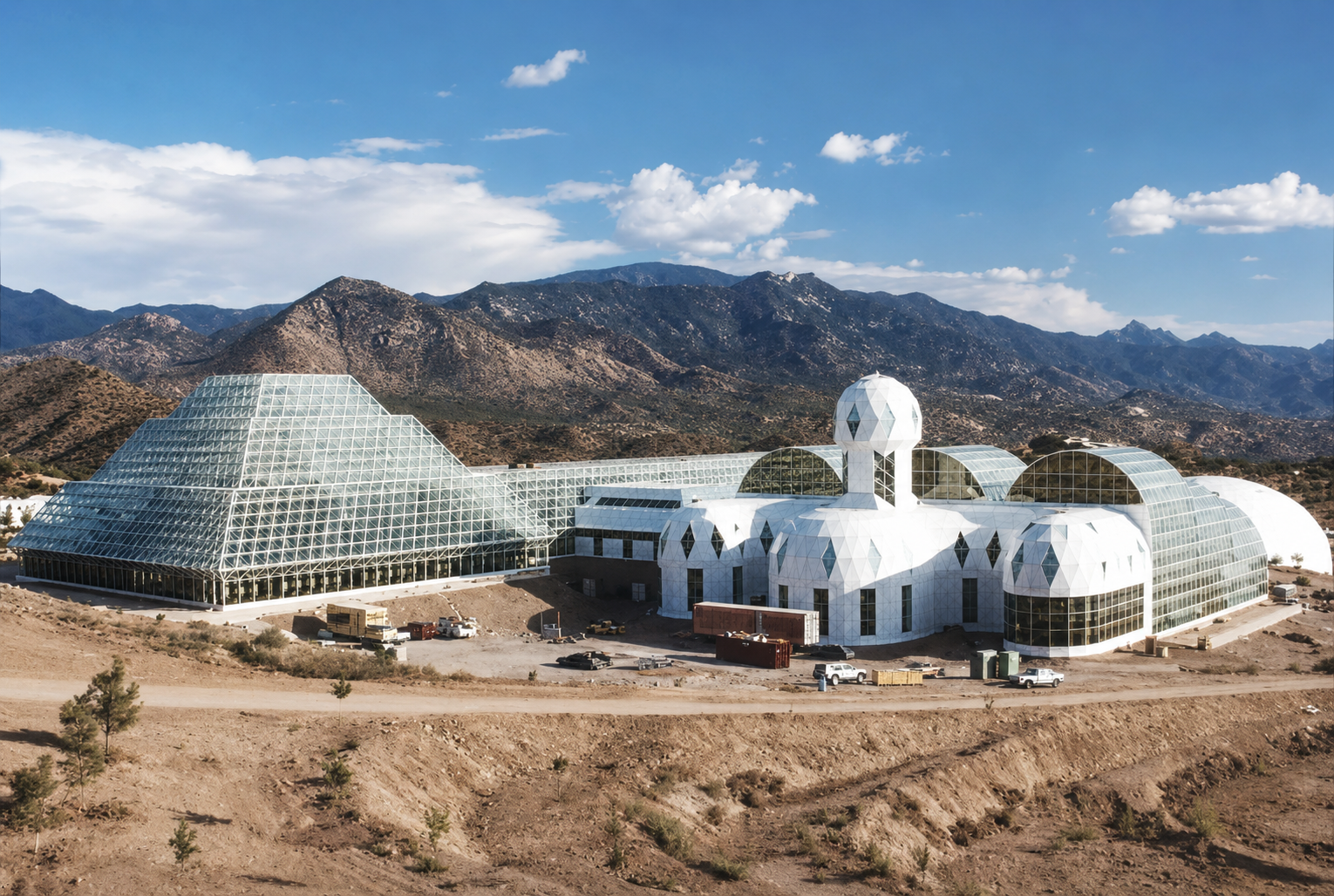
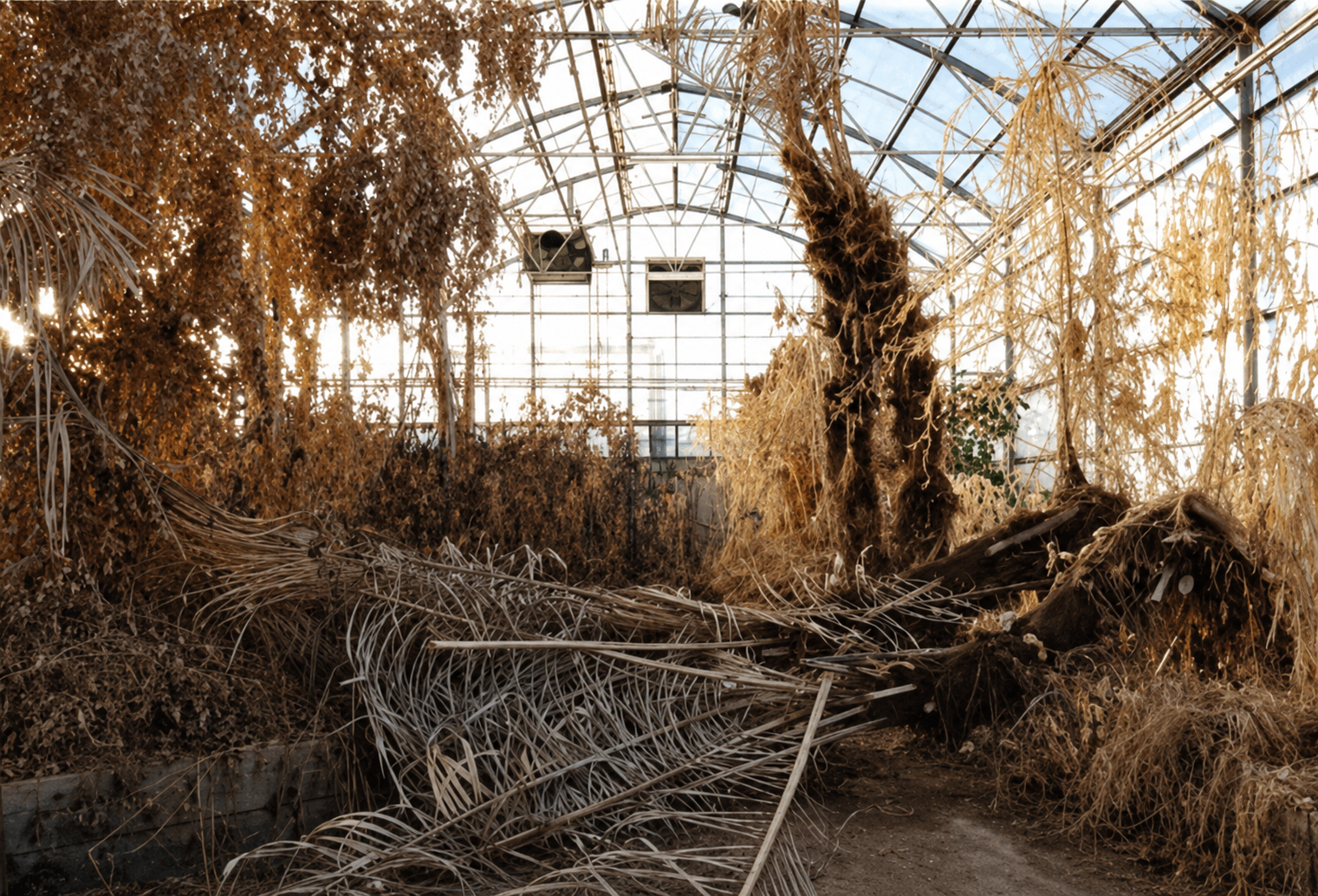
The total amount of water on Earth is approximately 1.4 billion cubic kilometers, and this amount has remained almost unchanged and has been maintained in a delicate balance ever since the system on Earth was first established. Although a certain amount of water is added to Earth by meteors from space or escapes into space from the upper layers of the atmosphere, this amount is so negligible compared to the total volume that it is not significant enough to be taken into consideration. This shows that the water cycle on Earth is a mechanism closed to outside intervention and functioning perfectly within itself. When one considers that it contains billions of human beings and trillions of animals and plants, none of which can survive without water for more than a few days, the continuity and quantity of water and the fact that it is provided after being purified reveal just how important water is to the cycle of life. At various times, in order to create a counterpart of Earth's ecosystem, artificial terrestrial atmospheres were created inside immense glass domes under the names Biosphere-1 and Biosphere-2, and artificial sunlight, plants and animals were added, yet all these artificial ecosystems ended in disappointment.
How Do the Stages of Water Purification Take Place?
The purification of water after it has been used, commonly known as the “water cycle,” is a purification system that operates at different speeds depending on the location of the water. The renewal period of each water source takes place through a miraculous system suited to its own structure. For example:
- Atmosphere: Water vapor remains in the air for an average of 8-9 days and descends to the ground after being purified through precipitation.
- Rivers: Depending on the flow rate, the renewal period of water in rivers is an average of 12-20 days.
- Lakes: The complete renewal of the water in a lake takes between 1 and 100 years.
- Oceans: It takes an average of 3,000 to 3,200 years for the immense volume of water in the oceans to evaporate and enter the cycle.
- Glaciers: Water frozen in the polar glaciers is preserved in these immense freshwater reservoirs for 10,000 to 16,000 years.
The reason why the amount of water on Earth that our Lord purifies and provides to us without our expending any energy is far greater than what is needed is that, as seen above, its recycling and purification often take hundreds or even thousands of years.
How Much of the Water on Earth Can We Use?
The fact that 70% of Earth's surface is covered with water should not be taken to mean that freshwater resources are unlimited. That is because the uses of this immense body of water are limited by extremely precise measures. Namely:
Saltwater: 97.5% of the total water is found in the oceans and seas.
Freshwater: Only 2.5% of the total water is freshwater.
Accessible Water: Approximately 69% of this 2.5% freshwater is frozen in glaciers.
According to these data, the amount of freshwater that mankind can easily access and use for agriculture, industry and drinking water is less than even 1% of the total water on Earth.
Moreover, considering the limited amount of surface water, groundwater is the most reliable freshwater reservoir. Approximately 30.1% of the freshwater on Earth is stored underground (in aquifers). The renewal of these sources, which are equivalent in volume to 8 to 10.5 million cubic kilometers of water, is very slow. Depending on the depth, it may take from several hundred to thousands of years for groundwater to enter the cycle completely. So how do these immense waters descend underground and become trapped there without going deeper and disappearing?
This also takes place by means of delicate infiltration techniques.
.jpg)
The Delicate Infiltration Techniques That Form Groundwater
The main source of groundwater is precipitation falling from the atmosphere. However, not every drop that reaches the surface descends directly underground. In order for water to seep underground, a series of physical and geological laws must operate simultaneously and in a flawless sequence:
At this point, the main driving force that causes water to move toward the depths of the earth is the flawless balance between the forces of ‘gravity and capillarity.’ Yet if gravity acted alone, water would constantly descend, reach the magma in the deep layers of the earth, evaporate and become useless for the surface of the Earth. The factor that prevents water from escaping and disappearing after reaching a certain depth is the force of “capillarity.” By allowing water to descend only to a certain depth, this force keeps it at a usable level.
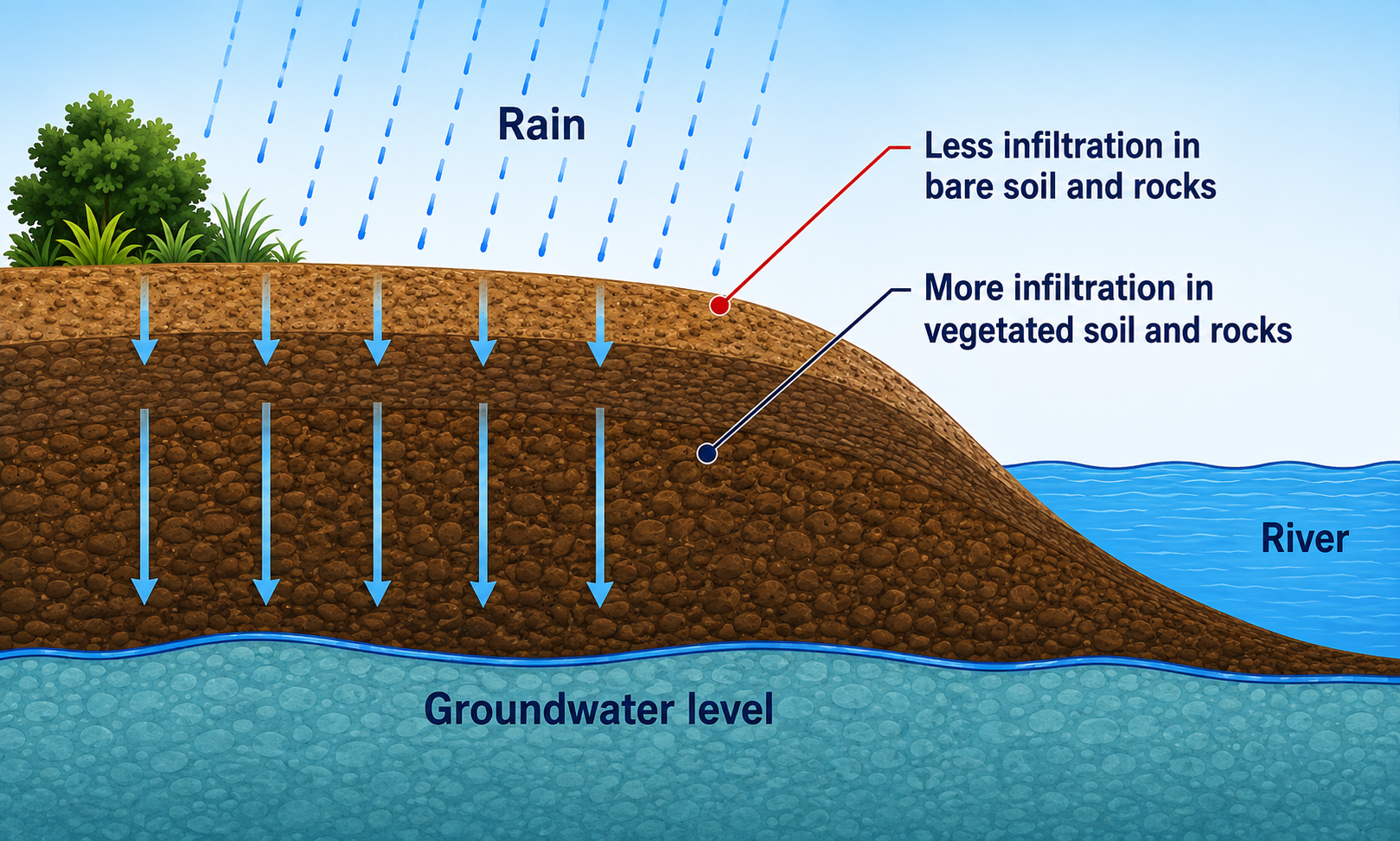
On the other hand, the miraculous system in the arrangement of the ground layers on Earth is also important for infiltration to take place, because the rocks that form the ground must be porous and permeable. While sandy soils rapidly convey water downward through their large spaces, clayey soils react in exactly the opposite way. When clay particles come into contact with water, they rapidly swell, close the spaces and form an impermeable barrier. As one of the signs of our Lord's infinite knowledge, the arrangement of the soil layers on Earth is ideally suited to this purpose: While the upper sections being composed of sandy layers allows water to seep through, the clay deposits in the lower layers serve as a reservoir floor that prevents the water from escaping deeper.
In addition, the surface has a certain infiltration capacity limit; Earth's crust does not possess an unlimited capacity to absorb water, and this prevents water from completely filling the underground and overflowing. While infiltration is rapid at the beginning of precipitation, it slows down and eventually stops as the fine material carried from above fills the pores and the clayey structure swells. In this way, groundwater is maintained at a constant level of saturation, and incoming water is transferred to neighboring regions.
Another important detail in the storage of water is vegetation, slope and type of precipitation; the efficient operation of the stages mentioned above also depends on the physical conditions on the surface. Vegetation slows down the raindrops falling to the ground and turns them into tiny droplets that can gently seep into the soil, and slows surface runoff. Similarly, the quality of infiltration also depends on the type of precipitation and the slope of the land. While downpours and steeply sloping land cause water to flow away rapidly without descending underground, drizzle falling on flat land provides the most suitable conditions for the soil to absorb the water gradually and feed underground basins. As a result of our Lord's infinite knowledge and power, the groundwater formed by the combination of all these geological and physical mechanisms is the most fundamental mainstay for the continuity of human beings, animals, plants—in other words, living things.
As can be seen, the collection underground of water falling on Earth and its return to the surface can only be possible when miraculous conditions are fulfilled. For example, even if all the conditions were fulfilled, if the force of gravity were greater, surface waters would be drawn toward the depths of the earth more rapidly and in greater amounts. In that case, the water cycle would be disrupted and life would be endangered. Or if the surface of the earth were covered with clayey layers and the lower layers were sandy, groundwater would not form, and any water that did form would rapidly flow toward depths that would prevent it from emerging again. Yet in reality, the situation is exactly the opposite, and it has been created exactly as it needs to be.
All this miraculous system and flawless order described above show that groundwater is provided by our Lord according to a specific plan and measure. God reminds us in a verse that it is He Who carries out this flawless planning and cycle:
"Say: ‘What do you think? If, one morning, your water disappears into the earth who will bring you running water?’" (Surat al-Mulk, 30)