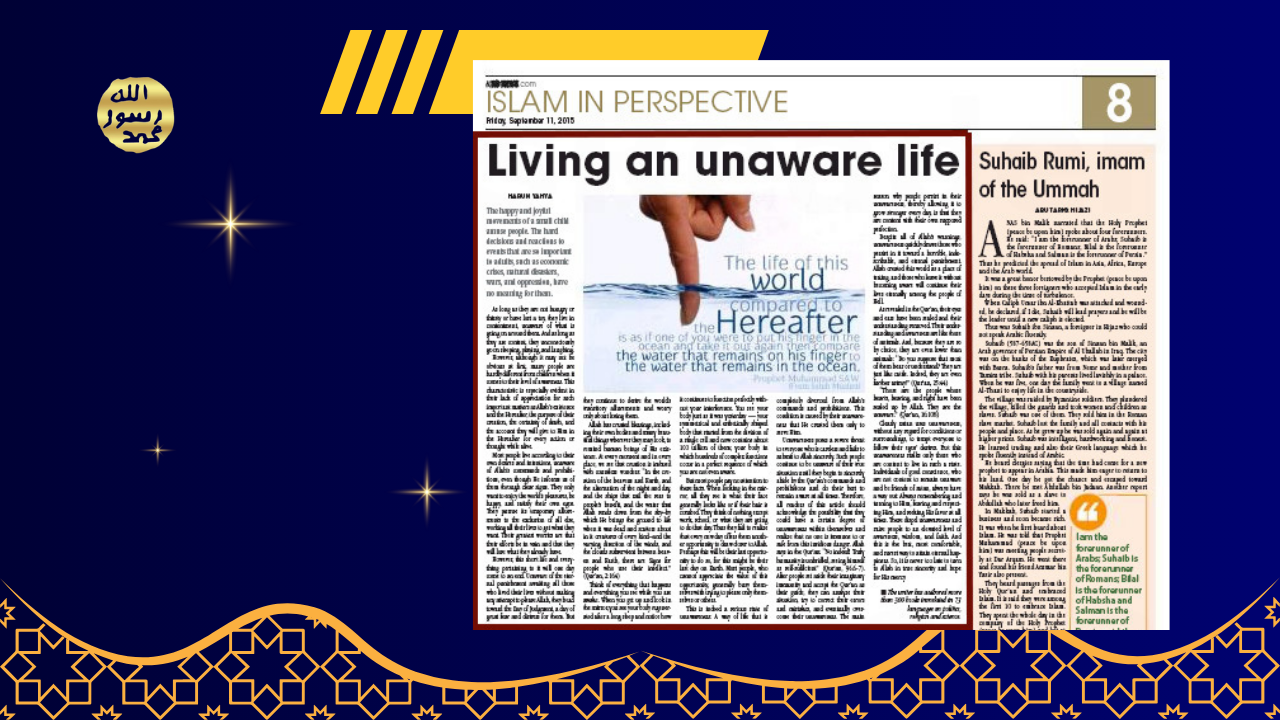
A person who ignores the transitory nature of the world and pursues the selfish desires of his lower self as though he will live forever overlooks many important truths about life and, without realizing it, finds himself in a narrow world made up of petty matters. His days pass by following the lives and behavior of others, concerning himself with what people do and say, thinking about who has surpassed him at work or in his social circle, who receives more attention, appreciation or opportunities, and magnifying countless petty matters such as these in his mind. Each of these seems important to him. He becomes upset and angry over them, responds to them and thinks about them for days. He places such vain preoccupations at the center of his life.
When a person begins to live by ignoring the fact that the world is transitory, over time this world surrounds him from every direction. The behavior dictated by his lower self seems normal to him. Without reflecting on his own creation, realizing his helplessness or calling to mind that the life he leads will inevitably come to an end one day, he attaches more importance than necessary to the things belonging to the life of this world. His profession and work, career, house and car, income, rank and position, possessions and property, reputation in society and standing in the eyes of people become the most important matters in life for him. He strives with all his might to acquire and preserve these and to possess more of them. He begins to measure his success by what he possesses and to determine the value he places on himself by his income, rank or position in society.
As a person places the transitory things belonging to this world at the center of his life, his behavior also begins to be shaped according to the standards of this petty world. Becoming angry, complaining, raising his voice, shouting, quarreling, making cutting remarks, mocking, belittling, speaking behind others’ backs, gossiping and similar traits of bad character do not appear to him as bad morality. On the contrary, he often regards all these as seeking his rights, defending himself or responding to an injustice committed against him. Like a fish swimming in an aquarium, he cannot find the opportunity to look at himself from outside the environment he is in and cannot realize how much he has filled his life with superficial matters.
.jpg)
A person who has fallen into this small world constantly struggles as though caught in a net surrounding him. Because of the uneasiness and tension he experiences, he suffers, becomes distressed and wants everything to go well. Yet no matter how hard he tries, the situation he is in does not give him true peace. Even the slightest setback he encounters in his daily life affects him deeply.
A wrong behavior arising in the selfish world often brings another wrong behavior with it, and these grow by feeding one another. For example, he regards someone’s failure to invite him to an event as an injustice done to him and becomes upset by it. He then begins to think, “Since he did not invite me, I will not invite him either.” Someone’s failure to call likewise turns into a desire to respond in kind, and he says, “If he does not call me, I will not call him either.” When he thinks he is not receiving anything in return for what he does, he becomes resentful, saying, “I am always the one doing everything; no one else does anything.” When a colleague at work takes someone else’s idea into consideration rather than his own, he thinks, “No one sees my efforts.” When someone else is promoted, this gives rise to the thought, “I work harder than he does.” Thus, following a petty incident that could initially be regarded as insignificant, a person produces a new reaction within himself, and this reaction brings another reaction with it, which in turn brings another behavior. After a while, the person’s entire day begins to be filled with these successive petty matters and his reactions to them. Moreover, he also finds a justification to vindicate himself for every behavior that emerges. He thinks, “He did this to me, so I behaved this way.” He defends himself by saying, “He forced me to do this.” He regards his behavior as justified, saying, “Of course I became angry because I was treated unjustly.”
Attaching more importance than necessary to the petty matters of this world also creates an increasingly greater burden in a person’s inner world. Constantly thinking about the behavior of others, repeatedly evaluating events in his mind, being unable to forget what has been done to him, becoming angry and offended and trying to respond to these may, over time, drag a person into an uneasy and weary state of mind. Indeed, many people today struggle with various psychological problems and receive support because of such anxieties, resentments, conflicts and mental preoccupations surrounding their lives. The more a person becomes caught up in these petty calculations of the world, the more his mind becomes occupied with these matters.
Yet it is possible for a person to be freed from all these troubles by turning with a sincere heart to his Lord Who created him. God knows man and his nature best; indeed, it is He Who created the entire universe and all living things. Without knowing the Creator of this world and submitting to Him, a person can easily lose his way in this world of trial that He created. A person who is lost in the petty calculations of the world will find the right direction when he submits to God Who created him. For this reason, a person should seek refuge in his Lord and trust and rely upon His infinite strength, might, mercy and forgiveness. Only in this way can a person be freed from all these burdens surrounding him and find true peace.
If a person reflects for even a brief moment, he will understand that he did not come to this world to become lost in petty calculations or pursue vain deeds, vain preoccupations and disputes. These are not the purpose of this world. This is a place of trial, and man is being tested here. God, Who created the entire universe and man, reveals in the Qur’an:
“Every self will taste death. We test you with both good and evil as a trial. And you will be returned to Us." (Surat al-Anbiya', 35)
Those who do not become caught up in the transitory appearance of the world and their selfish desires, and who do not waste their lives pursuing small and superficial matters, are believers who know the true nature of the world, are aware of their helplessness and are bound to their Almighty Creator with love. A believer who loves God directs his attention not toward the transitory pleasures of the world, but toward knowing God, earning His approval, living in the manner shown by the Qur’an and preparing for the Hereafter. Vain preoccupations, conversations that provide no benefit, gossip, unnecessary disputes and petty matters that consume time do not take their place at the center of his life. He has responsibilities that fill his life and are incomparably more important than these. His responsibility is to serve God completely, seek His approval, purify himself of the evils of the lower self, fulfill the responsibilities imposed by the Qur’an and live by good morality. Living by and spreading the goodness commanded by God, enjoining what is right, preventing evil, upholding justice, treating people well, explaining the truth and striving to communicate the existence and oneness of God and the truths of the Qur’an to people are the priorities of his life.
The matters a believer considers important for the approval of God lie far beyond the small worlds woven from selfish ambitions and superficial perspectives. He thinks about the condition of weakened people who are forced to live amid war and persecution, who struggle against hunger and poverty and who have lost their homes and loved ones. He strives to do whatever he can to relieve these people’s suffering and to support goodness. He does not ignore the suffering experienced by children, the elderly and defenseless people who lose their lives in wars. He cares when a person is treated unjustly anywhere in the world and strives to oppose this to the extent of his means. Explaining the evidence of God’s existence to people, inviting them to the Qur’an and striving for the morality of the Qur’an to become widespread among people are also among the important responsibilities of his life.
A person who loves God and has such great goals is, of course, also involved with the matters of daily life. Yet these remain in their proper place. A colleague’s failure to help him, a relative’s failure to invite him or another person’s failure to show him the attention he expects cannot encompass the entire meaning of life for a person whose heart is filled with the love of God.
.jpg)
In the Qur’an, Almighty God invites man not to become lost in a small world, but to turn toward great goals. Man was not created merely to think about his life, comfort and enjoyment in this world. Before him lie great goals such as knowing God, serving Him, purifying his lower self, living by good morality, being beneficial to people and preparing for the Hereafter. When a person places these goals at the center of his life, he will realize how small many matters that previously appeared very great to him actually are. God reveals in the Qur’an:
“Race each other to forgiveness from your Lord and to a Garden, whose breadth is like that of heaven and Earth combined, made ready for those who believe in God and His Messengers. That is God's favor, which He gives to those whom He wills. His favor is indeed immense.” (Surat al-Hadid, 21)
These are the goals God shows His servants. Seeking God’s approval, earning His love and attaining the beauties of the Hereafter... In the heart of a person who has turned toward these great goals, the desire to know God better, to be closer to Him and to earn His approval grows increasingly stronger. He constantly strives to improve himself in order to deepen his faith, earn God’s love and become a better servant to Him. His heart is filled not with the petty matters of the life of this world, but with the desire to draw closer to God and earn His good pleasure.