Today, humanity invests billions of dollars in research aimed at developing advanced camera systems, optical sensors, night-vision devices, and fiber-optic communication technologies. The refraction, focusing, and efficient transmission of light constitute some of the most complex challenges in modern engineering. Even the slightest imperfection in an optical system can significantly degrade image quality. Refractive errors in lenses, light losses, image distortions, and focal aberrations remain problems that have not been completely resolved even today.
Yet certain living organisms have been utilizing such systems flawlessly for millions of years—systems that scientists are only now beginning to understand. Remarkably, they accomplish this without metal components, electronic circuitry, or artificial manufacturing facilities. Many optical solutions that humans strive to reproduce in laboratory environments already exist, fully integrated, within the bodies of living creatures.
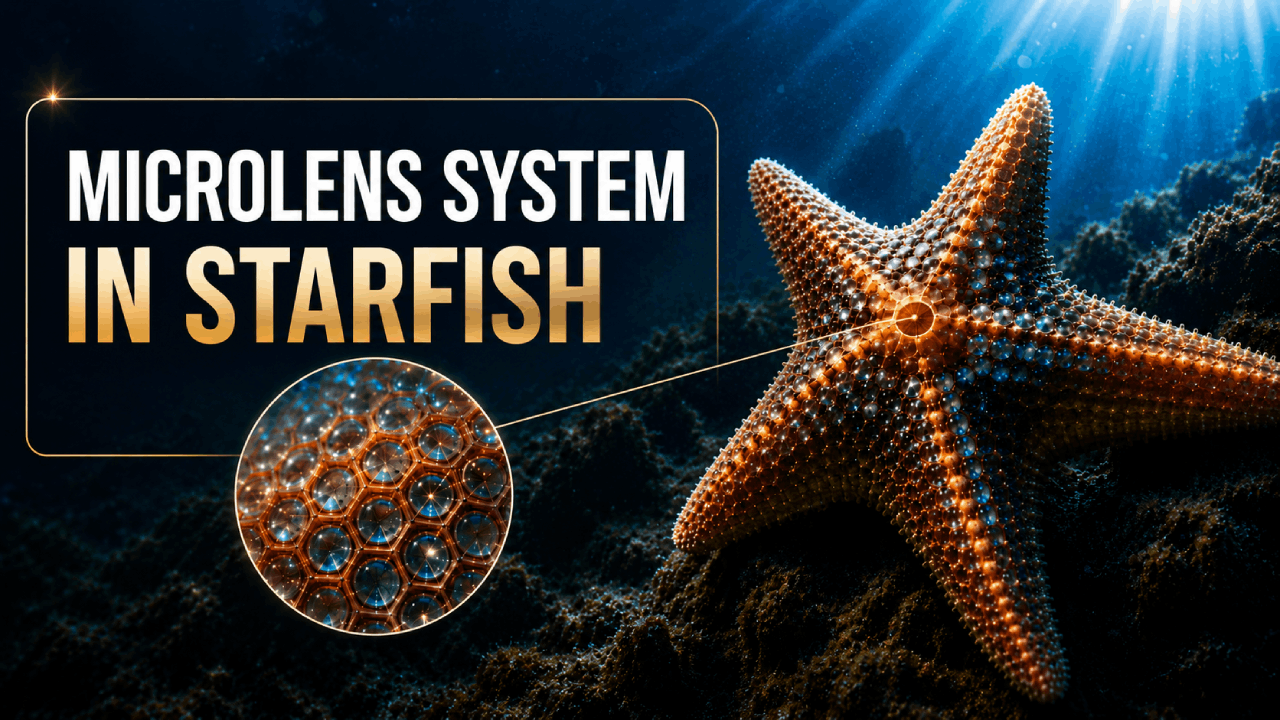
The microlens system discovered in starfish represents a striking example of this phenomenon. The optical structure found in these organisms is far more than a mere biological detail; it is an extraordinarily sophisticated system in which principles of physics, geometry, materials science, and information-based construction operate together in a highly coordinated manner.
The Body-Wide Visual System of the Starfish
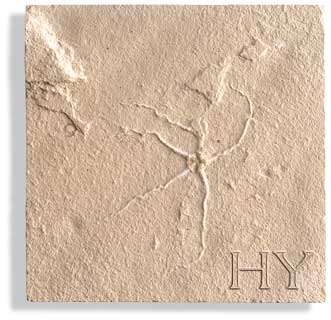
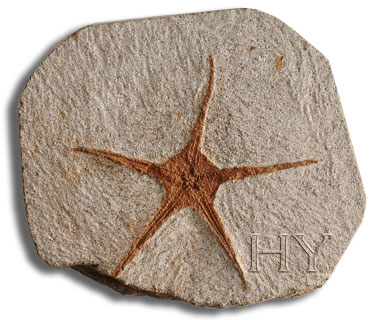
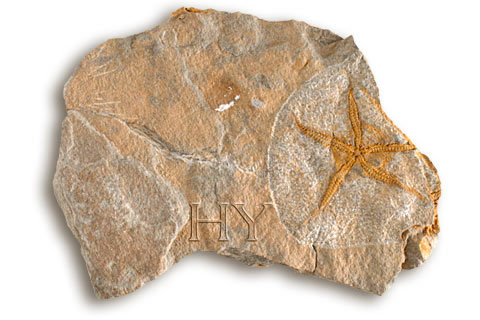
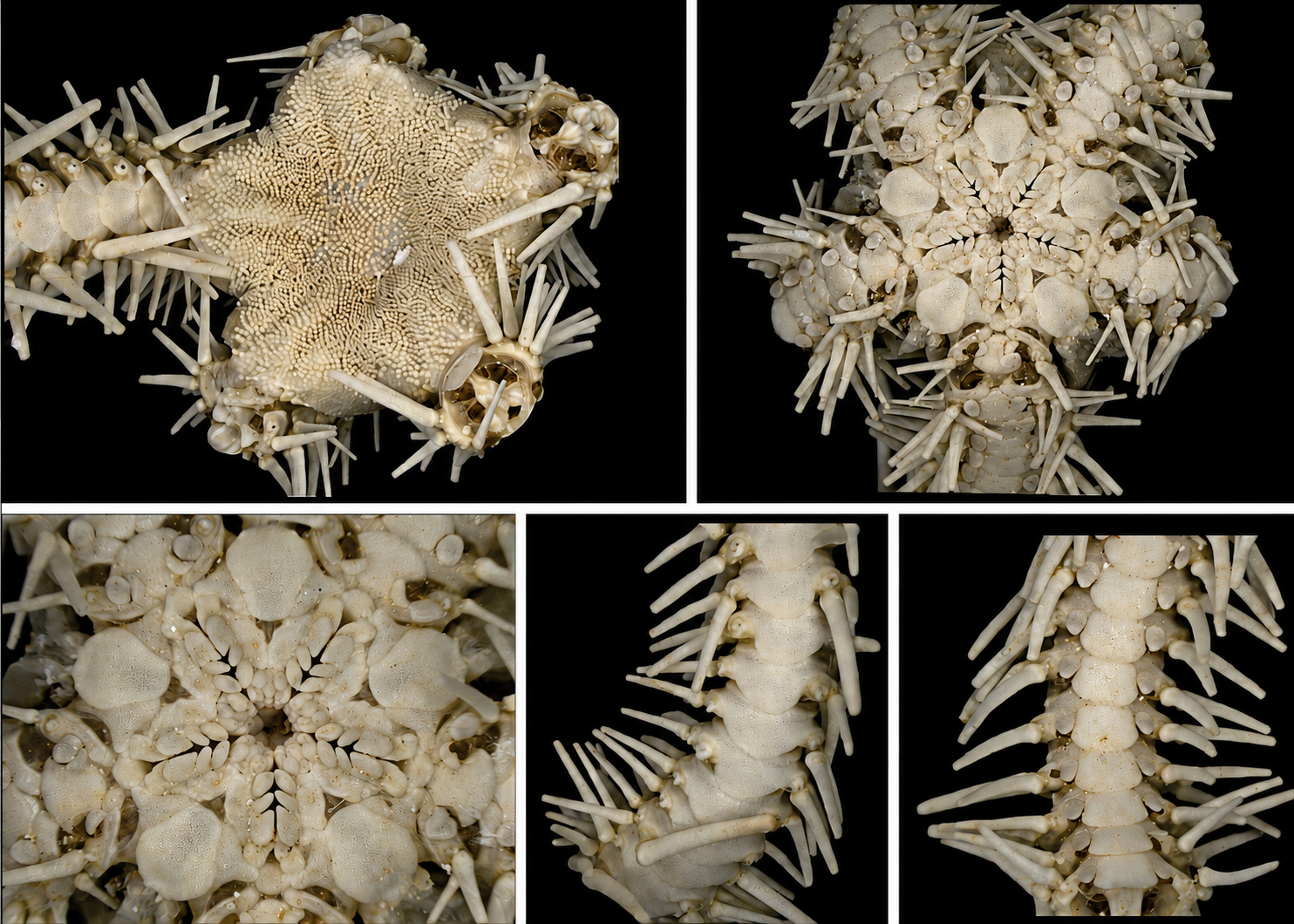
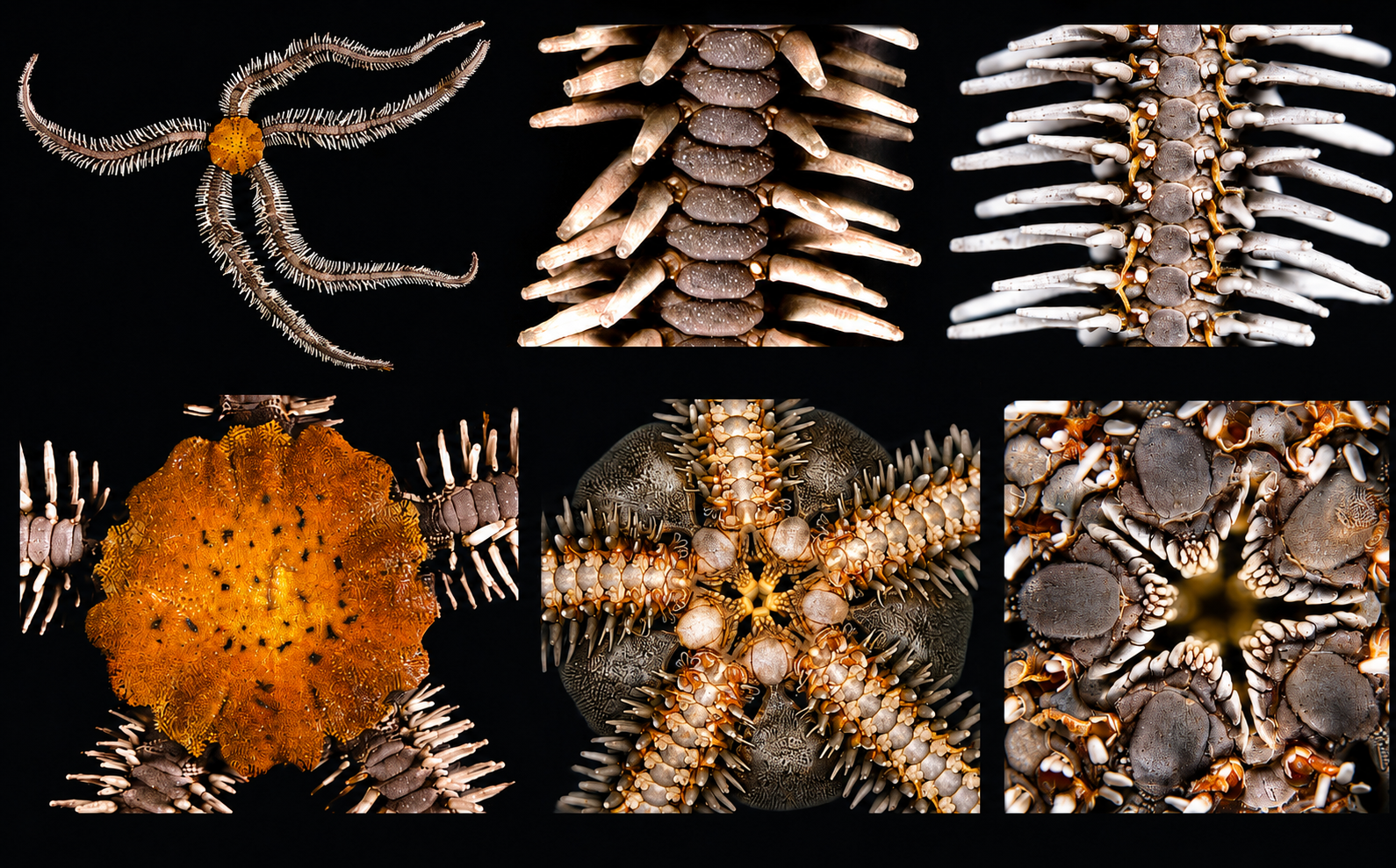
Research conducted particularly on the starfish species Ophiocoma wendtii has revealed that these organisms possess a highly sophisticated light-detection system distributed across their body surface. At first glance, they may appear to be ordinary and unremarkable creatures. However, each arm of these starfish contains thousands of ‘microscopic lenses’. These lenses do not merely detect light; they also focus incoming light from specific directions, enabling the animal to perceive features of its surroundings. As a result, the starfish is capable of distinguishing aspects of its environment despite lacking eyes in the conventional sense.
In humans and many other animals, visual processing is concentrated within specialized organs. In starfish, however, this capability is fundamentally different. Their visual system is not confined to a single center but is distributed across a large portion of the body. Consequently, the starfish possesses a widespread optical network capable of simultaneously evaluating light arriving from multiple directions. This arrangement closely resembles what modern engineering describes as a “distributed sensing system.” Today, engineers are increasingly seeking to develop multi-point sensing technologies as alternatives to centralized systems. Distributed architectures offer important advantages, including greater resilience and broader environmental coverage. In the starfish, however, such a system already exists in a complete and integrated form as a remarkable feature of its biological design.
Structure and Optical Properties of the Microlenses
The microlenses distributed across the surface of the starfish are composed of calcium carbonate crystals. What is particularly remarkable, however, is not merely the material from which they are made. The truly significant aspect lies in the geometric arrangement of these crystals and the precision of their optical properties.
The lenses are organized in a hexagonal pattern. Hexagonal geometry is one of the most efficient arrangements found in nature. Also observed in honeycombs, this structure enables maximum packing efficiency while minimizing unused space. Through this configuration, the microlenses of the starfish operate in complete coordination with one another. In addition, each individual microlens possesses highly precise characteristics, including its curvature, thickness, angle of light refraction, surface architecture, and crystal orientation. These parameters are determined with extraordinary accuracy. In optical systems, even an error on the scale of a few micrometers can significantly degrade image quality. The proper functioning of such a system therefore depends upon the precise integration of numerous optical variables acting together in harmony.
Research has shown that these microlenses do not exhibit certain fundamental optical defects commonly found in many artificial optical systems. For example, the problem of ‘spherical aberration’, which frequently affects human-made lenses, has been substantially minimized in these biological structures. Spherical aberration occurs when light rays are focused at different points, causing the resulting image to appear blurred. In modern camera technology, reducing this effect often requires the use of complex, multilayered, and costly lens assemblies.
In the microlenses of the starfish, however, this correction is achieved naturally. In addition, the phenomenon of ‘birefringence’—a common issue in crystalline materials—is also effectively controlled. Birefringence causes light to split into different paths, potentially degrading image quality and reducing optical accuracy. Despite this challenge, the lenses of the starfish are capable of directing light with remarkable precision.
Some researchers have suggested that, under certain conditions, these biological lenses may operate more efficiently than human-engineered micro-optical systems. This is because the starfish relies not on a single lens, but on an extensive optical network composed of countless microlenses functioning together as an integrated system.
A Living System That Controls Light
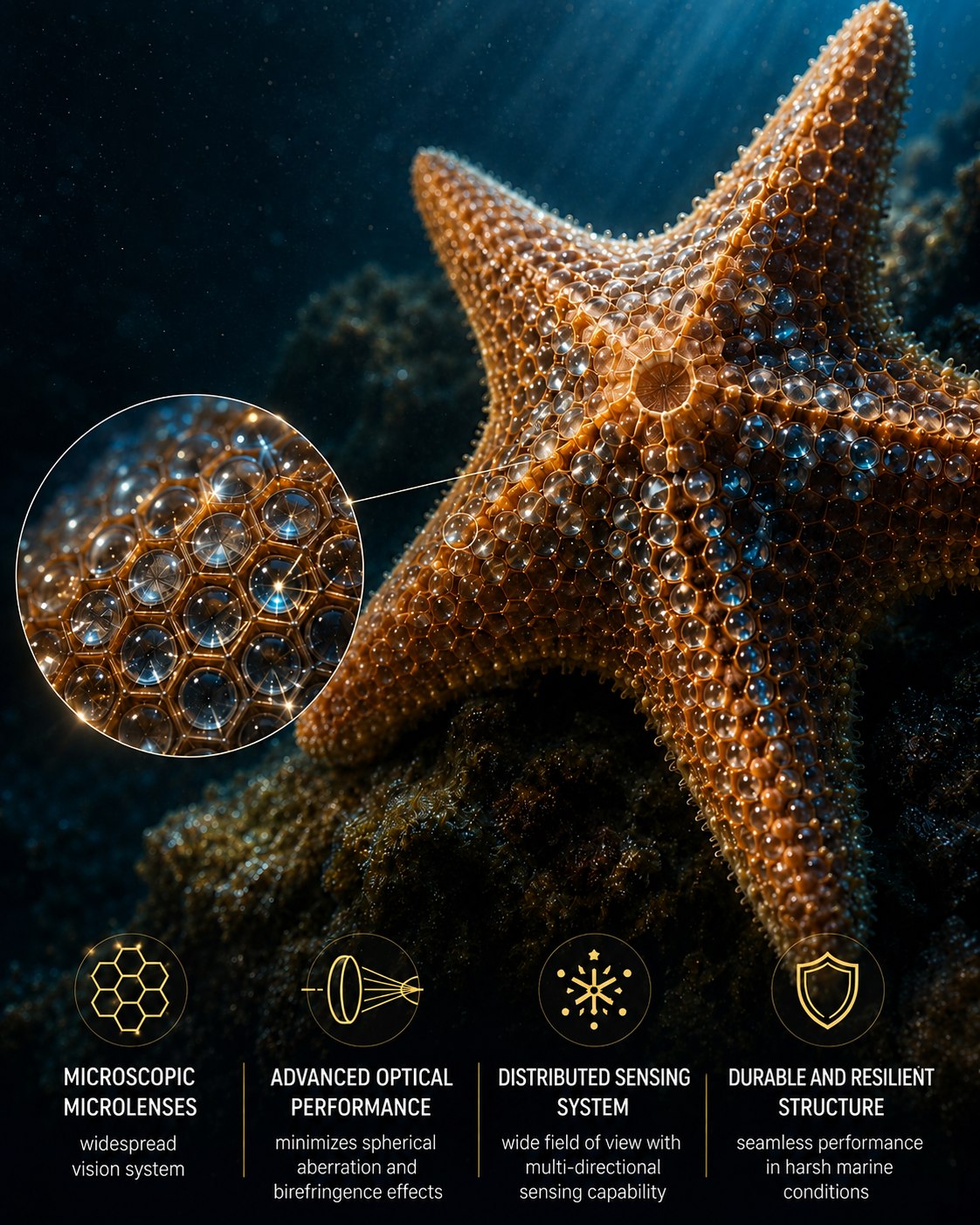
The system found in starfish does not merely collect light; it also prevents the unnecessary scattering of incoming light. Pigment cells surrounding the lenses absorb excess light, thereby enhancing image quality. This arrangement resembles the light-management systems employed in modern cameras. Today, engineers use specialized coatings, light-absorbing surfaces, and filtering technologies to ensure that light enters image sensors in a controlled manner. In the starfish, however, the same function is accomplished through living biological tissues.
Moreover, this entire optical system operates in a marine environment. When one considers the effects of saltwater, fluctuations in pressure, variations in temperature, and the constantly changing conditions of the surrounding environment, the durability of this optical architecture becomes even more remarkable. While many human-engineered precision optical devices can suffer damage relatively quickly under such demanding conditions, the optical system of the starfish continues to function throughout the organism's lifetime.
A System That Technology Is Striving to Replicate
Today, engineers working in the field of biomimetics are attempting to develop next-generation technologies by emulating optical systems found in nature. In particular, the lens structures observed in starfish are being studied as models for applications such as miniature camera systems, medical imaging devices, fiber-optic communications, light-sensing technologies, and underwater imaging systems.
One of the most significant challenges in fiber-optic technology is the efficient transmission of light with minimal signal loss. The microlens system found in starfish, however, is capable of directing light with exceptionally low levels of loss. For this reason, researchers believe that the optical architecture of these organisms may inspire future advances in data-transmission technologies. What is particularly striking is the following reality: solutions that humanity is striving to achieve through advanced technology are often already present in nature. In other words, humans are attempting to imitate the remarkable designs that God has created as examples of extraordinary precision and sophistication.
Production Based on Genetic Information
One of the most remarkable aspects of this system is the manner in which it is produced. For the microlenses in the starfish are not components that are assembled afterward. Each of them comes into existence through cellular production processes during the development of the living organism.
For a lens to perform its function, it must form in exactly the right place, possess the correct inclination, be produced with the appropriate crystal structure, be arranged in harmony with the other lenses, and operate in connection with the neural perception system.
All of this is based upon specific information. For what exists here is not merely matter; there is miraculous technical information that has been organized and arranged. Today, even the simplest optical sensor cannot be manufactured without detailed engineering plans, yet the thousands of microlenses in the starfish come into existence in the most perfect manner through our Lord's miraculous creation. The fundamental question that must be answered here is this: How can this delicate system, which operates in accordance with the physical laws governing light, be the product of chance—or, in other words, of unconscious processes—as claimed by proponents of evolution, a claim that human reason cannot accept?
This structure, which points to the existence of our Lord, is not merely a biological formation; it contains an optical arrangement based on the calculations of physics. The refraction of light, focal distance, surface curvature, and crystal orientation, along with numerous other technical details, all function flawlessly at the same time. An error in even one of these elements would cause the system to lose its functionality.
The microlens system in the starfish is only one striking example demonstrating how highly advanced the structures found in living things truly are. What exists here is not merely a biological formation; rather, it is a multilayered system in which physics, geometry, optics, and information-based production operate together.
Today, humanity is striving to understand and imitate these structures. Yet it has still not succeeded in developing systems that possess the same level of efficiency, that can reproduce themselves, and that are both energy-efficient and durable. This reality clearly demonstrates that the structures found in living things are not the products of random processes. For chance does not produce mathematical harmony. Blind natural events do not perform optical calculations. Unconscious processes do not establish engineering systems that govern and manage light.
Regarding God's creation, God states in the Qur'an:
He is God – the Creator, the Maker, the Giver of Form. To Him belong the Most Beautiful Names. Everything in the heavens and earth glorifies Him. He is the Almighty, the All-Wise. (Surat al-Hashr, 24)
The microlens system found in the starfish is one of the striking examples of this flawless measure and order observed in living things. As human beings continue to examine these systems in nature, they see more clearly the superior knowledge, measure, and planning that lie behind creation.