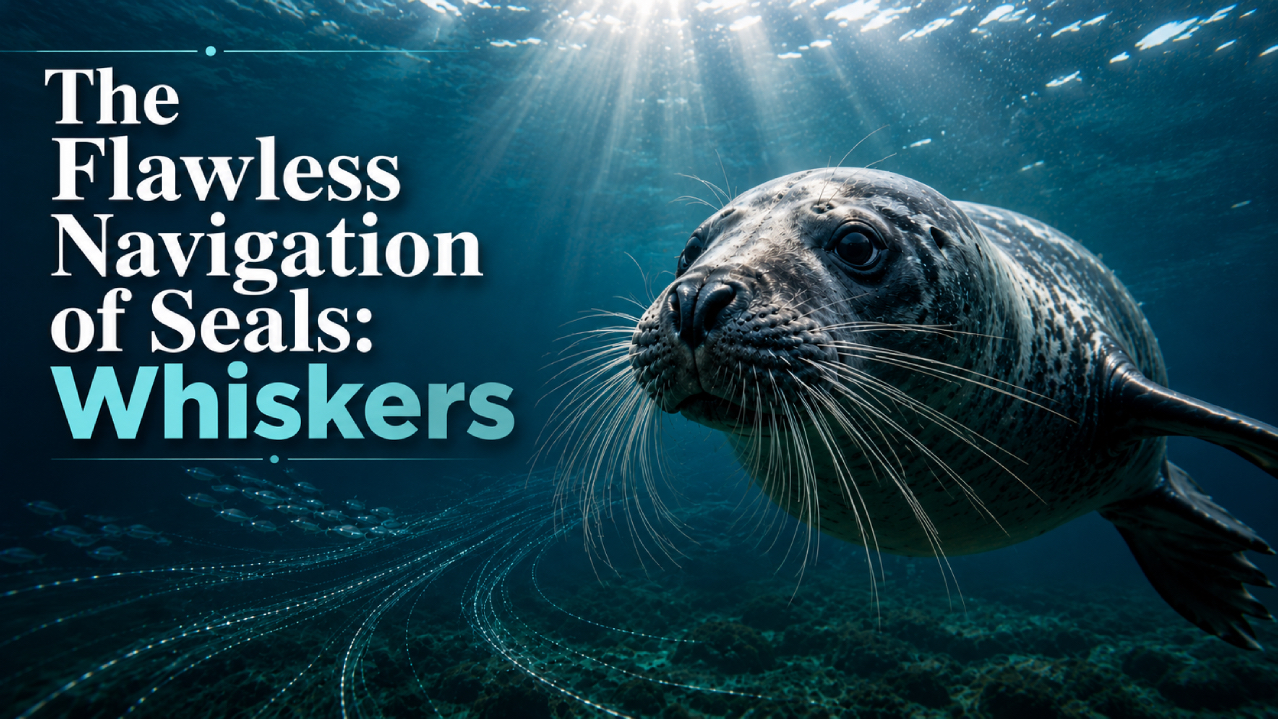
A group of scientists from the Universities of Bonn and Ruhr in Germany discovered, as a result of their study conducted on seals, that these animals use extraordinary methods to catch their prey in dark or turbid waters, and that they make use of their whiskers for this purpose. According to the research, in environments where seals cannot use sensory organs such as hearing and vision, they locate their prey by following the turbulent trails left behind by fish as they move through the water. This research, carried out by Guido Dehnhardt and his colleagues, shows that by tracking the disturbances in the water with their whiskers, seals are able to follow and capture their prey with extraordinary precision even at distances of up to 200 meters.(1)
How does this occur?
Although we cannot detect them with the naked eye, the trails left behind by fish as they swim have a vortical structure. The velocity of the particles within these vortices remains higher than that of the surrounding water for several minutes after the fish has passed by, meaning that fish leave behind a considerably long hydrodynamic trail as they swim. Marine animals that feed on fish detect and capture their prey from long distances by following these trails.(2) Seals likewise employ their whiskers, which function as highly sensitive antennae for this purpose, enabling them to capture their prey with ease.
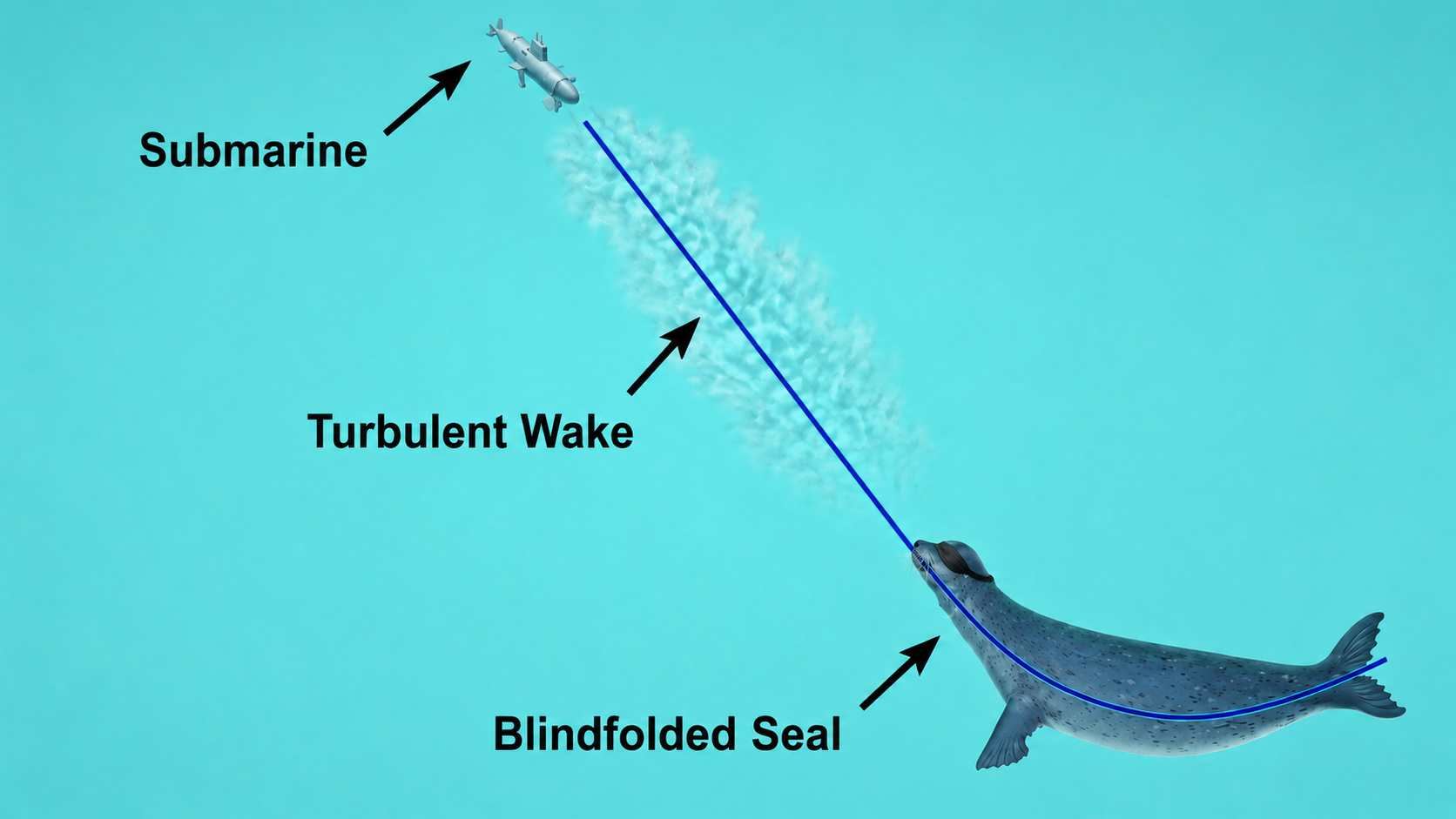
To determine this ability of seals, researcher Dehnhardt and his colleagues used two male seals named Henry and Nick as the predators, and a miniature submarine as the prey. The reason for using the miniature submarine was that the trail it left behind was approximately identical to the hydrodynamic trail produced by a fish measuring 30 cm in length.
In the first experiment, the researchers conducted the experiment with the seal Henry in a pool filled with turbid seawater. They placed a type of hood over the seal's head that completely covered its eyes, fitted headphones over its ears so that it could not hear the sound of the submarine, and positioned Henry's head on a platform 40 cm above the surface of the water. Two seconds after the submarine's motors had been switched off, the headphones were removed from the seal's head. Immediately after the headphones were removed, seal Henry dived into the water, first swam toward the center of the pool, and established a point of orientation. It then directed its whiskers forward while simultaneously scanning its surroundings like a radar by moving its head gently from side to side as it swam. In this way, as soon as seal Henry encountered the trail left by the submarine's propeller, it turned in the direction in which the vehicle had traveled and began following these vortical traces formed underwater by swimming at a speed of 2 meters per second. In this experiment, the blindfolded seals successfully located the submarine on 256 occasions.
However, when the researchers placed a hood over Henry's snout that covered its whiskers, they found that the seal Henry was unable to detect the hydrodynamic trail in any of the trials. The same experiment conducted with the other seal, Nick, yielded similar results. As a result of this extensively repeated experiment, it was demonstrated that seals detect and analyze hydrodynamic information and follow underwater trails by means of their whiskers, which possess extraordinary sensitivity and function as an almost millimeter-precise navigation system, and which constitute a miracle of creation.
Not only seals, but all marine animals are able to track and capture their prey with ease in dark or turbid waters without using their eyes or other sensory systems, by means of the miraculous organs of creation that our Lord has bestowed upon them. For example, dolphins also use a radar scanning system to capture their prey; however, their system differs from that of seals. Dolphins perform this radar function by using sound waves, and the time required for the sound emitted by the dolphin to return to it—that is, its echo—enables them to locate their prey with ease.
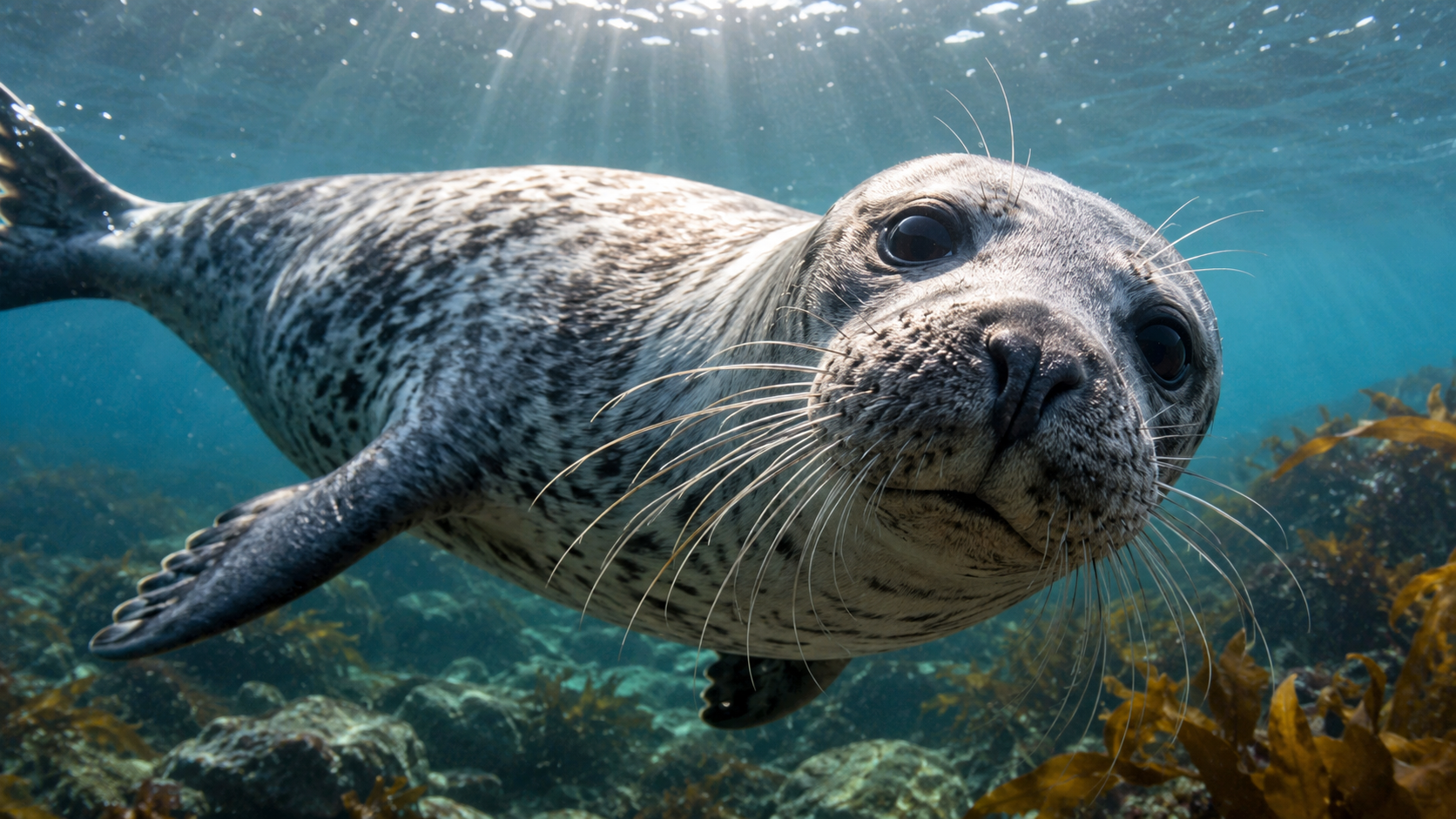
Although only their whiskers have been discussed here, the extraordinary abilities of seals, which possess a miraculous creation in every detail, constitute just one striking example of the perfect design found in living organisms in nature. In addition to using their whiskers as antennae and transmitting the signals received by them to the brain through highly sensitive nerves, their ability to interpret these signals accurately, determine the precise location of their prey, advance rapidly in the correct direction without error, and capture it is vital for their survival. Such detailed and functional systems are too complex to be explained by chance and are an indication of the superior knowledge and power of our Lord in creation. As in seals, the miraculous characteristics present in all living beings that we observe around us demonstrate that the universe has been created by our Lord in a unique and unparalleled manner:
[He is] the Originator of the heavens and earth. When He decides on something, He just says to it, “Be!” and it is.
(Surat al-Baqara, 117)
References
1. Dehnhardt, G. et al. Hydrodynamic Trail-Following in Harbor Seals (Phoca vitulina). Science, 293, pp. 102–104 (2001). https://www.science.org/doi/abs/10.1126/science.1060514
2. König, J. SCIENCE: Barthaare weisen Seehunden den Weg. idw-online, July 5, 2001. https://idw-online.de/de/news36875
3. Pfaff, C. Seehunde finden ihre Beute mit den Barthaaren. wissenschaft.de, July 12, 2001. https://www.wissenschaft.de/erde-umwelt/seehunde-finden-ihre-beute-mit-den-barthaaren/