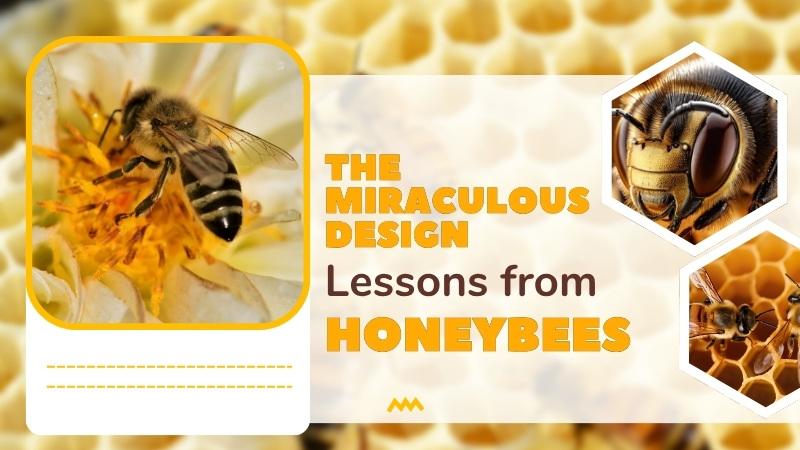
The sun has only just risen above the horizon. The first light of day is slowly spreading across the sky. This scene, which fills the human spirit with brightness, is not merely a source of beauty for the millions of species living in nature; it is also a vital signal. One of those creatures takes flight, beating its tiny wings, and from the very moment of its first departure knows exactly where it is going without the slightest hesitation. It possesses neither a compass, nor a clock, nor a map, nor any sophisticated flight-navigation equipment. Yet it never loses its way. Through dark forests, across vast plains, it flies for kilometers and ultimately finds precisely the flower it set out to reach.
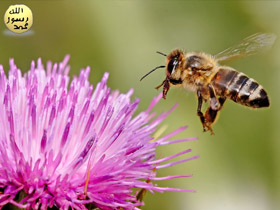
Acting almost like a piece of advanced technological machinery or a highly sophisticated drone, this remarkable creature is, in fact, a tiny honeybee.
For many years, scientists sought to understand the navigation system of honeybees. A major breakthrough came in the twentieth century through the pioneering work of Karl von Frisch. Researchers discovered that, through their famous “waggle dance” performed inside the hive, bees communicate the direction of a target location to other bees by referencing the position of the Sun. The direction of the dance indicates the direction of the target, the duration of the waggle phase conveys the distance, and the angle of the dance encodes the angular relationship between the target and the Sun.
What makes this particularly intriguing is the following: the Sun does not remain fixed in one position; it is constantly moving across the sky. How, then, can a creature possessing a brain no larger than the head of a pin compensate for this movement?
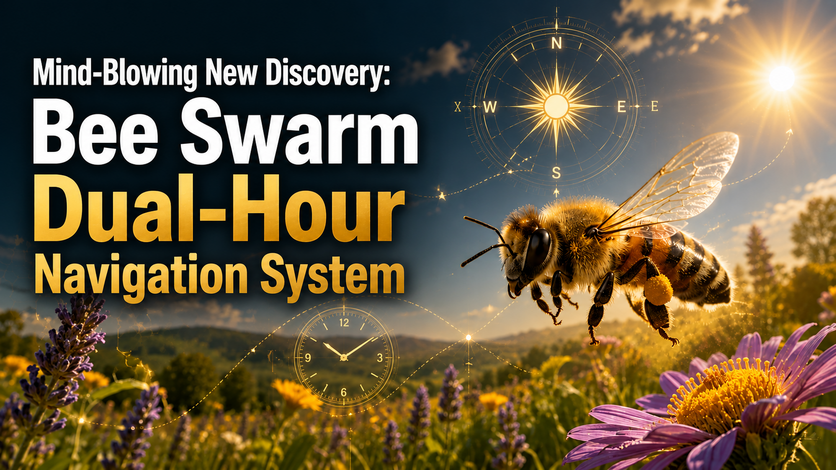
The answer to this question has revealed one of the honeybee’s most extraordinary abilities. Honeybees integrate the Sun’s movement throughout the day with their internal biological clocks and continuously update their calculations of solar position. In other words, directional information acquired in the morning can still be used accurately hours later, even around midday. This is not merely a behavioral trait; it is a sophisticated navigation process that incorporates biological rhythms, memory, and a form of astronomical computation.
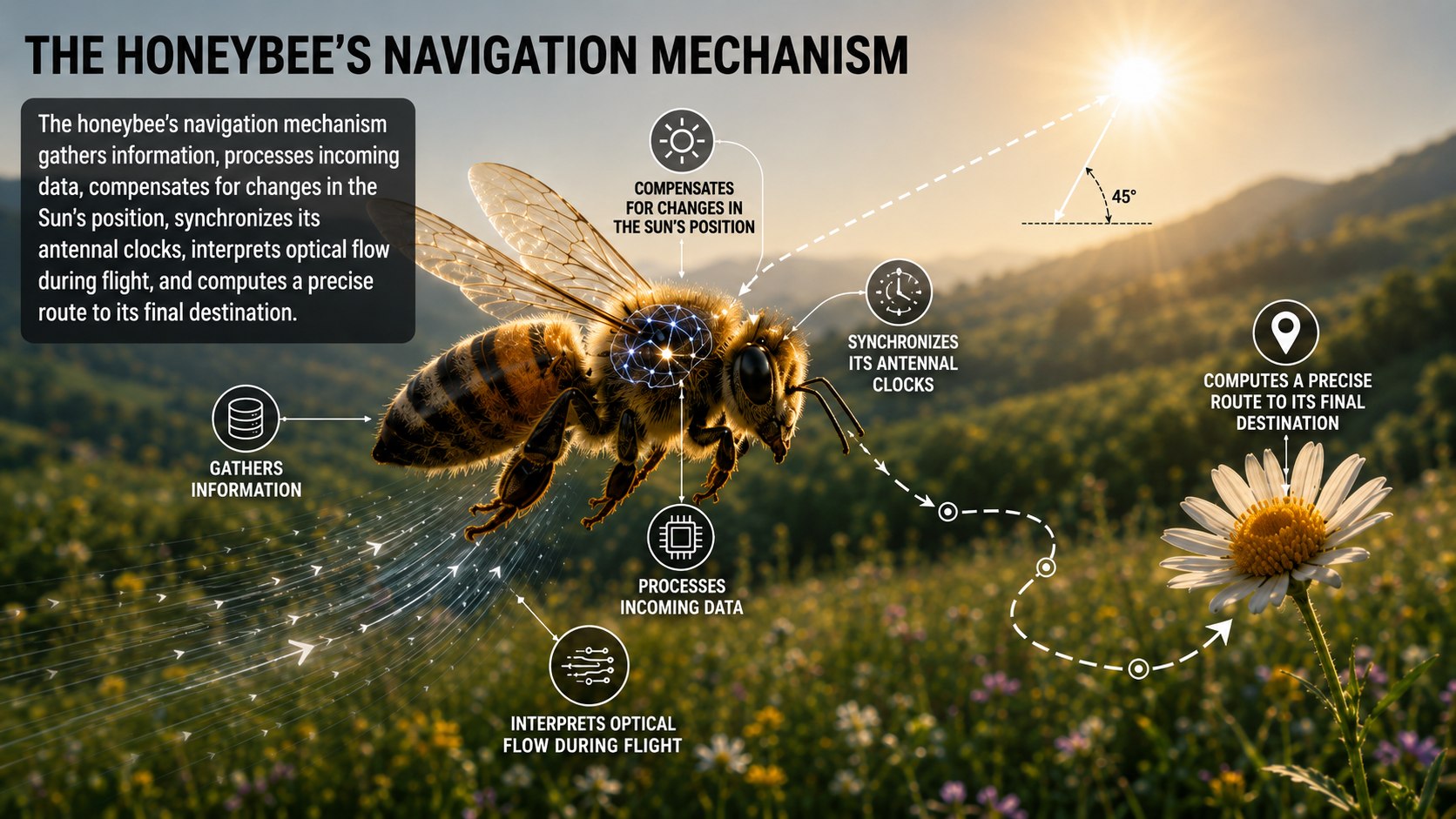
For many years, it was believed that honeybees relied on a single internal clock to calibrate their sun-compass navigation system. However, a new study conducted in the 2020s surprised the scientific community. Researchers exposed the right and left antennae of honeybees to different light cycles, effectively assigning different “times” to each antenna. The results were striking. When the right antenna was set to a “morning time” and the left antenna to an “afternoon time,” the bees’ navigation system broke down completely. This experiment revealed that honeybees navigate using two distinct timekeeping systems: a central clock located in the brain and an auxiliary clock located within the antennae. The timing mechanism in the antennae provides a secondary verification of the brain’s time signal, thereby minimizing navigational errors and enhancing the accuracy of sun-compass orientation.
The honeybee’s brain is no larger than a grain of sand. It consists of only a tiny neural network—approximately one million neurons—yet it functions like a sophisticated navigation computer. Simultaneously, it integrates numerous variables into a single computational process: the position of the Sun, the time of day, the synchronization of the antennal clocks, the target direction stored in memory, wind correction, patterns of polarized light, and features of the surrounding landscape. When all of these factors are considered together, the extraordinary nature of this dual-clock system becomes even more apparent. The slightest mismatch between the two timing mechanisms could cause the bee to lose its sense of direction entirely, become disoriented, fail to return to the hive, and ultimately perish.
This navigation mechanism, which modern artificial intelligence algorithms are still attempting to emulate, performs a remarkable sequence of operations: it gathers information, processes incoming data, compensates for changes in the Sun’s position, synchronizes the antennal clocks, interprets optical flow during flight, and computes a precise route to its destination. A honeybee receives no training in order to perform these tasks. It attends no school and does not acquire these abilities through trial and error. All of the information and biological machinery required for this complex system are already present within the bee from the moment it enters the world.
The honeybee’s navigation system is described by many biologists as “a complex whole composed of interdependent components.” This system acquires meaning only when it operates in a complete, coordinated, and uninterrupted manner. The absence of even a single component would render the entire system nonfunctional. A person guided by sound reason and conscience recognizes that such a multilayered and complex system leaves no room for chance and cannot be explained as the product of the random accumulation of unconscious processes.
Whether flying among mountains, through forests, or across open plains, the honeybee never loses its way. It reads the Earth like a map, uses the Sun as a compass, and internally tracks the passage of time with the precision of a clock. Its complex, delicate, and highly refined navigation system, like every detail of its body, resembles a masterpiece of engineering specially designed for its purpose. It is a clear manifestation of the supreme intelligence, infinite knowledge, and unparalleled power that govern the universe. This intelligence, knowledge, and power belong to God, the Lord of all the worlds. As God reveals in the Qur’an, honeybees act through divine inspiration:
Your Lord revealed to the bees: "Build dwellings in the mountains and the trees, and also in the structures which men erect. Then eat from every kind of fruit and travel the paths of your Lord, which have been made easy for you to follow." From inside them comes a drink of varying colours, containing healing for mankind. There is certainly a sign in that for people who reflect. (Surat an-Nahl:68-69)
.jpg)
References
Beer, K. (2024). “Ingeborg Beling and the Time Memory in Honeybees.” Journal of Comparative Physiology A. Springer. Review article on time memory and circadian clocks in honeybees.
Menzel, R. (2023). “Navigation and Dance Communication in Honeybees.” Journal of Comparative Physiology A.
Bloch, G. (2017). “Time Is Honey: Circadian Clocks of Bees and Flowers and How Their Interactions May Influence Ecological Communities.” Philosophical Transactions of the Royal Society B: Biological Sciences.
Guerra, P. A., et al. (2012). “Discordant Timing Between Antennae Disrupts Sun-Compass Orientation in Monarch Butterflies.”