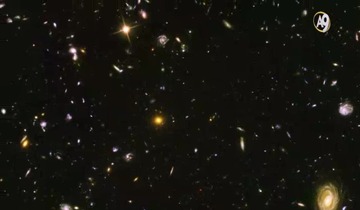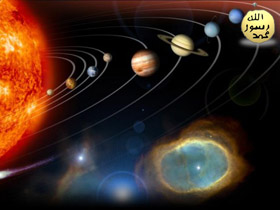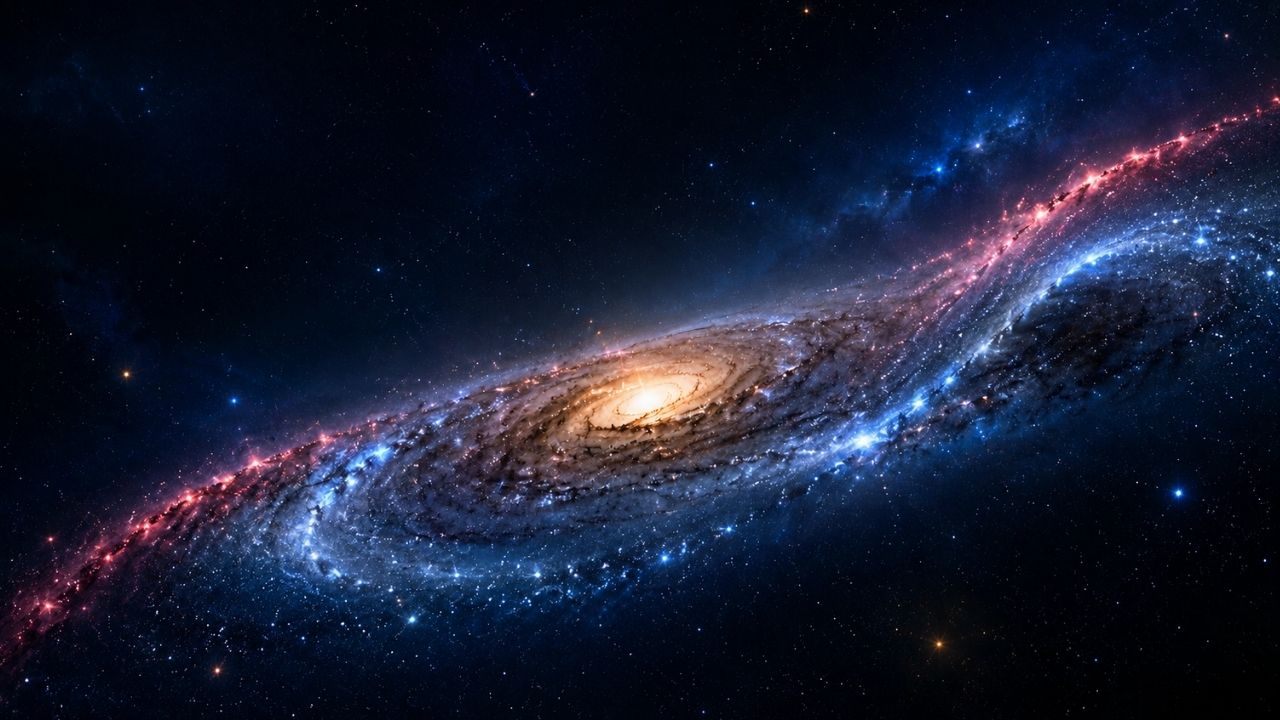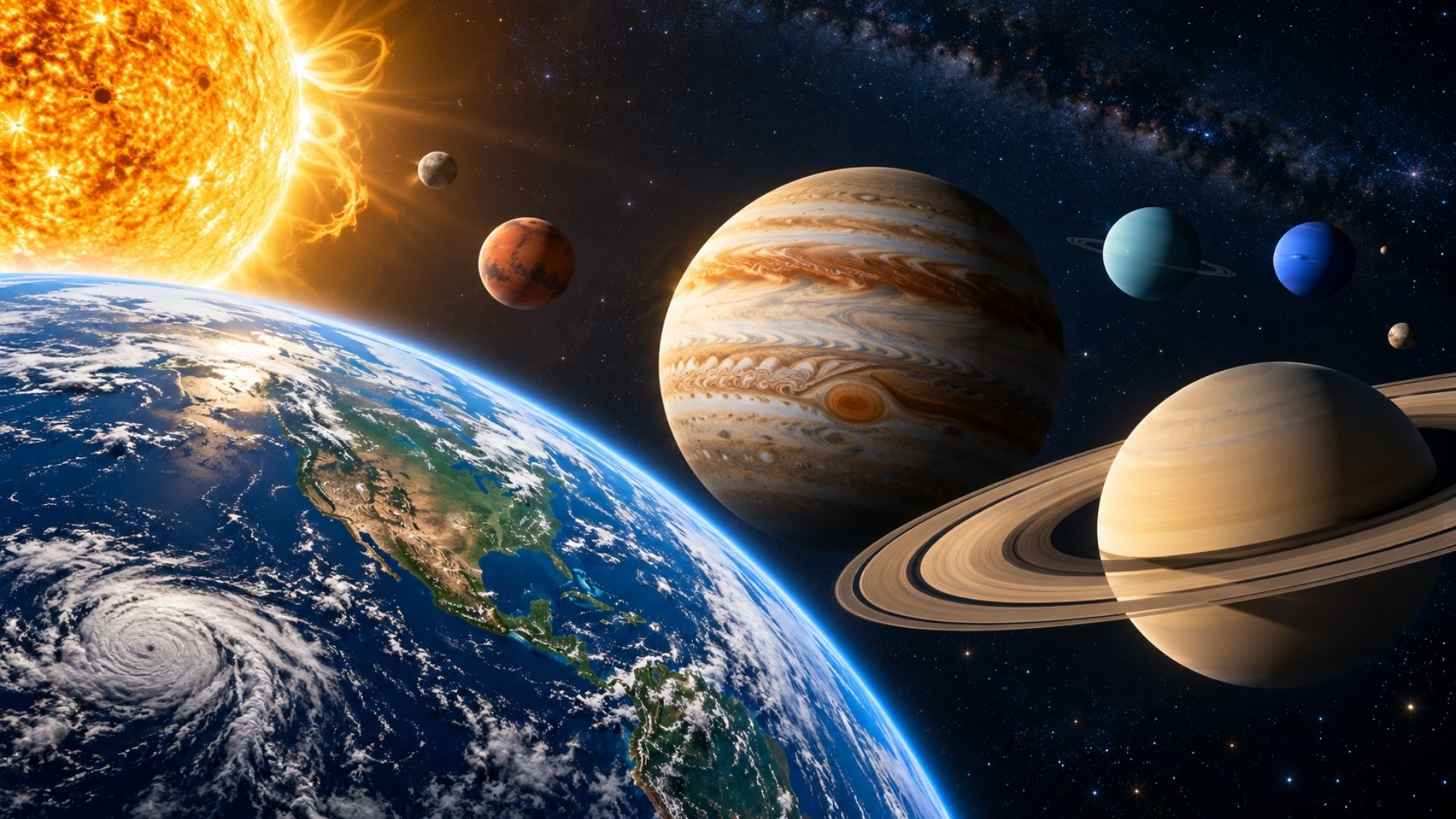
The Solar System is a magnificent celestial system located in the Milky Way Galaxy, with the Sun at its center. In this system, which is thought to have formed approximately 4.6 billion years ago, there are eight planets, hundreds of natural satellites, millions of asteroids, comets, meteoroids and dwarf planets orbiting the Sun.
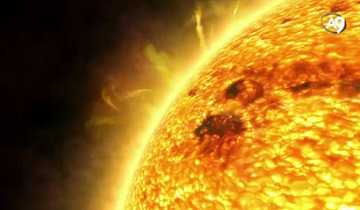
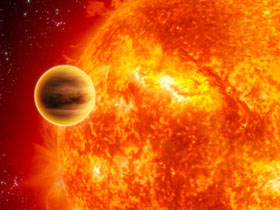
The Sun at the center of the system is not merely a star; it is also an enormous source of energy that constitutes approximately 99.8% of the mass of the Solar System. The planets, satellites and all other celestial bodies move in specific orbits due to its gravitational force.
God reveals as follows in the Holy Qur'an:
"And the Sun runs to its resting place. That is the decree of the Almighty, the All-Knowing." (Surah Ya-Sin, 38)
The order revealed by astronomy today enables us to reflect once again on this Divine order to which the Qur'an draws attention.
Striking Features of the Solar System
Mercury Is Constantly Contracting
Mercury, the planet closest to the Sun, is gradually shrinking because its core is cooling over time. Images sent by spacecraft show that the large fractures and fault lines formed on its surface are the result of this contraction.
Venus Is Like an Oven
Although Venus is the second closest planet to the Sun, it is the hottest planet in the Solar System. Due to its dense carbon dioxide atmosphere, its surface temperature reaches approximately 465°C.
The Soviet-built Venera 13 spacecraft, which landed on Venus in 1982, was able to operate for only two hours; nevertheless, it succeeded in sending the first color photographs of the surface and conducting soil analyses.
Jupiter Is a Giant Planet
Jupiter is the largest planet in the Solar System. Its volume is large enough to contain approximately 1,300 Earths. The Great Red Spot on it is a giant storm that has continued for centuries. This storm is large enough for the Earth to fit comfortably inside it.
The Giant Volcano on Mars
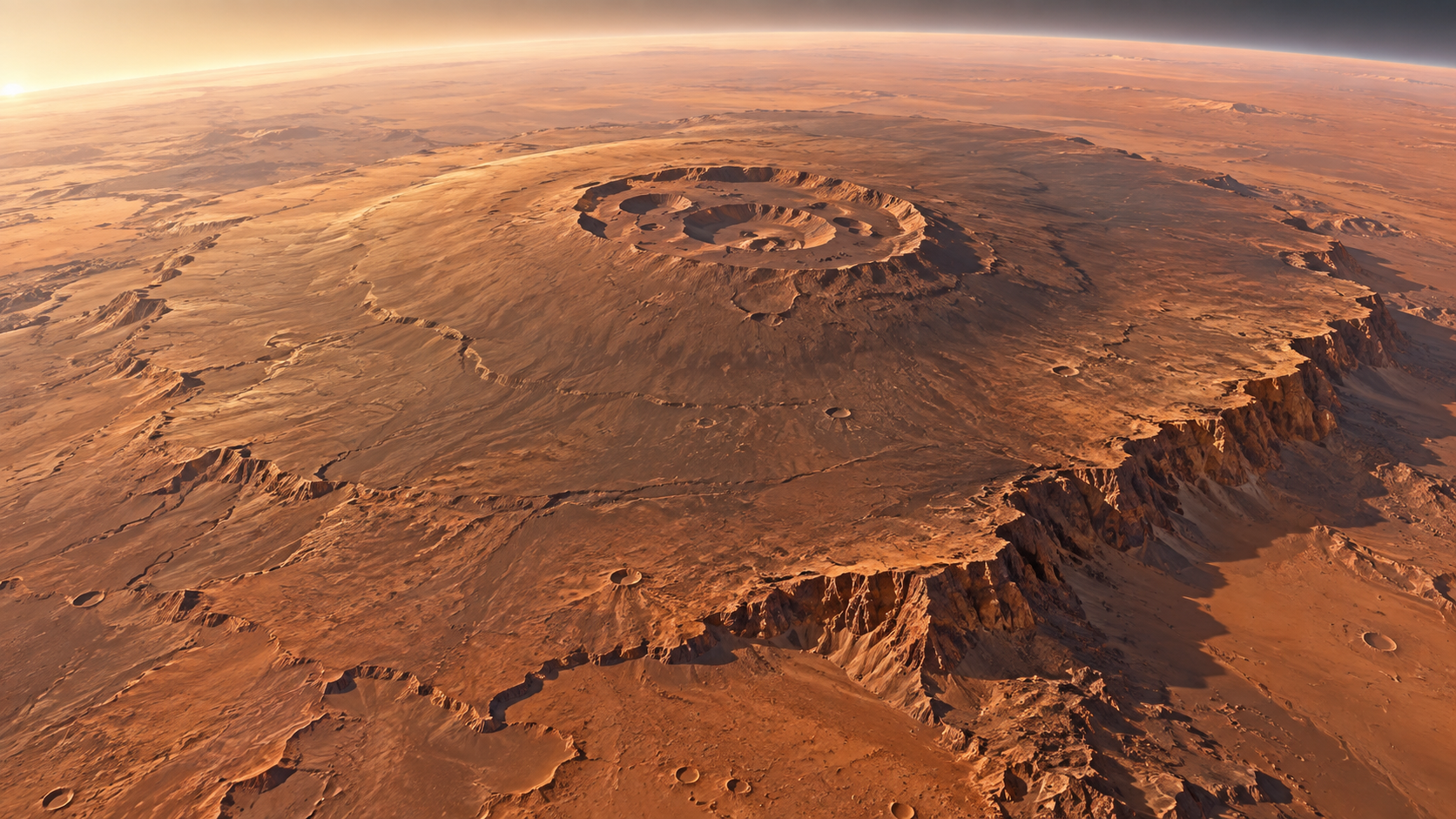
The largest known volcano in the Solar System is Olympus Mons on Mars. Reaching a height of approximately 22-26 kilometers, this giant structure is approximately three times as high as Mount Everest.
Comets
The Solar System does not consist solely of planets. There are billions of comets in its outer regions. They are found mostly in the Kuiper Belt and the Oort Cloud.
A comet is a structure made up of ice and rock until it draws sufficiently close to the Sun. When comets approach the Sun, their ice evaporates, their outer surfaces turn into clouds of gas and dust, and their distinctive long tails form.
In 2014, as part of the European Space Agency's Rosetta mission, the Philae probe made the first successful landing on a comet in history.
The Delicate Balances in the Solar System
The Sun's Gravitational Force
The gravitational force of the Sun is an enormous shield that affects not only the Earth but the entire Solar System. This magnetic field keeps the harmful particles emitted by the Sun (solar winds) under control and protects our planet particularly by interacting with the Earth's magnetic field. If this magnetic field were slightly stronger or weaker, the present-day orbits of the planets would also change.
This delicate order in the universe reveals how perfect the laws of physics established by God are.
God reveals as follows in the Qur'an:
“Verily, all things have We created in proportion and measure.” (Surat al-Qamar, 49)
The Sun's Magnetic Activity
The Sun's gravitational force ensures that the planets revolve in their orbits in a stable and orderly manner. If the mass of the Sun were too little or too great, the planets would either fall into the Sun or be hurled into space. This balance makes it possible for the Solar System to remain stable for billions of years.
This extraordinary balance is a manifestation of God's attributes of “creating, fashioning flawlessly, measuring and arranging”. Attention is drawn to this truth in the Qur'an as follows:
“He to Whom the kingdom of the heavens and the earth belongs. He does not have a son and He has no partner in the Kingdom. He created everything and determined it most exactly.” (Surat al-Furqan, 2)
The Effect of Jupiter
Jupiter's very great mass significantly affects the orbits of many comets and asteroids in the Solar System. While it draws some bodies toward itself, it alters the course of others.
Astronomers think that Jupiter has played an important role in the Earth's history of collisions. However, this effect cannot always be said to be protective; it is also known that in some cases it can direct celestial bodies into the inner Solar System.
Even this reveals how the delicate physical order established by God in the universe is based on very fine balances.
.jpg)
The Thinness and Order of Saturn's Rings
Saturn's rings are made up largely of ice and small amounts of rock and dust particles. The thickness of these rings, which can reach approximately 280,000 kilometers in width, ranges from only a few tens of meters to a few hundred meters in most regions. The fact that such a thin structure is spread over such a vast area is one of the most impressive sights in the Solar System.
This order is clear evidence that God is “He Who has created all things in the best possible way…” (Surat as-Sajdah, 7).

The Earth's Axial Tilt and the Formation of the Seasons
The Earth's axial tilt of approximately 23.4 degrees brings about the seasons. If this tilt were different, climatic conditions could also be significantly different. The seasons would either be extremely harsh, or there would be no seasons at all. It is a great blessing that Almighty God has made the Earth suitable for living things.
The Qur'an emphasizes how God has made the Earth suitable for human beings as follows:
“It is He Who made the earth a couch for you, and the sky a dome…” (Surat al-Baqara, 22)
Venus's Reverse Rotation
Venus rotates on its axis in the opposite direction to most of the other planets. This unusual feature reveals how the planets in the Solar System were created with features that differ greatly from one another.
Venus's reverse rotation once again proves that there is no room for chance in the formation of the planets. It is revealed in the verse as follows:
“The kingdom of the heavens and earth belongs to God. He creates whatever He wills…” (Surat ash-Shura, 49)
A Day on Mercury Is Longer Than a Year
Although Mercury is the closest planet to the Sun, it rotates very slowly on its own axis. A solar day lasts approximately 176 Earth days, while a year lasts only 88 Earth days. Therefore, a day on Mercury is longer than a year.
This extraordinary situation once again reveals the fact that God “created all things in proportion and measure”:
“He to Whom the kingdom of the heavens and the earth belongs. He does not have a son and He has no partner in the Kingdom. He created everything and determined it most exactly.” (Surat al-Furqan, 2)
Neptune's Giant Winds
The winds on Neptune, reaching speeds of 2,000 kilometers per hour, are the fastest winds in the Solar System. These extraordinary atmospheric movements are among the aspects of planetary physics that have still not been fully understood.
This is an indication of the might in God's creation. No chance can produce such great energy continuously and in an orderly manner.
God's might is emphasized in the Qur'an as follows:
“It is He Who created the heavens and the earth with truth. The day He says ‘Be!’ it is.” (Surat al-An`am, 73)
Pluto's Interesting Orbit
The orbit of the dwarf planet Pluto sometimes enters inside Neptune's orbit. However, due to the orbital resonance between the two celestial bodies, they never collide with one another. This delicate celestial order is one of the most striking examples in astronomy. Such delicate balances in the universe are evidence of the perfection in God's creation.
It is revealed in the verse as follows:
“Everyone in the heavens and Earth belongs to Him. All are submissive to Him.” (Surat ar-Rum, 26)
The Protective Role of the Asteroid Belt
The main asteroid belt between Mars and Jupiter contains millions of asteroids (pieces of rock). Their sizes range from 10 meters to 530 kilometers.
The asteroid belt located between Mars and Jupiter acts as a barrier protecting the inner planets of the Solar System from major meteorite impacts. If this belt did not exist, the Earth would be constantly exposed to major collisions.
Space Research Is a Means of Becoming More Closely Acquainted with God's Artistry
Some people may regard space research as unnecessary. Yet, by means of the probes sent into space, we learn new information every day about the universe created by God.
One of the finest examples of this is the Cassini spacecraft.
Launched in 1997, Cassini operated for approximately twenty years, traveled billions of kilometers and obtained countless pieces of previously unknown information about Saturn and its satellites.
When its mission ended on September 15, 2017, it was sent into Saturn's atmosphere in a controlled manner; it thus both made great contributions to the scientific world and prevented the contamination of Saturn's satellites.
These studies carried out by scientists are important efforts aimed at understanding the secrets of the universe created by God. Every new discovery reveals the order and refinement in the universe a little more.
Conclusion
Every planet, every orbit and every law of physics in the Solar System is a manifestation of God's infinite knowledge, might and wisdom.
Almighty God reveals as follows in the Holy Qur'an:
"In the creation of the heavens and the earth, and the alternation of night and day, there are Signs for people with intelligence." (Surah Ali `Imran, 190)
Astronomy does not merely introduce us to celestial bodies; it also enables us to see more closely the order, measure and artistry in God's creation. For people who reflect, the Solar System is only one of the countless signs displaying the might and wisdom of our Lord.
Source:
Danko, M. 24 Fascinating Facts About the Solar System Mental Floss. https://www.mentalfloss.com/article/649684/solar-system-facts