11. The Miraculous Molecule That Regulates Body Temperature
11. The Miraculous Molecule That Regulates Body Temperature
As you'll know, the normal body temperature for all human beings is between 36.5 to 37 degrees Celsius, or 96 to 98.6 degrees Fahrenheit. But have you ever wondered about the source of your body temperature and what maintains it at that constant level?
 |
| a. thyroxin |
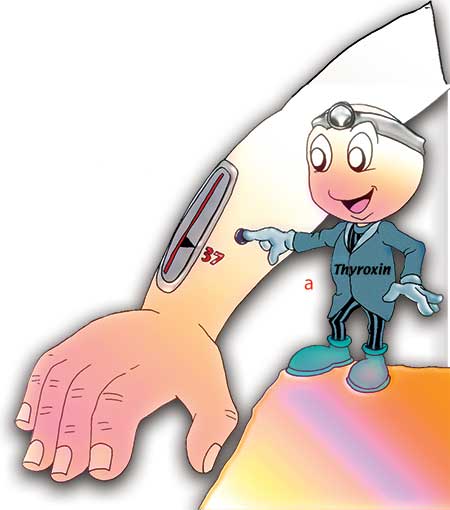
| Figure 56: The hormone thyroxin regulates the body's temperature, just like a thermostat. |
Central heating systems are generally employed to keep our homes warm, with thermostats that regulate the temperature. The householder warms his home by turning the thermostat up to the desired level. But what exactly is the human body's central heating system? And how is that "thermostat" adjusted?
The source of body heat is the 100 or so trillion cells in the human body. During the course of their activities, the cells emit a certain amount of heat, which causes the body to warm up. But it is the hormone thyroxin, a tiny molecule that regulates—with God's inspiration—how much heat each of these micro-heaters should give off. In other words, thyroxin acts as a thermostat (Figure 56).
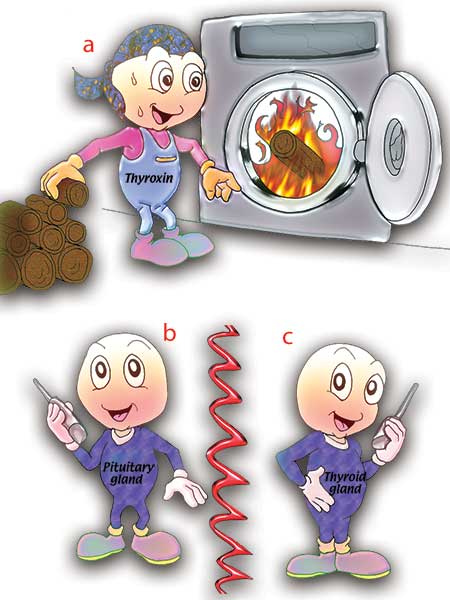
The way a cell generates a specific level of heat as it operates, and that the total amount emitted by those roughly 100 trillion cells reaches the exact level required for healthy human life is a miracle all by itself. Somehow, thyroxin molecules know how much heat each cell should give off, and how that heat is to be increased—in itself this is a miracle of creation (Figure 57).
The secretion of the thyroxin is another miracle of creation. The moment the need for the hormone is felt, the hypothalamus—in effect, the "brain" of the hormonal system—sends a command (via the thyroid-stimulating hormone or TSH) to the pituitary gland, the conductor of the nervous system. Receivings this command, the pituitary gland realizes that the thyroid gland needs to go into action. And so, it immediately dispatches a command in the form of thyrotropin (or thyroid-gland stimulating hormone) to the thyroid gland. The thyroid, the final link in this chain of command, immediately produces the hormone thyroxin in accord with the chemical instruction reaching it, and distributes it throughout the entire body by way of the bloodstream (Figure 58).
It is not only the duty of the hormone thyroxin that is so very important, but also the level at which it is secreted. But how is that level determined? How is it that neither too much nor too little of this hormone is secreted into the blood (apart from in times of sickness and fever)? What determines the level at which thyroxin is secreted is a special system created by God with His infinite knowledge, consisting of two separate measurement and feedback mechanisms. Both mechanisms are the result of matchless engineering design.
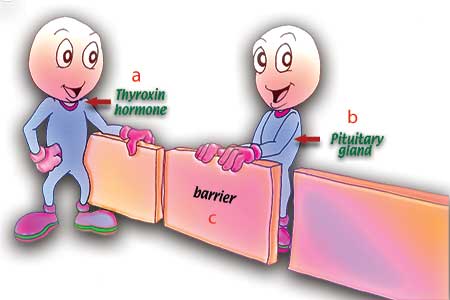
When the level of thyroxin in the bloodstream rises above normal, thyroxin produces a very significant effect on the pituitary gland: It reduces the pituitary gland's sensitivity to TSH, the thyroid secretion hormone (Figure 59).
 |
| a. thyroxin |
| Figure 57: The thyroxin molecules know how much heat the cell must give off and how that heat is to be increased—yet another miracle of God's creation. Figure 58: When the pituitary gland sends a command to the thyroid, the thyroid immediately begins producing thyroxin and distributes this hormone to the entire body via the bloodstream. |
If you think about it, a most marvelous structure is plain to see. The hormone TSH's task is to set the pituitary gland in action and send a message to the thyroid gland—which represents the second link in the chain of command established for the production of the hormone thyroxin.
 |
| a. Thyroxin hormone |
| Figure 59: When the level of thyroxin in the blood rises above normal, this hormone erects a literal barrier in front of the pituitary gland. |
The system has been planned in such great detail that the increased thyroxin takes a most intelligent measure to prevent any excess production of itself, and so interrupts the chain of command responsible for that production. Thus it is automatically able to slow down the production of thyroxin when the level of thyroxin in the bloodstream rises above normal (Figure 60).
There's a second system that also determines the level of production of thyroxin. Increased thyroxin affects the hypothalamus cells, which then reduce the production of TSH—and thyroxin production is slowed accordingly.
 |
| Figure 60: When the level of thyroxin in the blood rises above normal, the production process is automatically halted. |
When the level of thyroxin in the blood decreases, the system works in the opposite direction. Aware that the level of thyroxin has gone down, the hypothalamus produces more TSH, which increases thyroxin production.
We now need to ask the following questions: how does thyroxin know that the chain of command for thyroxin production must be interrupted? How do the hypothalamus cells know that hormone secretion must be interrupted when thyroxin rises, but that they need to produce more when the thyroxin levels decline? How did this precisely efficient system first come into being?
To imagine that such a finely-planned procedure arose by chance is even more irrational than to claim that a computer and all its programs came into existence by chance. That is because just as with a computer, in order for this system to function, literally hundreds of other specially planned details—which we have not gone into here—must take place at the molecular level.
It is obvious that it is Almighty God, with His sublime intelligence and might, Who has created this system. God's knowledge pervades all places:
... My Lord encompasses all things in His knowledge so will you not pay heed? (Surat al-An'am, 80)