35. The Journey of Vitamin B12
35. The Journey of Vitamin B12
One feature of the stomach’s mucus is that it contributes to the bone marrow that produces blood. It ensures that vitamin B12, which is of enormous importance to the body, reaches the marrow. When we examine the journey that vitamin B12 undertakes before it reaches the marrow, and the role played by this in the stomach mucosa, we shall see yet another miracle taking place at the microscopic level.
After entering the human body, vitamin B12 makes a long journey through the digestive system. It finally enters the bloodstream from the small intestine and reaches the bone marrow cells (Figure 127).
The absorption of vitamin B12 takes place in the small intestine. However, no digestive cell in the small intestine is able to trap the vitamin. There is a special group of cells in one small region of the small intestine that has solely been charged with capturing vitamin B12.27 This group of cells dedicates their lives, in a most miraculous manner, to trapping this vitamin. These cells identify and seize vitamin B12 from among trillions of molecules. How do these cells identify it, and how do they distinguish it from so many other substances? Why do they feel themselves obliged to capture vitamin B12?
 |
| Figure 127: Vitamin B12 first enters the body through the digestive system, and then enters the bloodstream through the small intestine. |
The intelligence exhibited by these cells in catching vitamin B12 cannot, of course, emerge as the result of chance. As we shall clearly see, Almighty God, the sublime and mighty, deliberately created this system. When we examine it in a little more detail, miraculous proofs of creation will become more clear.
The cells in the small intestine are unable to recognize vitamin B12 in its raw form. In order for it to be recognized and caught, vitamin B12 needs to be marked with a special molecule. This requirement has, of course, already been taken into account, and a system to mark the vitamin B12 before it reaches the intestine has been established.
While the vitamin B12 is still in the stomach, the stomach cells produce a special “marker” molecule for B12. This molecule is like an identity document that the vitamin will need on the later stages of its journey. This “marker” adheres tightly to the vitamin B12 as it continues on its journey to the small intestine (Figure 128).
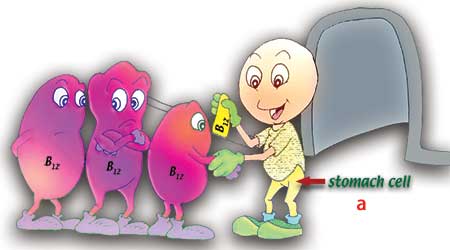 |
| a. Stomach cell |
| Figure 128: While vitamin B12 is still in the bloodstream, the stomach cells produce a special molecule for it. This molecule is an identity document that this vitamin will need on every stage of its journey. |
In the small intestine, border officials—a specialized group of cells, whose sole duty is to find vitamin B12—ensure its passage into the bloodstream. However, these “officials” are unable to recognize vitamin B12 in its unprocessed state. At this point, the “passport” carried by the B12 comes to its assistance. Thanks to this document, the border officials identify and locate the vitamin B12 from among trillions of other molecules. Then, again thanks to this marker molecule, they enable the vitamin B12 to enter the bloodstream. In this way, the B12 succeeds in reaching the bone marrow (Figures 129 through 131).
As you’ve seen, the stomach cells know the importance to the body of vitamin B12. Moreover, the intestinal cells know what kind of marker they need in order to recognize B12, and they produce this marker molecule. Intestinal cells, have no eyes, hands or brains, yet they recognize this marker and thus catch the vitamin B12.
Another very important point is that the vitamin B12 absorbed as the result of all these events provides no direct benefit to the cells in either the stomach or the intestinal wall. Vitamin B12 is used very far away, in the bone marrow. Thanks to it, the human body can produce blood, and is thus able to survive.
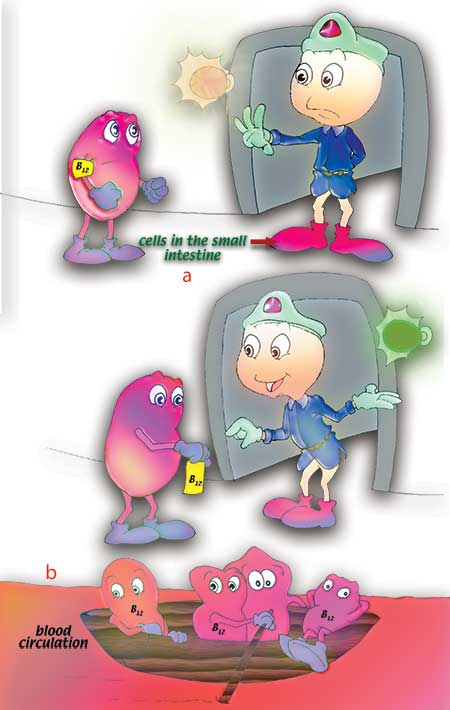 |
| a. Cells in the small intestine |
| Figure 129: Cells in the small intestine are unable to recognize vitamin B12 in its unprocessed form. In order for B12 to be recognized and caught by the cells, it must be marked with a special molecule. Figure 130: The labels affixed to the vitamin B12 by the stomach cells come into play here, as the small intestine cells recognize these labels and accept the B12. Figure 131: In this way, vitamin B12 enters the bloodstream. |
The journey undertaken by a single vitamin and the details of that journey are sufficient for us to realize the flawless nature of the system established inside our bodies.
It is certain that the keen awareness and flawless functioning displayed in the course of these processes cannot take place through the will of the cells concerned. After all, the entities known as cells are structures consisting of collections of unconscious molecules. It would be meaningless to look for consciousness, will or a power inside a cell. It is our Lord, Almighty God, Who created this system, and all things, from nothing.