22. Chemical Communication in the Nerve Cell
22. Chemical Communication in the Nerve Cell
The links between neurons, or nerve cells, are established both by electrical signals and by means of chemical signals. Both forms of communication contain significant marvels.
In this section we shall be concentrating on various aspects of chemical communication, established by messenger molecules that comprise the spinal neurotransmitter. These are produced in the body of the nerve cell, carried along the axons (the long arms of neurons), and stored in miniature “bubbles” at the axons’ terminals. Each bubble contains some 5,000 messenger molecules.19And recent research has shown that every neuron produces different chemical messengers.20 To put it another way, it resembles a chemical plant in which the various tools to be used in communication are produced. (Figure 89)
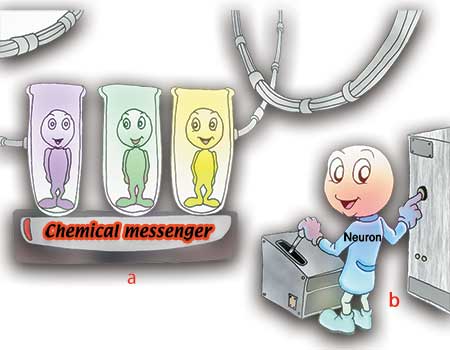 |
| a. Chemical messenger |
| Figure 89: Every neuron produces a different chemical messenger, unique to itself. To state that another way, every neuron works like a factory producing chemical messengers to be used in communication. |
The neuron that transmits the signal may be described as the transmitter and the receiving neuron as the receiver. These two come face to face at the synapse junctions. The distance between them is approximately 0.00003 millimeters (1.1811 inches).21 The electrical signal sets in motion the messengers at the end of the nerve-cell axons. Bubbles filled with chemical messengers attach to the cell membrane and release the molecules inside them into the spaces, or synapses between neurons. The message carried by the messenger is forwarded to receptors on the receiving neuron’s membrane. There is a particular receptor with which each messenger molecule connects. Thus the message carried by the messenger molecule is perceived by the receiver neuron (Figure 90).
Every stage of the communication process described here in the briefest of terms involves processes not yet completely understood. Indeed, scientists state that their knowledge regarding the nerves’ transmissions is still indistinct.22
Consider, for instance, just the fusion of the bubbles to the cell membrane. The event we describe as “fusion” in fact refers to a very special bonding, analogous to adding of a single component or update to a highly advanced computer.
At this point, the following considerations come to mind: the addition of any part to a computer is preceded by highly complex engineering calculations. Otherwise, inevitably, the new part will be incompatible or may even damage the computer. Of course, fusion compatible with the cell membrane, far more complex than any computer, does not taken place haphazardly. No doubt all these complex processes take place under the control of God, Who created and regulates them.
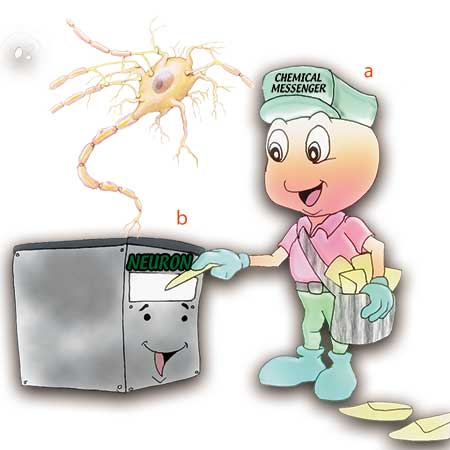 |
| a. Chemical messenger |
| Figure 90: A chemical messenger molecule establishes a link with a different receptor. The message conveyed by the messenger molecule is thus perceived by the receptor neuron. |
Footnotes
19- E. Kandel, J.H. Schwartz, T.M. Jessell, Principles of Neural Science, New York: McGraw-Hill, 2000, p. 277.
20- Eric H. Chudler, “Making Connections—The Synapse,” 2001, http://faculty.washington.edu/chudler/synapse.html
21- E. Kandel, J.H. Schwartz, T.M. Jessell, Principles of Neural Science, p.176.
22- Axel Brunger, “Neurotransmission Machinery Visualized for the First Time,” 1998, http://www.hhmi.org/ news/brunger.html