3. Mother's Milk and the Hormone Oxytosin
3. Mother's Milk and the Hormone Oxytosin
Mother's milk is one of the countless miracles that God has created. The ingredients it contains meet all of a newborn baby's nutritional needs. Furthermore, those ingredients change according to the changing needs of the baby's developing body. The manufacturers of this substance, the like of which scientists are unable to manufacture in their laboratories, are particular cells in the mother's breast. These cells possess the matchless formula for mother's milk and know exactly when to begin production and when to alter the makeup of the fluid they produce.
So how does the production of mother's milk begin, and how is it controlled? In the answers to this question lie hidden many miracles of creation. The hormonal system and nervous system work together in milk production, which in turn takes place as the result of a flawless flow of information and planning (Figure 13).
One very special hormone activates the milk glands in the mother's breast. This is the hormone prolactin, secreted by the pituitary gland.
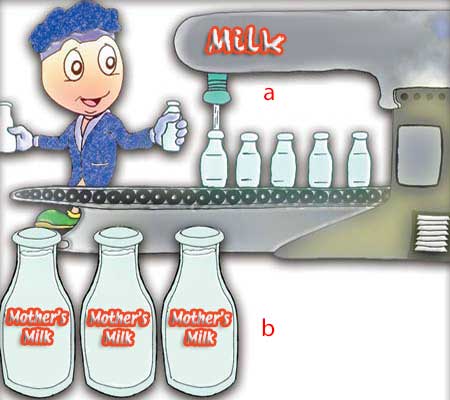 |
| a. Milk, |
| Figure 13: The hormones involved in the production of mother's milk work just like skilled, conscious technicians and workers in a factory. Every detail is a manifestation of the infinite knowledge and mind of God. |
At the beginning of pregnancy, however, a number of factors restrict the secretion of the hormone prolactin. We may think of these factors' function resembling the pressure on a brake pedal in a car moving downhill. The tendency of the car is to keep rolling freely downhill, but it will not do so as long as the brake pedal is pushed down. In the human body, milk production is suppressed.
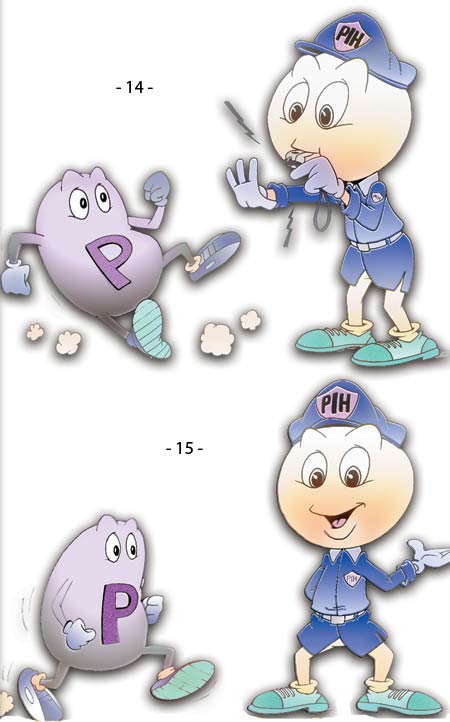 |
| Figures 14 and 15: The hormone PIH accelerates or slows the production of prolactin, as required. Milk production is thus prevented during the first months of pregnancy. This, of course, is not a system that hormones could have thought up themselves. God creates all details without flaw. |
Halting the production of the hormone prolactin is a very wise decision, since there is no point a mother producing milk being before her baby is even born. So how does this "brake pedal" in question function? How is prolactin kept from being secreted earlier than it's required? Here, a perfect system must be factored in. The hypothalamus region of the mother's brain secretes a hormone that suppresses the production of prolactin. This hormone, known as for prolactin-inhibiting hormone (or PIH for short) slows the production of prolactin, thus putting a brake on its secretion.How is the depression of the brake pedal established? The hormone known as estrogen, with the chemical formula C18H24O2, is produced during pregnancy, and permits the hypothalamus to secrete PIH (Figures 14, 15). Secretion of estrogen declines with the birth of the baby; which in turn permits a corresponding reduction in PIH. This process resembles the "brake" being slowly lifted (Figure 16), and thus the production of prolactin slowly increases, stimulating the milk glands to produce mother's milk.
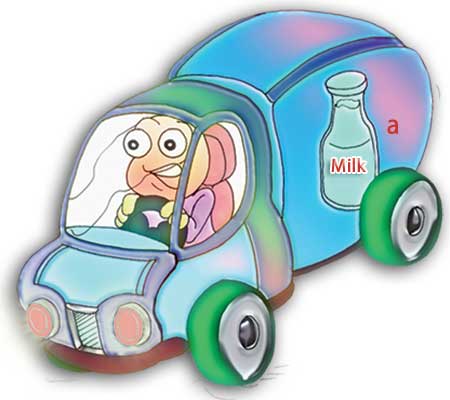 |
| a. Milk |
| Figure 16: After the birth of the baby, the release of estrogen decreases, which in turn leads to a reduction in PIH. This process resembles the way a car starts rolling downhill when you slowly take your foot off the brake pedal. In this way, production of the hormone prolactin gradually increases, setting the milk glands in action to produce mother's milk. |
We are looking at a marvel of creation here. Thanks to this design, milk production is prevented during the first months of pregnancy. Let us now raise questions presented by this system as a whole:
How do the cells that produce the hormone prolactin recognize the milk glands? By what intelligence and consciousness do they give the needed command to the cells responsible for milk production?
How can the hormones that prevent the production of prolactin before birth know that milk need not yet be secreted, and that they should wait a while longer?
How have these hormones learned that prolactin stimulates milk production in the first place, and that its production must be prevented in order to prevent production of milk?
The answer is that God, the Lord of the worlds, creates all this miraculous system. All things act by His inspiration.