25. The Power Station in the Human Body
25. The Power Station in the Human Body
 |
| a. Energy |
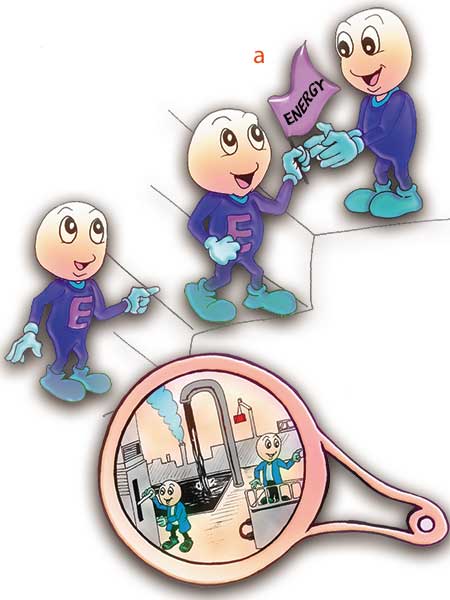
| Figure 95: Many different enzymes work in just about every stage of the cell's production of energy. In a most conscious manner, enzymes that complete their tasks at a later stage take over from other enzymes in an earlier stage. This change of enzymes happens with no confusion. Figure 96: The power station in our cells, just 1/100 millimeter in size, is far more complex than any oil refinery or hydroelectric station. |
The energy we need to stand up and walk, stand on our feet, breathe, and open our eyes—in short, for our very survival—is produced in power stations in our cells known as mitochondria. The aptness of this comparison can clearly be seen when we examine the processes that take place in these microscopic organelles.
Oxygen plays the major role in the production of energy in the cell, but oxygen also has many assistants. In just about every phase of energy production, several enzymes enter the equation with their exceedingly conscious behavior; the enzymes that complete their functions in one stage make way for others in the next. Thus thanks to dozens of intermediate processes and the countless chemical reactions and hundreds of different enzymes involved in these processes, the energy stored in foodstuffs, having been digested, is transmuted into a form that can benefit the cell. During these many changes, these enzymes never create any confusion, and their order never goes wrong. All the components work together as a disciplined team (Figure 95).
We can say that the power station inside our cells, just 1/100 millimeter in size, is more complex than any petrol refinery or hydroelectric station (Figure 96).
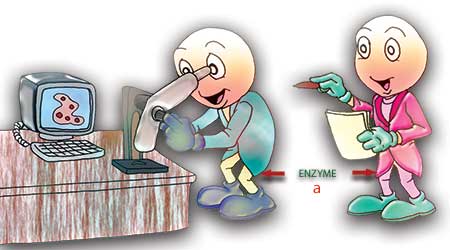
A gasoline refinery is built and run by engineers who know what petroleum is, who have analyzed crude oil under laboratory conditions and who act in the light of that knowledge. It is impossible even to imagine that people with no knowledge and experience could build a functioning oil refinery (Figure 97).
The production of energy in the living cell, which is far more complex than oil production, also requires information. Yet it would be ridiculous to suggest that a cell has the ability to learn anything at all. How, therefore, does this energy production take place?
Naturally, no cell has the opportunity to learn any biological function in the literal sense of the word. If the cell were unable to perform any function at the moment it first came into being—as evolutionists maintain—then it would be impossible for it to obtain the ability to do so later. That is because oxygen, which plays the paramount role in energy production, has harmful effects on the cell. The cell has to emerge together with the ability to utilize oxygen. This is just one of the proofs that cells cannot have emerged by chance, but were created in a single moment by Almighty God.
This artistry that God located in a space as small as 1/100 millimeter, shows us the infinite nature of His might.
 |
| a. Enzyme |
| Figure 97: Enzymes work just like expert chemical engineers in their chosen fields to produce the energy needed by the human body. |