24. The Endothelial Cell: A Nitric Oxide Production Center
24. The Endothelial Cell: A Nitric Oxide Production Center
An amino acid by the name of L-arginine; the NO synthesis enzyme; nicotinamide adenine dinucleotide phosphate; calmodulin; oxygen; flavin mononucleotide; flavin adenine dinucleotide; tetrahydrobiopterine ...
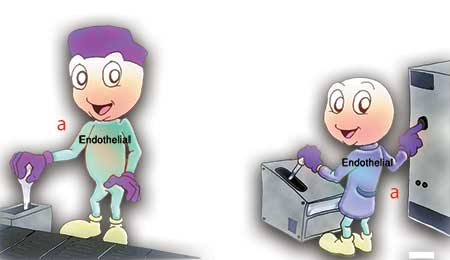
Probably most people never have heard these words ever before. Yet the endothelial cell knows all these microscopic compounds very well and uses them for its production of the NO molecule (Figure 94).
Factories manufacturing chemical products using modern-day technology are trillions of times larger than endothelial cells. Nonetheless, the advanced technology of the microscopic factory known as the endothelium is far superior to that of any human technology.
The endothelial cell knows which chemical substance it has to use, and in what proportion, in order to produce the nitric oxide molecule. There is never any incidence of wrong or incorrect production. For example, it does not produce laughing gas (N2O) instead of NO. Remember, were the endothelial cells to produce fewer messengers than necessary, our veins would contract and our blood pressure would rise rapidly, leading to a heart attack. In the event of excessive production, our veins would over-expand, our blood pressure would plummet, and this would result in shock. However, the endothelial cells never make such possibly fatal errors.
 |
| a. Endothelial |
| Figure 94: The endothelial cell works just like a factory, accurately identifying microscopic substances and using them to produce NO molecules. |
The cells in question are always ready to produce. When the need arises, they immediately go into operation and start production. These miniature factories work very efficiently. They never store the messenger NO molecules they produce, so the problems associated with storage thus never arise.
There are no undesirable, harmful side products from these extraordinary factories in the depths of our veins. When you consider that a great many health-threatening problems—such as global warming, acid rain and environmental pollution—all stem from chemical wastes, the endothelial cells’ achievement can be better understood. That is because the NO molecules are broken down in as brief a space of time as 10 seconds, never accumulating in the body long enough to give rise to any harmful side effects. All this means that the endothelial cells use ideal methods in their manufacture of chemical products.
In the same way that a factory’s systems indicate the advanced technology their designers must have mastered, the endothelial factory shows the infinite intelligence and knowledge of our Lord, with His sublime creative artistry. Like the other 100 trillion cells in our bodies, this microscopic factory acts under the inspiration of God.
He is the First and the Last, the Outward and the Inward.He has knowledge of all things. (Surat Al-Hadid, 3)