18. The Communications System in the Cell
18. The Communications System in the Cell
Modern-day telecommunications systems have been set up using electronic and mechanical equipment and the most advanced technology. Yet the communications systems inside the cell, whose secrets have still not been unraveled, employ devices composed entirely of protein. Instead of electronic circuits or semiconductors, as in our mechanical devices, organic proteins contain carbon, hydrogen, oxygen and nitrogen atoms.
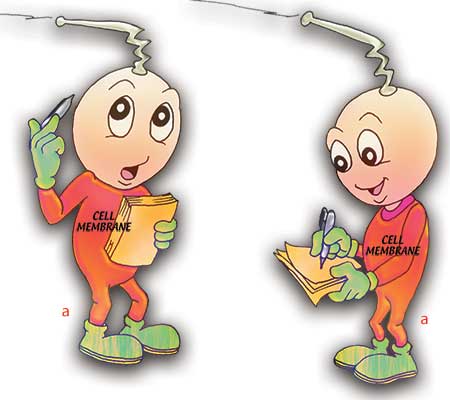
Even so, the communications system established among cells resembles those used by human beings in many respects. For example, there are sensors analogous to antennas on the cell membrane that permit them to understand the messages reaching them. Immediately beneath these antenna are structures analogous to switchboard that decode the messages arriving at the cells (Figure 77).
 |
| a. Cell membrane |
| Figure 77: The antennae on cell membranes perceive the messages reaching them. |
The "antennas" in question are located on the cell membrane, 1/100,000 millimeters thick, which surrounds the cell. Each receptor, known as tyrosine kinase, consists of three basic sections, the head, body and tail.
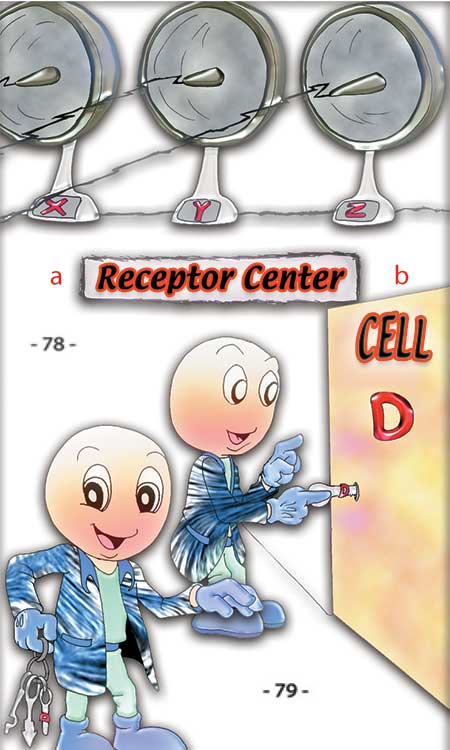
That part of the antenna that protrudes from the cell membrane is shaped somewhat like the dishes used to collect satellite broadcasts. In the same way that each satellite dish is directed towards the emissions of a given particular satellite, so different antennae understand the languages of the messages carried by different hormonal messengers.
Messages from other cells—in the form of hormones—make contact with the antennas along the cell membrane. However, each antenna has been designed in such a way as to perceive only one chemical message. This is the work of a very special creation. In this way, one message sent does not erroneously set another cell into action (Figure 78).
Both the hormones and corresponding antennas have been created in such harmony with one another that almost all biology textbooks describe this relationship as resembling that between a lock and a key. Only the right key can open the lock; in other words, only the right antenna can address the message sent, which message meaning nothing to any other antenna (Figure 79).
 |
| a. Receptor Center |
| Figure 78: Each antenna has been created in such a way as to perceive only one single message. Thus a given message does not mistakenly stimulate another cell. Figure 79: In the same way that only the correct key will open a lock, the right antenna is affected by the message sent, which means nothing to any other antenna. |
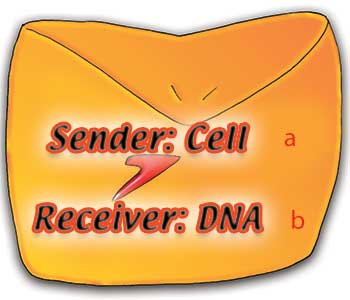
The moment the hormone reaches the cell, an amazing system inside the cell goes into operation. The hormonal signal arriving at the cell is transferred onto its DNA by a very special communications system, and in light of that message, the cell is set in motion (Figure 80).
The message reaching the cell antennas is forwarded to the cell's nucleus at great speed, and during the course of this communication a most superior technology is employed. Both of these facts are great miracles, because the cell is an inanimate entity consisting of unconscious molecules—and the human body in turn consists of combinations of these cells. In the human body there are some 100 trillion cells each with its own highly advanced communications system. Even this information by itself, just one of the countless examples in the human body, is proof of the infinite knowledge of Almighty God, the Creator of humanity and the entire universe.
 |
| a. Sender: Cell |
| Figure 80: The message reaching the cell is transmitted to the cell's DNA by very special communications systems, and in light of that message, the cell is set in motion.. |