21. Protein Traffic within the Cell
21. Protein Traffic within the Cell
Every cell in every human being contains more than a million protein molecules, of thousands of different kinds.16
In addition, these proteins are constantly renewed. Once every month, they are separated into the amino acids that comprise them and reproduced according to the cells’ needs.17 At the end of complex processes known as protein synthesis, they are combined together again within the cell.
Here, we wish to concentrate on the protein traffic flow that results from the newly produced proteins changing places inside the cell. Because the cell immediately begins using part of these proteins, they must be transported to the sites where they will be used.
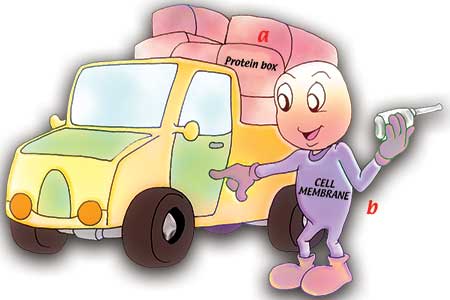 |
| a. Protein Box |
| Figure 86: Entries into and departures from the cell constitute a heavy traffic, which the cell membrane is responsible for supervising. The membrane admits essential and useful substances to the cell, while refusing entry to the others. Proteins are the main elements of that traffic. |
One portion is sent to the cell’s “protein warehouse,” to be used at a later date. Proteins to be used outside the cell membrane are removed from it under the supervision of the cell membrane itself. At this point, proteins entering the cell from the outside—again under the cell membrane’s supervision, represent a significant part of this heavy protein traffic. In short, there is considerable activity in the cell, despite its microscopically small size (Figure 86).
This activity is managed by an extraordinarily organized system. As you know, the postal code was originated with the aim of sending mails quickly to the correct destination, with the fewest errors and in the most efficient way possible, thus increasing the efficiency of communications between individuals and corporations. But recent research has revealed that a similar mechanism exists inside the cell.18
Proteins are synthesized by hundreds of “original” proteins combining according to various predetermined plans. One significant, chain-shaped section that consists of between 10 and 30 amino acids comprises the protein’s “postal code.” To put this another way, the postal code written on any envelope consists of (depending on the country) a combination of numbers and/or letters, while the “code” in any protein consists of various amino acids. This code is located in one end of the protein molecule, or else inside it. Thus every newly synthesized protein receives instructions regarding where it should go, and how to get there.
Let us now examine the protein’s journey inside the cell in greater detail (Figures 87 and 88).
When we look at how every new-synthesized protein is to pass to the endoplasmic reticulum region, for instance, we see the following: Firstly the code is “read” by a molecular component known as SRP—another protein with the best possible design for deciphering the code and helping the protein find a channel through which to pass. It solves the special information in the protein and then combines with it, acting just like a guide. Together, the SRP component and protein later attach to a special receptor that is waiting for them in the endoplasmic reticulum membrane, and the protein attaches to the entry channel. With the receptor being stimulated in this way, the channel in the membrane opens—at which point, the SRP separates from the receptor.
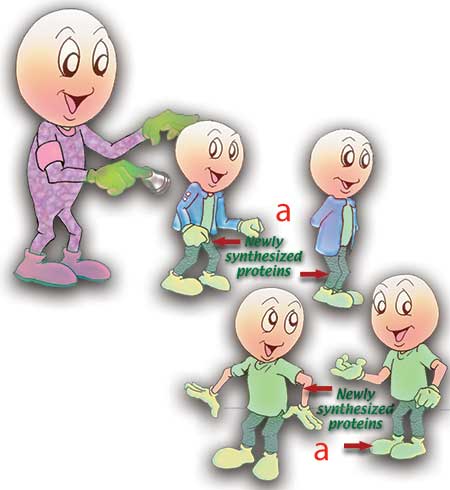 |
| a. Newly synthesized proteins |
| Figures 87 and 88: After receiving instructions as to where to go in the cell—and how—newly synthesized proteins go where they are programmed. There exists a perfect order in this world, too small to be seen with the naked eye. |
All these processes take place with flawless timing and in perfect harmony. But at this stage, the protein faces another problem. As we know, proteins emerge through being shaped by the bending and folding of amino-acid strings. As a result, it is impossible for proteins to pass through the endoplasmic reticulum membrane, which is only 0.0000002 millimeters in diameter. Now, however, a flawlessly designed plan comes into play, because this problem has been already solved well in advance. The ribosome that produces protein does so in the form of an unfolded chain, whose chain structure permits the protein to pass through the membrane. Once the passage process has been completed, the channel closes until another crossing takes place.
After the protein has entered the endoplasmic reticulum region, the task of the “code” section comes to an end. Therefore, specific enzymes separate that section from the protein, which then bends and assumes its three-dimensional form. The situation in question is analogous to how the postal code no longer has any meaningful function once the envelope has arrived at its destination. The enzymes in question know which of the hundreds—and sometimes, even thousands—of amino acids on the protein they must break off, and act with that awareness. That is another miracle altogether, because if any of the amino acids constituting the protein itself are broken off, instead of the amino acids that comprise the code, then the protein will lose its function. As we have seen, a great many parts work together in perfect harmony at every stage. It is self-evident that this harmony does not stem from any feeling of awareness and responsibility originating in these tiny molecules.
The fact of the matter is that the cooperation among the proteins, the SRP molecule, the ribosome, receptor, protein-entry channel, enzymes, organelle membrane and molecules involved in a great many other processes not described here, is utterly flawless. Even taken alone, the “postal code” system in the cell is a proof of God's magnificent creation. A system that mankind has been using for only the last 40 years functions inside trillions of cells in the depths of billions of human bodies.
No doubt that God, Lord of infinite mercy and compassion, has created all things, from atoms to molecules and from proteins to cells, and that He has placed these at our service. That being so, our duty is to reflect deeply on the countless blessings of our Lord and to give proper thanks to Him.
Footnotes
16- Gunter Blobel, “Intracellular Protein Traffic,” 2000, http://www.hhmi.org/research/investigators/blobel.html
17- Blobel, op. cit., , http://www.hhmi.org/research/investigators/blobel.html
18-The Nobel Foundation, Press Release: “The 1999 Nobel Prize in Physiology or Medicine,” 1999, http:// www.nobel.se/medicine/laureates/1999/press.html