13. Hormones That Prepare the Way For the Baby -1
13. Hormones That Prepare the Way For the Baby -1
Every four weeks, a healthy woman's body makes broad preparations in order for an egg to be capable of fertilization. Once again, hormones effect the main elements of those preparations.
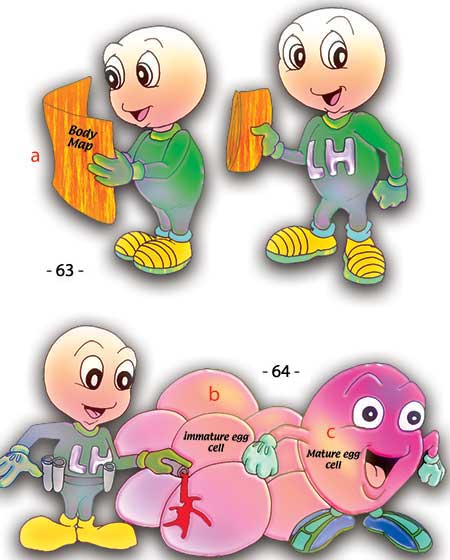
At the very beginning of this four-week period, the woman's pituitary gland produces LH. After setting out from its origin in the brain, this hormone travels a considerable distance through the bloodstream before reaching the ovaries. Hormones are exceptionally minute molecules, and for them, movement through the human body represents a journey equivalent to many kilometers. However, every LH hormone reaches the ovary directly, never getting lost, with full apparent knowledge of its destination, and without being diverted toward any other organ. LH's arrival signals that it's now time for the ovaries to go into action (Figure 63).
 |
| a. Body Map |
| Figure 63: Just as if it had consulted an anatomy chart, the hormone LH knows just where it has to go and reaches the ovaries without ever losing its way or deviating to any other organ. Figure 64: The ovary contains thousands of immature egg cells. Under the effect of the hormone LH, some of these cells begins to mature. LH has a special formula that sets these cells in action. |
Each ovary contains thousands of immature egg cells. Under the influence of the LH arriving from the pituitary gland —which possesses a special formula to set these cells in action (Figure 64)— a few of them begin to mature. There are a great many substances in the blood, yet apart from LH, none of these possesses the ability to activate ovulation. In other words, LH must have been especially cr ated for this purpose.
 |
| a. Fully mature egg cell |
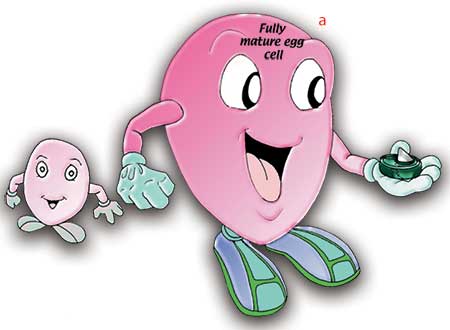
| Figure 65: Only one of the cells waiting to mature does so fully and then leaves the ovary. |
Only one of the cells fully matures, and this is released from the ovary in the form of an egg cell (Figure 65).
The developing egg cell and the nourishing layer around it are known as the follicle. FSH, another hormone sent from the pituitary gland, has a very interesting effect on the follicle, which suddenly starts producing another special molecule: the hormone estrogen.
How is it that the follicle, itself not yet fully developed, begins producing a hormone? How did it come to possess the mechanism and organization with which to make that production? What is the goal of that production?
It is certain that it is Almighty God, Lord of the worlds, Who does all these things. These systems are just one of the proofs of His infinite knowledge and sublime creation:
Does He Who created the heavens and earth not have the power to create the same again? Yes indeed! He is the Creator, the All-Knowing. His command when He desires a thing is just to say to it, "Be!" and it is. Glory be to Him Who has the Dominion of all things in His Hand. To Him you will be returned. (Surah Ya Sin, 81-83)