16. Other Properties of the Hormone Testosterone
16. Other Properties of the Hormone Testosterone
 |
| a. Testosterone |
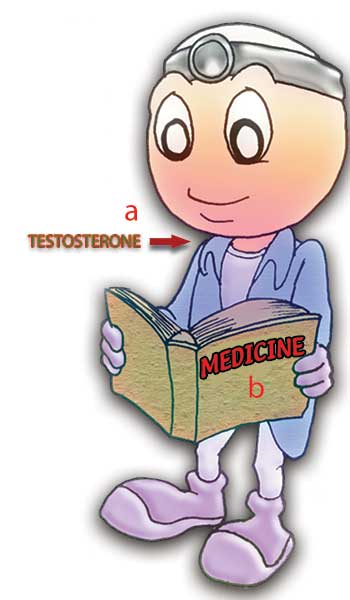
| Figure 72: Testosterone is able to locate the few "letters" it seeks from among information consisting of 3 billion letters, enough to fill an encyclopedia thousands of volumes in size. This is another miracle of the countless miracles in God's creation. |
The plan behind the creation of the testosterone goes much further than this. An evident miracle of creation can be seen in the mechanism of this hormone's effects. In order to have the effects listed before, when the testosterone reaches the targeted tissue (the male genitalia) it enters the cells there. Inside the cells, it combines with an enzyme specially created for testosterone, which thus assumes a far more effective state.
The design and planning are still not finished. This newly formed hormone now combines with a receptor specially designed for it. The emergent molecular combination binds to the cell's DNA, and in the light of information it receives from the DNA, a new protein synthesis is created. This permits the determination of the difference between the male and female sexual characteristics, as well as the beginning of sexual functions.
This system is so perfectly designed that the mechanism—consisting of the testosterone, enzyme and receptor—locates the information encoded for it from among all the billions of pieces of data in the DNA and allows production to be made according to that information. For example, in order for a man's beard to emerge, the hair roots must literally know which portion of their DNA has to be activated. In order for the male voice to deepen, hormones trigger the appropriate region of the DNA in the cells of the vocal cord.
This information is of crucial importance. Testosterone is a molecule consisting of various numbers of carbon, hydrogen and oxygen atoms, with the chemical formula C19H28O2. How does this inanimate, unconscious compound know where to find the relevant information in the DNA? More importantly, how can it locate the few letters it seeks from among information consisting of 3 billion letters—sufficient to fill thousands of encyclopedias— at great speed and without ever going wrong? Naturally, this takes place with the inspiration of Almighty God, the one God (Figure 72).
By now, hundreds of scientists have spent the last decade working on the Human Genome Project. They have succeeded in reading DNA only by using the most highly advanced technology. Yet they still do not know which region of DNA is concerned with which organ, protein or hormone in the body. Yet the hormones estrogen and testosterone know this very well, and have been acting on that knowledge for millions of years, without error, in the bodies of billions of human beings.
No doubt that this system by itself is a marvel of creation in which the artistry of Almighty God is revealed.