12. An Extraordinarily Delicate Balance
12. An Extraordinarily Delicate Balance
Thanks to the amazing systems we examined in the preceding chapter, the hormone thyroxin is secreted at a guaranteed level. In addition, however, yet another extraordinary system maintains the level of thyroxin in the blood stable, in the face of any emergency situation.
The molecules of thyroxin that the thyroid gland releases into the bloodstream are attached to a transporter molecule specially created for that task alone. Traveling through the bloodstream in that form, they are unable to perform their function so long as they are bonded to the transporter molecule. Out of any 10,000 thyroxin molecules in the blood, only four will be present in an unattached form. These are the four molecules of thyroxin that affect cells' metabolic rates.12
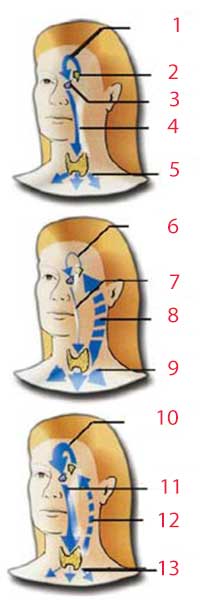 | 1. Thyrotropin releaser hormone |
| When the need arises for the hormone thyroxin, the hypothalamus sends an instruction to the gland. Realizing that the thyroid has to be activated, the pituitary gland immediately sends a command to the thyroid, which produces the hormone thyroxin and distributes it throughout the body. |
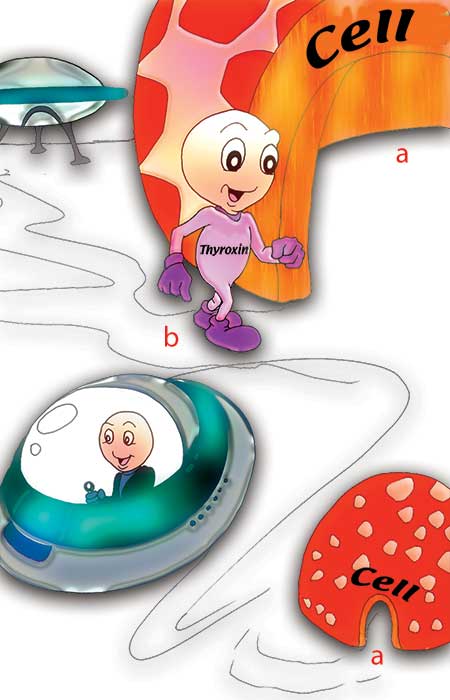
When these free thyroxin molecules enter the cells, new thyroxin molecules separate from the transporters to replace them. Thus the thyroxin molecules attached to the transporter molecules serve as a kind of storage depot, and the requisite thyroxin is always kept ready for immediate use (Figures 61 and 62).
This level of thyroxin necessary to affect the cells is based on a very delicate balance, to avoid the possible consequences if the amount of thyroxin acting on the cells increases or decreases beyond the level of 4 in 10,000. Inevitably, therefore, we should ask the following questions: By what mechanism are these trillions of molecules counted? How was it determined that a proportion of only 4 molecules in 10,000 is ideally suited to human health? How was it calculated that the remaining 9,996 molecules need to remain in a bonded, inactive state? How can the body determine that those four thyroxin molecules circulating in the blood vessels have declined in number and that other molecules need to be released to replace them?
 |
| a. Cell |
| Figure 61 and 62: When free thyroxin molecules enter the cells, they are replaced by new thyroxin molecules separating from the transporters. Thus thyroxin molecules bonded to transporters are used as a reserve, and the requisite thyroxin is always ready to hand. |
How have these extraordinary mathematical calculations—and the system based on those calculations—functioned to perfection for thousands of years in all the human beings who have ever lived?
This example is without doubt just one of the countless proofs that Almighty God rules all worlds, whether visible to our eyes or not, and enfolds all things:
... He encompasses what is in their hands and has counted the exact number of everything. (Surat al-Jinn, 28)